---blog Title---
Exclude and Rule - 11 Exclusion Segments to hone your Customer Segmentation Strategy
---desktop---

---mobile---
What is an exclusion strategy?
Why is it a powerful, yet overlooked part of customer segmentation strategy?
Are exclusions necessary?
Are they permanent?
What are the most effective exclusion segments for enterprise marketing campaigns?
Answers and more, in this one-of-a-kind article.
By definition, your customers are those who are convinced by your marketing messages. And expressed their conviction by buying your product or service. Congratulations! You may now think your customer base is one large happy family, connected by common brand experiences, and eager to buy your next offering. Sadly, no.
An unfussy -grab every customer you can get- approach may have been necessary for initial product launches by early-stage companies. Mature enterprises, though, with follow-up with campaigns to sell more, are extra focused in creating customer segments with approachable monetizable characteristics. But, common as this approach is, your engagement and conversion rates are likely to be dishearteningly low.
Why?
You are ever inventive in refining your segmenting. Why then are your seeing campaign response rates flattening? The problem is not with what you are seeing. It's with what you are not seeing. The did-not-respond rates. This is the blind-spot for most enterprise marketing campaigns. Look closely at it. It might dawn on you that some of these customers should not have got the campaign messaging at all.
Exclusion lists flip the paradigm around from whom to target, to whom NOT TO target. Approaching customer segmentation from the other end. Enterprise marketeers are great at segmentation. They, however, do not identify and exclude customers unlikely to engage with your campaign. Unintentionally sabotaging the efficacy of the campaign, even before launching it. And risking long-term damage to seller perception.
This article reflects the light-catching facets of an exclusion strategy. Not so much about whom to include, as whom NOT TO. The thrust of this article about creating exclusion segments for campaigns directed at existing customers. There is something for everyone, though.
What are exclusions?
Exclusions are a customer segmentation strategy. The exclusion segment lists those you don't want to reach through your campaign. Mostly because reaching them can be unprofitable. It can be something as simple as using an age filter to exclude pensioners if you are a bank selling salary accounts. Or a campaign to sign up for a newsletter or event will exclude those who have already signed up. Saying - if you have already signed up, please ignore this message–is not elegant.
Or it could be more complex, like identifying an ideal target persona and excluding everyone who doesn't fit the bill.
Excluding a set of customers from your segment does not mean consigning them to the digital graveyard where unpopular customers go to die. (That would be a suppression list, but that's another story for another day.)
Exclusions are bystanders, not outcasts.
Exclusions are campaign specific.
Customers excluded for one campaign may be addressed by another.
Or at another time.
Or not at all.
Depends.
Why exclusions?
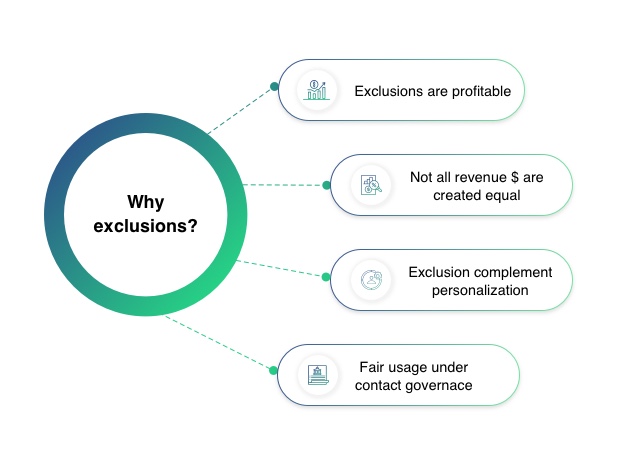
Exclusions are profitable: Exclusions reduce the size of the segment. How can selling to fewer people be more profitable? Though counterintuitive, it's true. Exclusions are, by nature, exceptions. They prune a segment, not decimate it. When segments are sharpened, and exclusion lists implemented in tandem, it results in sum-of-parts efficiencies that are disproportionately bigger. And not just by the math of a smaller base.
Not all revenue $ are created equal. Sales to poorly segmented customers cost more to maintain. With lower potential to upsell or cross sell. And possibly churn more. All of which result in lower margins and unstable customer bases. Try building exclusion lists. Prepare to be amazed at how your cost and efficiency metrics shine.
Exclusions complement personalization. Exclusions clarify. They help keep your marketing communications direct and focused. Rather than play safe with scatter-bomb hit-or-miss messages that are one-size-fits-all.
Fair usage under contact governance. Socially sensitive enterprises that run 1-on-1 marketing usually have, and honor, contact governance policies. These cap the number of times per period, you can send marketing messages to customers. The governance policy deters overzealous marketeers from bombarding customers with messages.
An exclusion strategy allows upholding this fair usage policy frequency limits. It also judiciously allows you to include only those customers relevant to this campaign. And exclude those for whom it is not. You reach a much wider audience this way.
There is also a happy unintended consequence. Customers perceive your brand of being respectful of their preferences. You also gain a reputation for being a brand that only sends messages that are relevant. So, they engage with each of your CTAs, resulting is superior campaign response rates.
Averting unintended damage to brand perception.
- Irate Customers: Customers -who have enough reasons to be excluded but are not- could be annoyed to receive marketing communication they have little interest in. If this happens often enough, they might brand you irritating, insensitive and intrusive. This will have a long-term impact on your brand perception. Salvaging the relationship with an irate customer is inefficient. Don't annoy them in the first place.
- Weed-out duplicates. Target audiences overlap. There will be duplications. Use an exclusion method to weed them out. Receiving the same message multiple times can annoy customers. Spare a thought for those who acted on your message the first time, and those that otherwise have a benign or beneficial view of your brand.
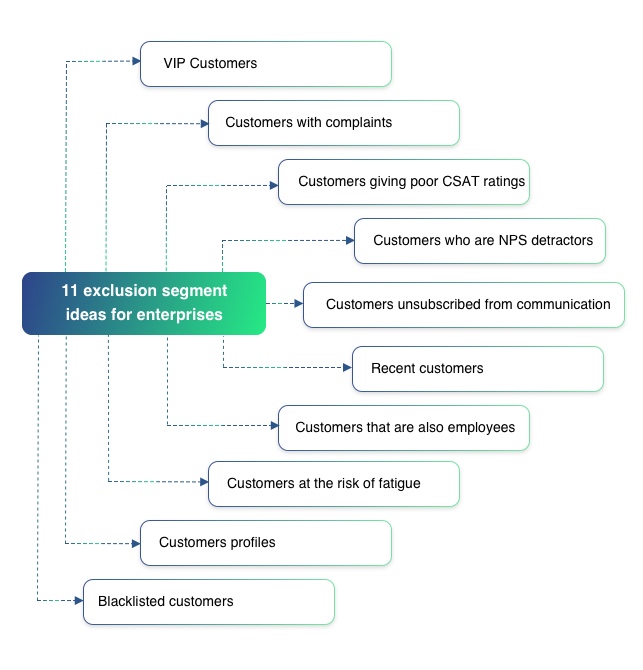
11 exclusion segment ideas for enterprises
Are you targeting existing customers in the next campaign? Is the campaign CTA to buy a product or service that is new, or not previously offered? Are you already seeing signs of flattening response rates from earlier campaigns?
Here are 11 ideas to exclude customers who are unlikely to be interested in the campaign. (Not 10. Not a dozen. Exactly 11 ideas. No padding with bs for nice round numbers.) Empirically, we've seen that exclusion of these segments improves campaign responses.
- VIP Customers: VIP customers spend large amounts on your products, and more frequently. They are long-term loyalists, and possibly brand advocates. They have a significantly larger life-time value than other customers. And they know it. Clubbing them broad campaign segments will not give them the hyper-personalization they are used to. Do not send them the evergreen newsletter. Exclude to target them separately. Through sneak-peak or early access campaigns, for example.
- Low value customers: These could be long-time customers who have got no further on their journeys than initial engagement, not put more in the kitty. Or new customers for whom it's too early to estimate lifetime value, growth prospects, and cost of maintenance. Low value customers clutter your segment. They are unlikely to engage with your campaign.
- Customers with complaints : Customers with complaints already have a grouse with you. For example, complaints could be an as-yet unresolved issue with your product, service, or policy. Or an unfulfilled product return. Whatever be the issue, they are not likely to take kindly to being asked to buy the next product when they are probably having trouble with the first. But do keep track of this segment. A successful issue resolution may put them in a frame of mind that reacts positively to your upsell or cross sell campaign.
- Customers giving poor CSAT ratings: They have already indicated poor Customer SATisfaction. Don't waste resources on them. It's unlikely they will buy your next product. Instead, separately open individual lines of communication and try remedy the cause for unhappiness.
- Customers who are NPS detractors: When asked if they would recommend your brand to others, those who said they won't, and those undecided are unlikely to engage with a campaign for new product or service. Exclude them. Don't give them fodder to reiterate their opinion. Start a separate campaign to understand their response and turn perceptions around.
- Customers unsubscribed from communication: This is the Do Not Contact segment. Do not contact. Some may have opted out of marketing notifications but want transactional alerts. Like in a bank or e-commerce website. Others may not be interested in some product categories, but are keen to be notified about others. Honor the distinction. And do review this list periodically. A DNC today may be curious tomorrow.
- Recent customers: This is based on conventional wisdom. That customers who have just made a purchase are unlikely to make another so soon. New-to-brand customers require a different kind of hand holding to take them further on their journeys. Depending on your campaign launch schedule, set a date and exclude all customers making purchases after that.
- Customers that are also employees: If employees are already enjoying your offering at concessional pricing, there is no sense in including them. It's just clutter. But if they are as new to the product or service as your other customers, include them by all means. Employees have the potential to be your most vocal brand advocates.
- Customers at the risk of fatigue: This one comes from another optimized metric. The Frequency Cap. A personalization technique that estimates the number of marketing communication that a customer can see in a period before they stop noticing them, become numb or fatigued from them. It's a fine line when apathy turns into anger. Pushing messages to them beyond this threshold is counterproductive. They turn irate and can damage your brand reputation. So, you may want to exclude customers who have reached their cap for now. And target them when the cap opens, and they are more receptive.
- Customers profiles: Simple and logical exclusions based on demographic profiles. Exclude corporates if you're selling a retail product. If you're selling menstrual cups, exclude men. Exclude women if you're selling beard oil. Exclude college kids when selling pension plans. Etc. etc. etc.
- Blacklisted customers: Customers who have, for instance, defaulted on housing loans repayments, or insurance premiums. Or those who display stubborn belligerence and animosity to company policies or service models. It's best to exclude them. They will not show the enthusiasm or curiosity required of a new product or service offering. You ideally dealt them through individual interactions. Once accommodated, placated, or otherwise engaged and resolved, you can then include such customers for the next campaign.
Recap and Reiteration
Enterprises certainly cannot afford to overlook an exclusion strategy in customer segmentation. When done in tandem, an intelligent inclusion and exclusion strategy results in significantly higher engagement and conversion. Than with segmentation that only focuses on inclusions. We detailed eleven such exclusions categories that have empirically resulted in better campaign efficiencies.
Broadly, make exclusions in response to the following questions:
- Is the probability that set of customers will respond to a campaign low or high? Look at trends from past campaigns.
- Is there a possibility that brand damage from including a set of customers will be greater than the potential gains to be had from a conversion? Play safe.
- Do your segments include customers that have no discernable trend of engagement in past campaigns? Do they not have any overt reason for exclusion either?
- Are you leaving them in because they have always been included in campaign after campaign? At what point do they become clutter?
Don't exclude if you can't include.
Exclusions are exclusive.
Before you make the first exclusion, make sure you have processes in place to deal with each excluded segment -parallelly, separately, or subsequently. This is critical.
Exclusions should not be permanent. Exclusions are just a set of customers you determine are not best addressed at this point in time, through this particular campaign. Without a re-inclusion strategy, you'll just be whittling down your customer base and dishonoring the very reason they became customers first.
Exclude. Rule. Reinclude separately. Repeat