---blog Title---
Attribution Is Only As Good As the Events Feeding It
---desktop---

---mobile---

Every growth team eventually asks the same question: why doesn't the attribution report match what actually happened in the business? The usual answer points at the model first-touch, last-touch, multi-touch, MMM, incrementality. Pick a better model, the thinking goes, and the numbers will make sense.
That's the wrong place to look first. Marketing attribution accuracy isn't a modeling problem before it's a data problem. A model can only assign credit based on the events it's handed. If those events are missing, duplicated, mislabeled, or pointed at the wrong channel, a more sophisticated model just produces more sophisticated wrong answers.
Quick takeaways
- Attribution models cannot correct bad inputs; they process whatever events they're given, accurate or not.
- A single mislabeled event (paid tagged as organic, a duplicated conversion, an untracked form field) can quietly rewrite which campaigns look like winners.
- Growth teams and analytics teams feel this differently: growth teams misallocate budget, analytics teams take the blame when the numbers don't reconcile.
- The fix isn't a new attribution model. It's a measurement integrity check on the event layer that feeds the model you already have.
Why can't attribution models fix bad event data?
An attribution model has one job: distribute credit across the touchpoints it sees. It has no way to know that a "form submit" event is actually a video play, or that an add-to-cart fired twice for the same session. It treats every event as ground truth, because ground truth is all it has access to.
This is the gap that gets skipped in most attribution conversations. Teams debate which model to adopt while assuming the underlying event stream is already clean. It rarely is.
What are the four ways measurement actually breaks?
Digital measurement failures tend to fall into four buckets:
- Accurate - the event is correctly conceived and correctly measured. This is the baseline everything else gets compared against.
- Mistracked / Confusion - the intended event is measured, but incorrectly. A video play logged as a form submit is this category.
- Unutilized / Orphaned - the event fires and is captured, but never makes it into a dashboard or a decision. The data exists; nobody's using it.
- Dark Data - the interaction happens, but nothing measures it at all. It's invisible to every downstream report, including attribution.
Only the first bucket produces trustworthy attribution. The other three are where conversion tracking accuracy quietly erodes without anyone noticing until the numbers stop making sense.
How do bad events distort attribution and campaign decisions?
A few patterns show up repeatedly in real funnels:
- A paid campaign gets tagged as organic, hiding the true CAC behind it.
- A duplicate conversion event inflates ROAS on a channel that isn't actually performing.
- Missing OTP or form-field tracking hides exactly where users abandon a signup flow.
- A page load gets counted as engagement, overstating how well the content is actually working.
- A checkout coupon interaction goes untracked, hiding friction that's happening right before purchase.
None of these are attribution-model problems. They're event-quality problems that happen to surface as attribution problems, because attribution is the layer that reports the damage.
Why is event quality getting harder to ignore in 2026?
A handful of trends are compounding the problem rather than easing it: privacy-driven signal loss, customer journeys fragmenting across more devices and sessions, and a shift toward server-side tracking that changes how and where events get captured in the first place. AI-driven discovery is also reshaping how users find and re-enter a funnel, adding more junctions where tracking can quietly break.
None of this makes attribution less important. It makes a clean event foundation more important, because the models being layered on top MTA, MMM, incrementality testing all inherit whatever quality problems already exist underneath them.
What should you check before you touch your attribution model?
Before swapping models or adding another layer of measurement sophistication, it's worth running a digital measurement audit on the event layer itself:
- Map the interactions the funnel is supposed to be capturing.
- Extract the tags and events actually firing in production.
- Compare expected measurement against actual measurement.
- Identify what's mistracked, duplicated, missing, or captured but unused.
- Prioritize fixes by impact on CAC, conversion, and funnel-level decisions.
- Validate that the fixes actually hold after deployment.
In this case, Xerago TrueMeasure will be helpful. It maps expected funnel events against what's actually firing and flags what's mistracked, duplicated, orphaned, or dark so you can see this audit run on your own funnel before you commit to fixing anything.
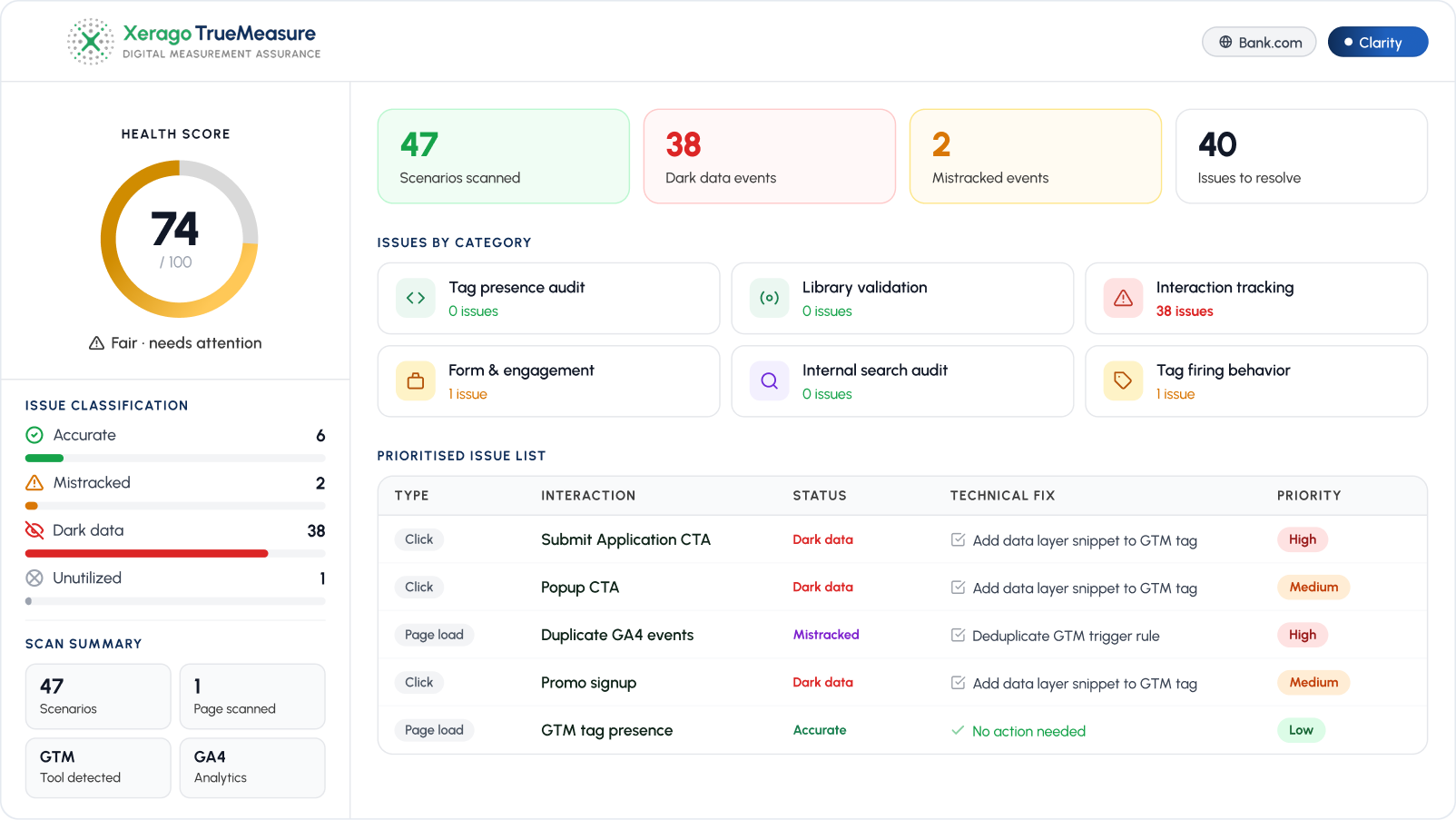
Book a Xerago TrueMeasure demo to see your website tracking health score
This is a smaller, more mechanical exercise than re-architecting an attribution strategy and it's the exercise most teams skip.
Fix the event layer before trusting the attribution layer
None of this is an argument against MTA, MMM, or incrementality testing, and it isn't an argument that attribution is broken beyond use. Better models don't fix bad inputs, they just make the wrong conclusions look more precise. It's an argument for sequencing: verify the inputs before you trust what the model does with them.
Run a digital measurement audit to find tracking gaps: verify whether the right events are being captured, labeled, and used before you touch your attribution model.
---cta--- Find tracking gaps across your website TrueMeasure compares expected user interactions with your actual tracking implementation to uncover missing, duplicate, broken, and untracked events. Book a demo