---blog Title---
Real-Time Personalization Is Losing You Conversions. Here Is How to Take Them Back
---desktop---

---mobile---

Most organizations believe they are personalizing. They have a CDP. They run segmented campaigns. They send triggered emails. They retarget on paid. The tools are live, the campaigns are running, and the dashboard shows traffic moving through the funnel.
Conversion rates stay flat. CAC keeps climbing. And somewhere between the signal the customer sent and the response the brand delivered, the sale was lost.
The problem is not personalization. It is timing. By the time most brands act on customer intent, the customer has already decided compared alternatives, dropped off, or moved to a competitor. The data was right. The response was late. And late response is not personalization. It is recovery.
Two things make this particularly hard to fix.
It looks like personalization - segmented emails are going out, retargeting is running, recommendations are appearing. The infrastructure exists. The timing does not.
It is invisible in reporting - no dashboard measures missed in-session intent. The moment the customer was ready to convert, and the brand was not ready to respond, never shows up as a data point.
The Window Is Shorter Than Most Brands Think
Customer intent is not a persistent state. It is a window and in most B2C categories, that window is measured in minutes, not hours.
Here is the irony most brands do not see: the customer who browsed a loan product at 11 AM left behind a precise, high-value signal. Page visited. Time spent. Eligibility checked. Comparison behaviour recorded.
The CDP captured all of it. And then the stack waited, for the overnight segment refresh, for the scheduled trigger, for the retargeting pixel to serve its next impression. By the time the response reached the customer, three days had passed. The data was perfect. The timing made it irrelevant.
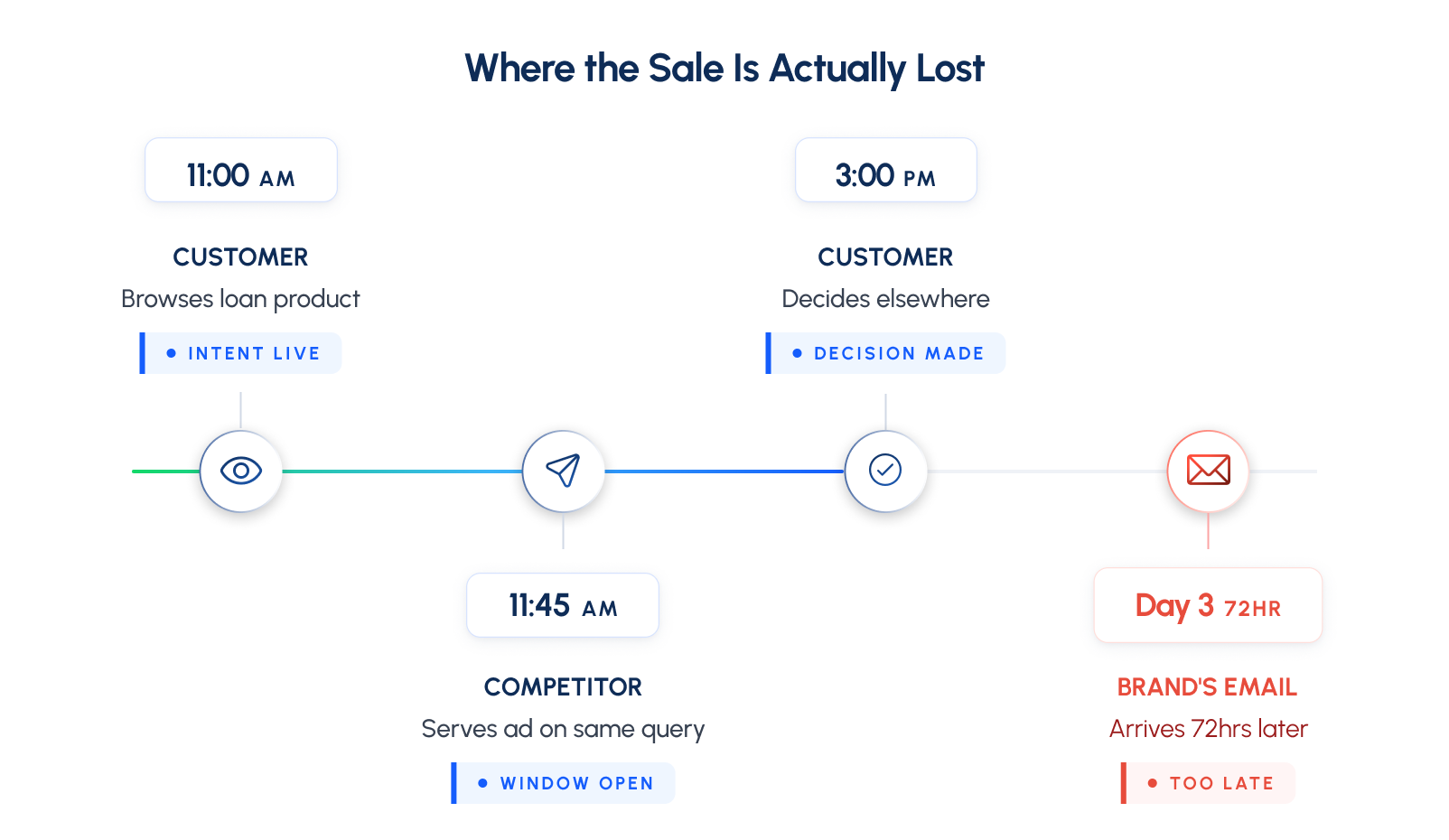
The signals that mark an active intent window are specific and detectable:
- Repeated visits to the same product or category within a short session
- Comparison behaviour switching between two or three options
- Adding to cart or starting a form without completing
- Checking pricing or eligibility details
- Long dwell time on a decision page with no action taken
- Returning to the same product within 24 to 48 hours
Each signal tells a brand something precise: this customer is deciding right now. In financial services the window is often under two hours. In retail, under thirty minutes. In insurance, a customer starting a quote is typically comparing across three or four providers simultaneously.
- The brand that responds first with the right message, through the right channel and captures the conversion.
- The brands that respond later are competing for a decision that has already been made.
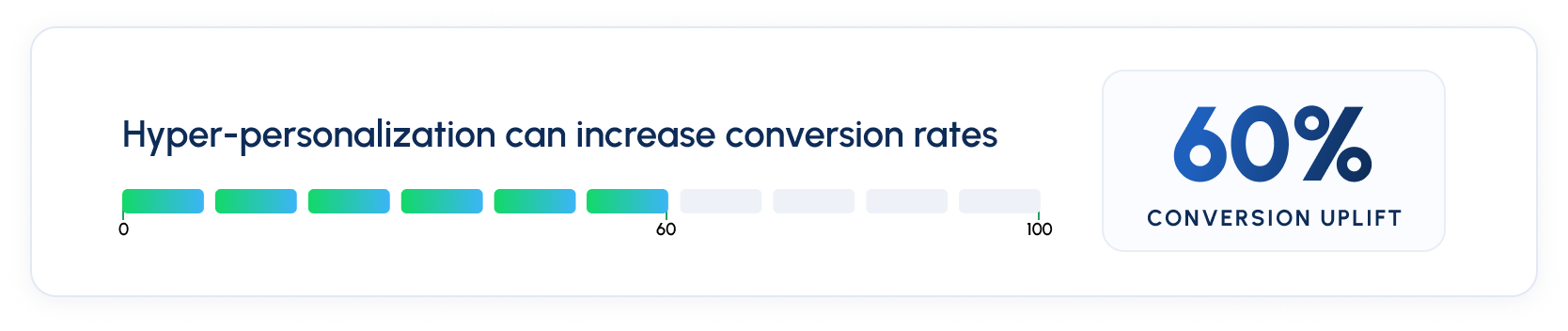
The Signal Reached Your Stack. It Never Reached the Customer in Time
The signal exists. The response arrives too late. This failure is almost always architectural, not strategic.
Most marketing stacks were built for batch processing. Data collected, synced to a CDP, segmented overnight, fed into campaign tools on a schedule. This works for planned campaigns. It does not work for intent-based response, where the value of a trigger degrades with every hour of delay.
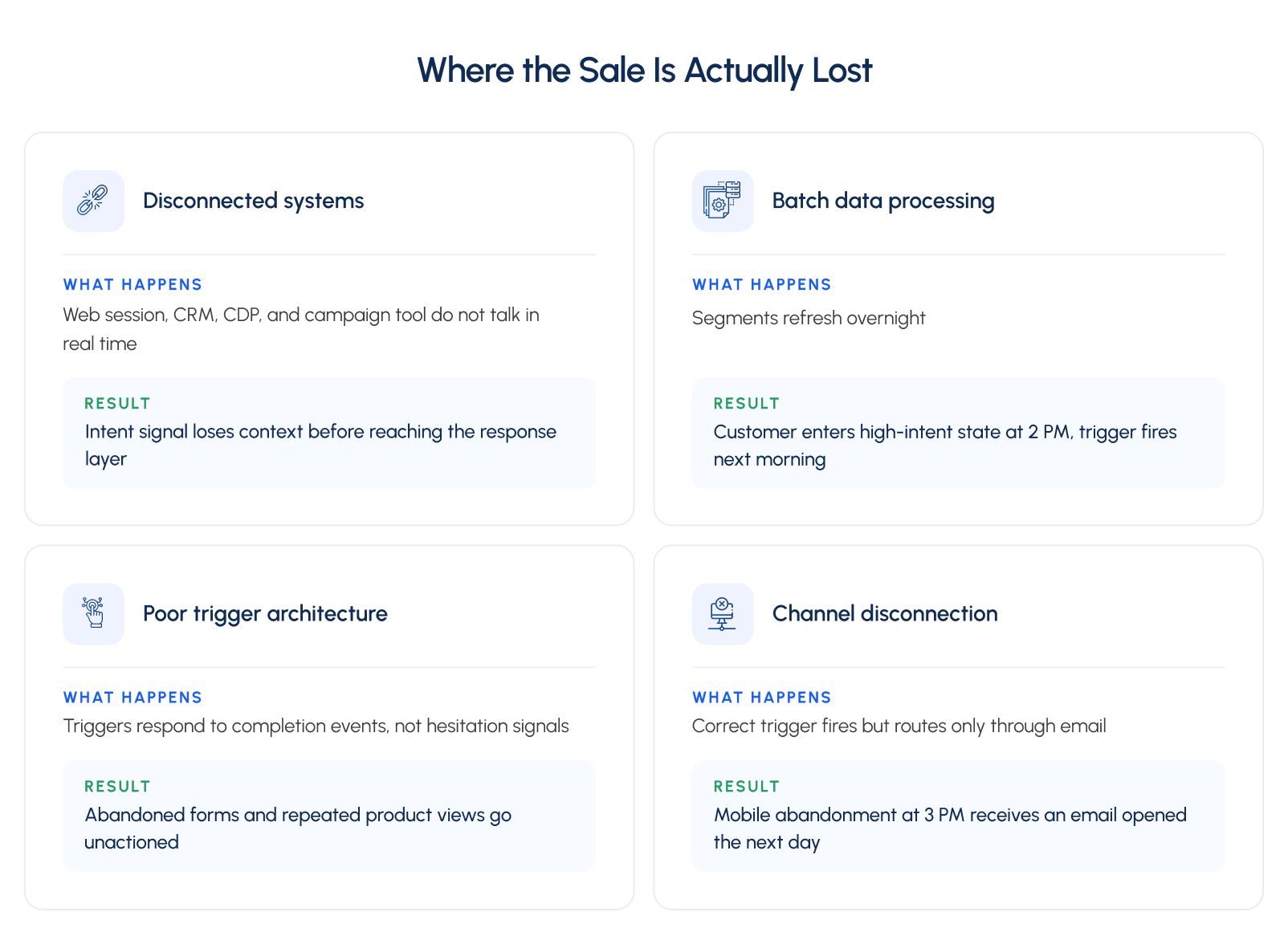
This is where conversion leaks, not in one dramatic failure but across four specific abandonment moments that repeat at scale every day.
Cart abandonment is intent at its highest point, and it is also where the timing gap costs the most. The customer was ready to convert what the brand delivered was an email that arrived hours after the decision had already moved on.
The same logic applies to form drop-off. A loan application or insurance quote that was started and not completed is not a lost customer, it is an interrupted one, and the urgency that drove them to open the form in the first place does not hold overnight while a scheduled trigger waits for its next send window.
By the time the email lands, the moment has passed. Product comparison is even more time-critical because it is the moment the decision is actively being made by a customer who has spent time weighing three options and left without choosing is one well-timed intervention away from converting, and one poorly timed retargeting ad away from converting somewhere else. App exit brings the same dynamic into the sharpest focus of all.
The step where a customer dropped out of a banking or insurance application tells you precisely where the friction was. A real-time prompt addresses it while the customer is still reachable and the context still makes sense. Everything that arrives later is answering a question the customer has already stopped asking.
In every case, conversion failed not because the product was wrong but because the response arrived after the customer had already moved on.
---cta--- Not sure where your stack is losing intent? That is exactly what the Bootcamp is built to find in just 5 days Book a Bootcamp |
This Is What Real-Time Response Actually Requires
Hyper Real-time personalization is not a faster version of the campaigns most organizations already run. It is a different capability entirely and it requires four things working together simultaneously that most stacks have never been built to connect.
- Detecting intent in real time: Every behavioural signal, page visits, form interactions, comparison behaviour, pricing page exits, needs to be captured and interpreted the moment it happens. Not batched. Not refreshed overnight. Most stacks collect this data. Almost none process it in the time window where it still has value.
- Interpreting what the signal: A customer spending ninety seconds on a pricing page before checking eligibility is in a different intent state than one who bounced after ten seconds. The stack needs to distinguish between them and respond accordingly. Without this layer, every signal produces the same generic response regardless of what it actually means.
- Deciding the next best action: Given the customer's intent state, their history, their channel preferences, and what has already been sent today, the response needs to be determined in seconds by a decisioning layer that sits above every channel and governs what each one does in response to a live signal. A schedule was never built to do that.
- Activating through the right channel: An in-app prompt while the customer is still in session. A WhatsApp message within minutes of abandonment. A call centre flag for a high-value customer in hesitation. A personalized page on the next visit. The right channel at the right moment, not the default channel on tomorrow's schedule.
Most stacks have the data to support all four. Almost none have the architecture to execute them inside the window that matters. The data sits in the CDP. The channels sit on their own platforms. The decisioning layer, the thing that connects a live signal to an immediate response does not exist. That is the gap. And it is not a gap that campaign optimization closes. It requires a different layer of infrastructure entirely.
---cta--- The intent window is shorter than your current stack can act on. Let's change that. Schedule a Consultation
The Infrastructure Behind a Real-Time Response
Closing the gap between signal and response requires a layer that sits above every channel tool, one that reads live customer behaviour, interprets what it means, decides what should happen next, and activates the right channel before the customer leaves.
This is not a campaign tool. It is a decision layer. And the distinction matters.
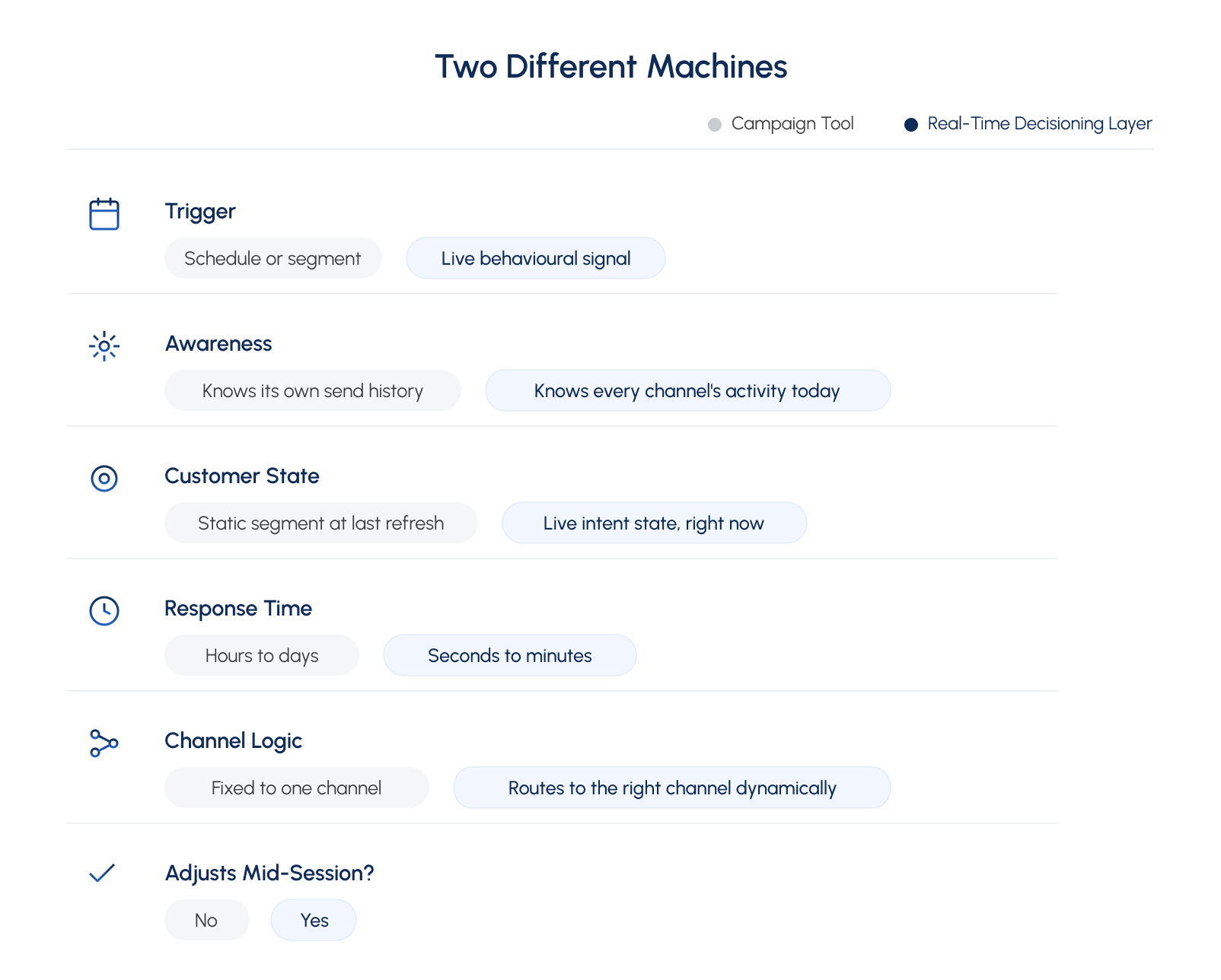
Most stacks already have the data. What they are missing is the layer that connects a live signal to an immediate response. The CDP holds the profile. The channel tools hold the delivery infrastructure. But nothing governs what happens between them, in real time, for each customer individually.
That is the gap. And it has four components that must work together simultaneously.
AI Can Read the Signal. The Stack Has to Act on It.
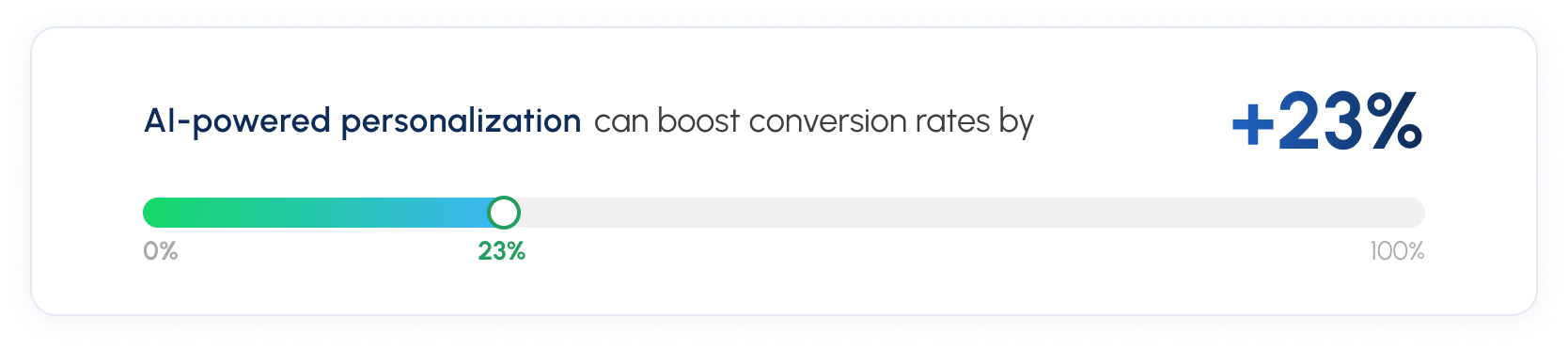
AI personalization tells you what the customer wants. The decisioning layer determines whether your stack responds before they find it somewhere else.
Most organizations have already introduced AI into their marketing recommendation engines, predictive scoring, behavioural models that identify intent before the customer has finished forming it. The intelligence is there. What is missing is the execution layer that takes that intelligence and turns it into a response inside the window where it still has value.
AI that identifies a high-intent customer three seconds into a session is only as powerful as the infrastructure that can act on that identification in the same breath. Without the decisioning layer, AI personalization becomes the most sophisticated way to generate insights that arrive too late.
What the Business Looks Like When Timing Is Right
When real-time intent response is in place, the metrics that have been flat start moving not because the campaigns changed, but because the timing did
The infrastructure does not generate new demand. It captures the demand that was already there are leaving, every day, because the response arrived too late.
- In-session conversion rates improve. The brand is responding while the customer is still deciding. Not after the tab is closed. Not the following morning. While the intent window is open and the decision is still live.
- Cart abandonment recovery rises. Not because the email got better because the response now arrives in the three-to-twenty minute window where it can still change the outcome. After that window, recovery is not recovery. It is a reminder of something the customer has already moved past.
- Form completion rates climb. Friction addressed at the moment the customer encounters it recovers the session. A message that arrives the next day is not a recovery, it is a reminder of something the customer has already moved past.
- Paid traffic returns better value. The intent that paid search and social media are already generating starts converting at a higher rate not because the media strategy changed, but because more of it is being captured before it expires.
The spend does not change. The conversion rate does. That is what makes CAC drop.
-
CAC falls as a direct consequence. When more of the traffic already being paid for converts, less budget is required to hit the same acquisition targets. No new channels. No increased bids. The same investment, working harder because the response infrastructure can now act on it in real time.
-
Upsell and cross-sell performance improves for the same reason. Post-purchase intent the window immediately after a transaction when a customer is most receptive to related products is short. A real-time response captures it. A scheduled campaign misses it by days.
The window after a purchase is as time-sensitive as the window before one. Most stacks treat it like neither.
- The measurement layer changes too. For the first time, in-session intent becomes visible not just as a behaviour logged somewhere in the CDP, but as a metric the business can act on. How many customers entered a high-intent state today? How many received a real-time response? How many are converted within the session versus requiring follow-up?
These numbers do not exist in a standard analytics dashboard. They only become visible when the infrastructure to act on intent is in place because that infrastructure, by definition, has to measure intent in order to respond to it.
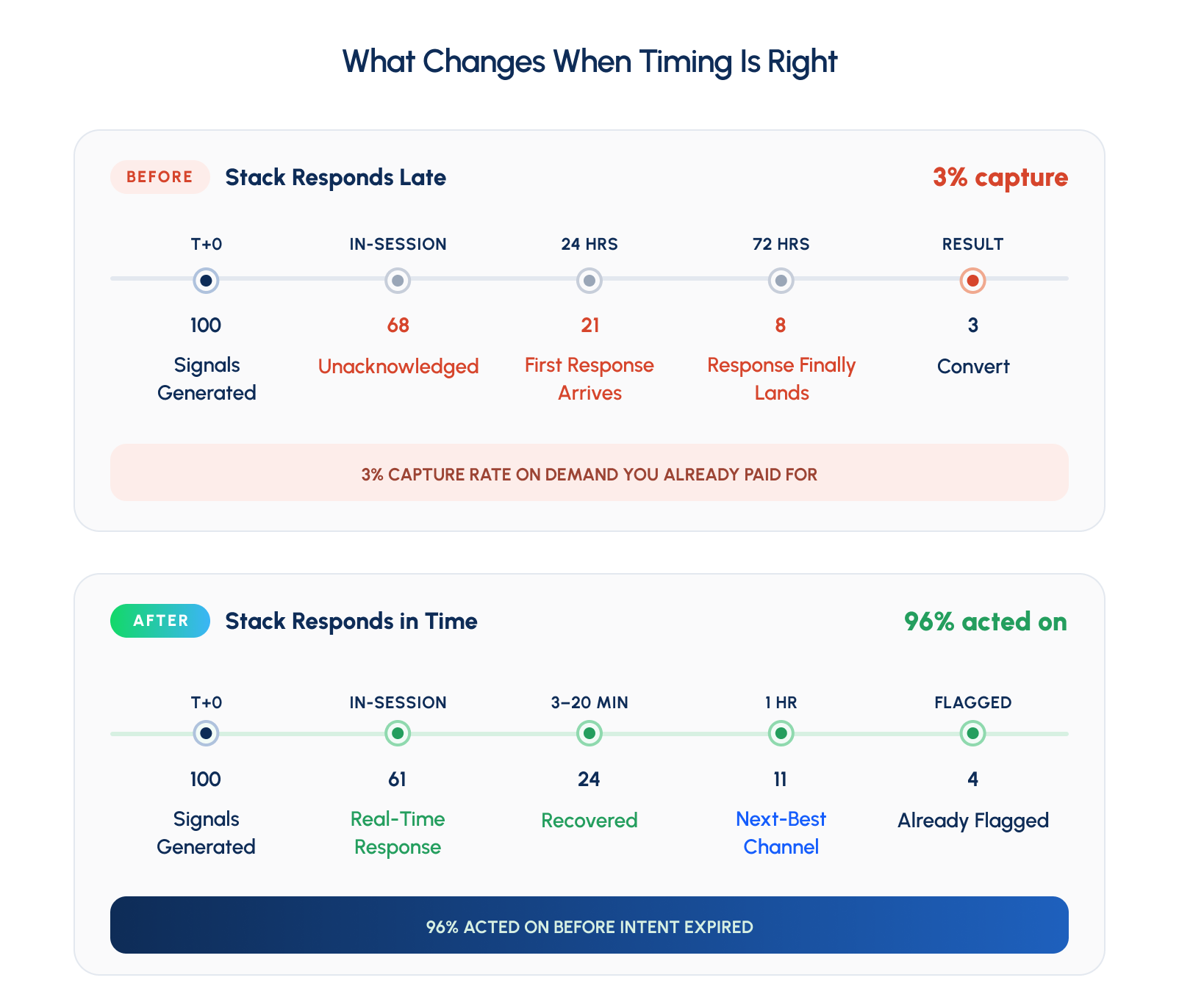
The cumulative effect is a marketing operation that stops losing value between the signal and the response and starts capturing the demand its paid and organic channels are already generating, before it expires.
The Conversion Was Already Yours. The Timing Gave It Away.
The gap between signal and response is not a strategy failure. It is an infrastructure gap and infrastructure gaps can be closed.
Most organizations are closer than they think. The data exists. The channels exist. The customer intent is real and detectable. What is missing is the layer that connects all three the decisioning infrastructure that reads a live signal, determines the right response, and activates the right channel before the window closes.
That is exactly what we build.
We diagnose where your stack is losing intent. Not at a category level at the specific failure points where high-intent customers are dropping off unacknowledged. The form exits. The comparison drop-offs. The cart abandonment windows your current triggers are missing by hours.
We build the decisioning layer your stack is missing. Not by replacing what you have by adding the governance layer that connects your CDP, your channels, and your live customer behaviour into a single, real-time response capability. The infrastructure that makes every channel in your existing stack perform the way it was always supposed to.
We close the window before the competitor fills it. The customer who compared three loan products this morning. The retail cart that was one push notification away from converting. The insurance quote that needed one advisor call to close.
The demand is already there. The intent is already firing. What changes is whether your infrastructure can meet it at the moment it exists or arrive after the decision has already been made.
The brands that have made this shift are not outspending their competitors. They are out-timing them. And in a market where customer intent moves in minutes, timing is the only advantage that compounds, because every session captured is revenue that does not need to be re-acquired, every window closed is a conversion that does not go to a competitor, and every real-time response delivered is proof that the brand was present at the moment that mattered.
That is what real-time personalization delivers when it works. And it is what we are built to make happen.
---outlined-cta---
Close the Gap Between Signal and Response
Turn live intent into conversions before the window closes, with our 5 days bootcamp