---blog Title---
Why AI-Powered Customer Journey Mapping Tools Are the Only Path to Profitable Growth
---desktop---

---mobile---

"Is your customer journey map a GPS or just a paper map in an era of self-driving cars?"
Think about traditional customer journey mapping tools like static blueprints. They're helpful, but only if everything stays the same.
But markets shift, customers evolve, and yesterday’s insights quickly become today’s blind spots. Traditional tools for customer journey mapping rely heavily on historical data and manual interpretation, limiting their ability to anticipate customer behavior or adjust swiftly to market dynamics.
Using traditional user journey mapping tools is like navigating today's traffic with yesterday's paper map. It can show you the route, but not the real-time roadblocks, detours, or alternate paths emerging as conditions change.
Businesses using AI-enhanced customer experience journey mapping tools not only chart where their customers have been but also predict where they're headed next.
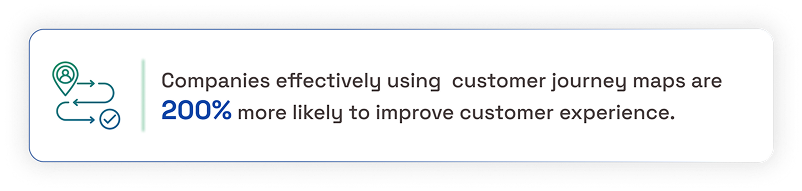
That’s why AI-powered customer journey mapping software are getting the attention.
AI-Powered Customer Journey Mapping Tools, Where Precision Meets Profitability
Think of your customer journey mapping tools like advanced machinery in a modern factory. Traditional static maps behave like conveyor belts—linear, predictable, and rigid.
But customers rarely move in straight lines. If your journey mapping tools can't instantly adapt to customer behaviors, you risk losing valuable opportunities.
With real-time personalization, the best tools for customer journey mapping adapt dynamically at every customer interaction.
For example, if a shopper hesitates at checkout, traditional maps blindly push predetermined content. In contrast, AI-driven customer journey systems immediately recognize this hesitation and display tailored offers or messages designed specifically to complete the sale.
Real-time personalization transforms passive data points into active, revenue-generating strategies, creating seamless customer experiences precisely when it counts.
Data Integration and Unified Customer View
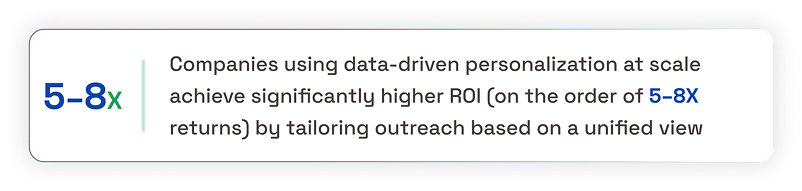
Another hallmark of advanced customer journey mapping tools is the ability to ingest and unify data from multiple sources. Enterprises have customer information siloed in CRM systems, e-commerce platforms, mobile apps, social media, call centers, and more.
The best AI customer journey platforms break down these silos by creating a single, integrated customer view that fuels the journey map.
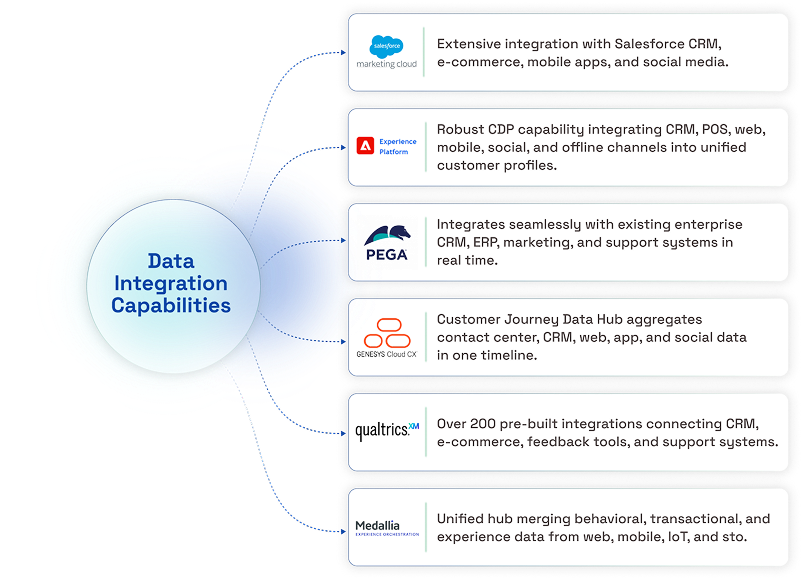
For example, Genesys’s journey data hub can “aggregate customer data from any source,” bridging data from contact centers, data warehouses, customer data platforms (CDPs), websites, and marketing systems into one unified profile.
This unified data is often time-series based, capturing each interaction in sequence, so the platform knows if “a customer who just browsed a product on the website also called support and clicked an email” – all in one timeline.
By integrating data streams, customer journey mapping tools ensure that customer context travels with them across touchpoints. Salesforce Marketing Cloud and Adobe Experience Platform rely on robust data integration to power their journey mapping:
- Salesforce lets companies connect data from Salesforce CRM, web analytics, and even social listening, creating a holistic profile that is “updated across CRM, website, and social media channels” for personalization.
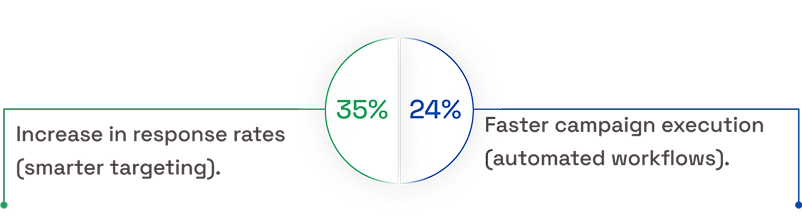
Marketing silos are like a factory where machines don’t talk email, SMS, and social run separately, leading to inefficiency. A financial services provider faced this, struggling with slow, uncoordinated campaigns.
Xerago’s Fix: We integrated IBM Experience One Suite with Salesforce, creating a central control panel for seamless marketing execution. CRM data powered campaigns, IBM Campaign automated outreach, and real-time tracking optimized engagement.
The result:
Most leading platforms provide pre-built connectors or APIs to make integration easier.
- Qualtrics Journey Optimizer, for instance, includes “200+ pre-built integrations with existing systems” so that data from ERP, CRM, support systems, etc., can flow into its analysis and orchestration engine.
- Pegasystems CDH similarly acts as an “always-on brain” unifying disparate data and customer journey analytics in real time – it “easily integrates with your technology stack” to leverage existing customer data and streams. By consolidating data, these tools eliminate blind spots in the customer journey.
Every touchpoint, whether an in-store purchase or a tweet, can inform the next interaction. This level of data integration is crucial for accurate customer journey maps and insights.
It lets businesses discover pain points (e.g. frequent drop-offs after a support call) and opportunities (e.g. a social mention that can trigger proactive outreach) across the entire lifecycle. In short, seamless data integration provides the foundation for both analysis and action in modern customer journey orchestration.
---outlined-cta---
Enhance Customer Lifetime Value with the Right Metrics- Download Now
Customer Sentiment Analysis for Journey Insights
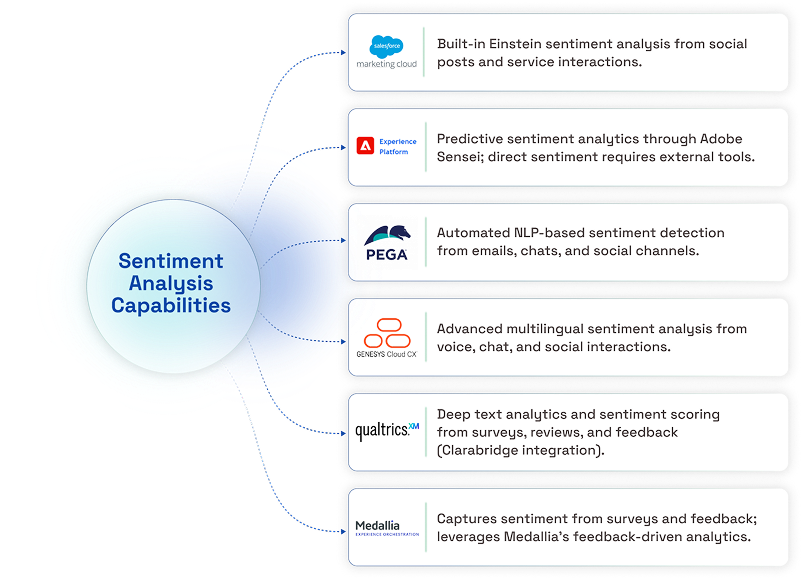
Many top customer journey platforms now include built-in sentiment analysis using natural language processing (NLP). This means the customer journey mapping software can automatically gauge if customer feedback or conversations are positive, negative, or neutral.
By “listening” to emails, chats, social media posts, and survey responses, AI models detect the customer’s mood and intent.
For example, if a customer leaves an angry review or writes an unhappy email, the system flags negative sentiment. The journey can then adapt – perhaps by routing that customer to a live agent or offering a special apology incentive.
Conversely, highly satisfied customers (positive sentiment) might be funneled into upsell or advocacy journeys. This use of sentiment makes customer journey orchestration more empathetic and proactive.

Enterprise platforms like Qualtrics XM (which now includes Clarabridge’s text analytics) and Genesys Cloud CX illustrate this capability.
- Qualtrics uses AI to automatically “detect human sentiment, effort, and intent from every interaction” across channels, building what it calls the world’s largest database of customer sentiment data.
- Genesys, through its integration with social listening tools, applies multilingual sentiment models to understand slang and colloquial phrases in many languages – enhancing the platform’s understanding of customer feelings in real time.
- Pegasystems Customer Decision Hub likewise analyzes text from emails or chats; for instance, Pega’s NLP can read an incoming service email and if the tone is very negative, automatically assign a high priority or escalation, ensuring urgent issues get immediate attention.
By infusing customer journeys with sentiment insights, AI-powered tools help brands treat customers according to their emotions and turn data into the “next best action” for each individual. This leads to faster issue resolution, more personalized offers, and ultimately a better customer experience
Omnichannel Orchestration in Real Time
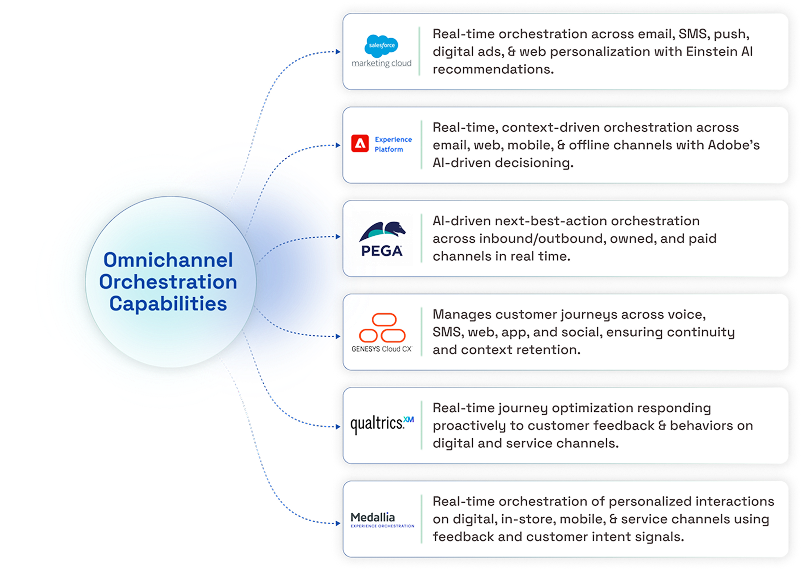
True omnichannel customer journey orchestration means the platform not only maps the customer’s path, but also coordinates personalized interactions across all channels in real time.
---outlined-cta---
Monitor Key Lifecycle Metrics That Impact Customer Value- Get the Resource
The goal is that a customer receives a consistent, context-aware experience whether they are on email, SMS, a mobile app, chatting with a bot, or talking to a human agent.
Leading AI-powered tools treat this as essential: Pega describes its AI as “a single brain that connects experiences across inbound, outbound, owned, and paid channels”– ensuring that whatever the channel, the next step in the journey makes sense for that individual.
Modern user journey mapping platforms use real-time decision engines to adjust paths instantly based on customer behavior or events. For example, if a customer is browsing a product on the website, an AI-driven journey tool might immediately trigger a relevant in-app message or notify the sales team.
If a customer complains on Twitter, the system can log that in the journey and prompt a support follow-up on that same channel.
- Thunderhead (Medallia Experience Orchestration) is known for this kind of responsiveness: it identifies a customer’s intent from their actions and feedback data, then drives “tailored experiences across channels” at that moment. Its real-time interaction management ensures that each customer’s intent is understood and touchpoints are orchestrated seamlessly in the moment
To achieve omnichannel personalization, these platforms provide journey designers that cover email, SMS, push notifications, in-app messages, call center scripts, social replies, and more – all from one canvas.
- Salesforce Journey Builder, for instance, allows marketers to drag-and-drop interactions across email, SMS, social ads, and push, and have Einstein AI optimize timing and channel for each customer.
- Adobe Journey Optimizer similarly coordinates messages on web, mobile, and email with a real-time rule engine that looks at “current behavior combined with historical data” to decide the next best touchpoint.
The emphasis is on consistency and immediacy: a change in one channel (say, a purchase in-store) can instantly update the journey so that other channels (like marketing emails) respond appropriately (perhaps suppressing a redundant promo).
The result of true omnichannel orchestration is a seamless, personalized experience for the customer and greater efficiency for the business. Customers feel recognized no matter how they interact, and AI ensures no channel operates in a vacuum.
This capability is key to driving higher engagement and conversion rates, as interactions reach customers on their preferred channels at just the right times.
Predictive Analytics: Shaping Customer Actions, Not Just Anticipating Them
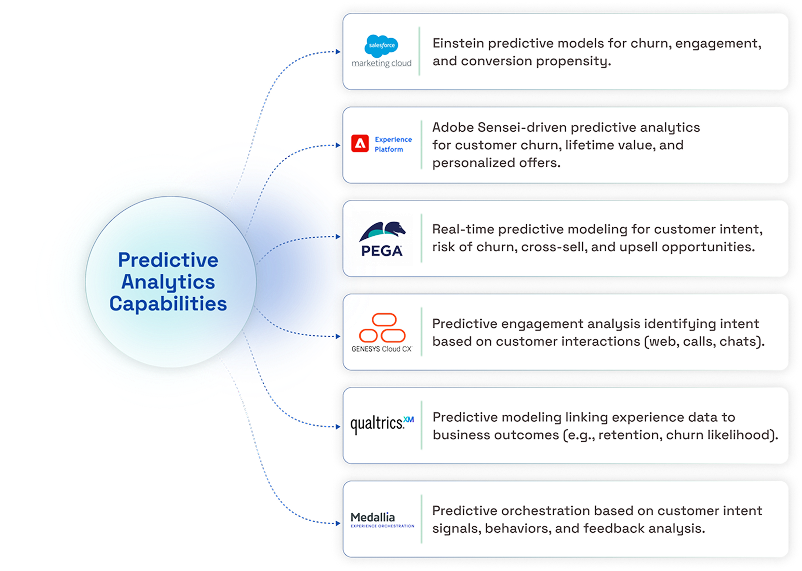
Yet responding in real-time isn't enough, truly advanced customer experience journey mapping tools also use predictive analytics to anticipate and shape future interactions.
Predictive analytics takes historical and current interaction data to forecast customer behaviors, helping you proactively meet expectations.
For example, if your predictive models show that customers frequently abandon carts unless incentivized, AI proactively offers personalized discounts before abandonment occurs. Xerago's strategist sums up this concept powerfully:
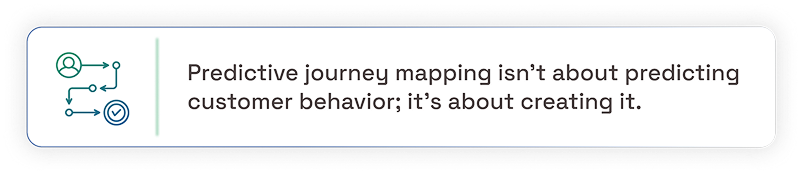
By influencing actions proactively, predictive analytics moves you from merely reacting to customer choices, toward strategically guiding customer decisions.
Leading enterprise customer journey mapping tools employ predictive models to:
- Forecast churn or retention probability: Identifying at-risk customers before they churn and proactively triggering retention campaigns. For instance, Adobe Experience Platform’s Adobe Sensei calculates churn probabilities to initiate targeted loyalty promotions before customers even show explicit dissatisfaction.
- Optimize timing and relevance of promotions: Predicting the exact moment when customers are ready to buy. Salesforce Marketing Cloud’s Einstein AI analyzes historical purchase patterns to trigger offers precisely when customers are most likely to engage, significantly improving conversion rates.
- Enhance real-time personalization: Adjusting experiences on-the-fly based on predicted intent. For example, Pegasystems CDH immediately senses when a customer browsing auto loans online matches patterns of ready-to-buy behavior and proactively offers a tailored financing package.
---outlined-cta---
Enhance Customer Value Beyond Conversion- Get the Guide
Behavioral Insights: Deeper Understanding Drives Deeper Profits
Adding another layer, AI-driven customer journey mapping tools offer powerful behavioral insights, analyzing detailed customer behaviors instead of vague demographics. This precise understanding helps segment your audience based on actual intentions and responses.
For example, behavioral insights reveal which customer segments value loyalty programs versus discounts, or new product trials versus bundle offers. This enables targeted messaging that resonates deeply, dramatically improving campaign effectiveness and profitability.
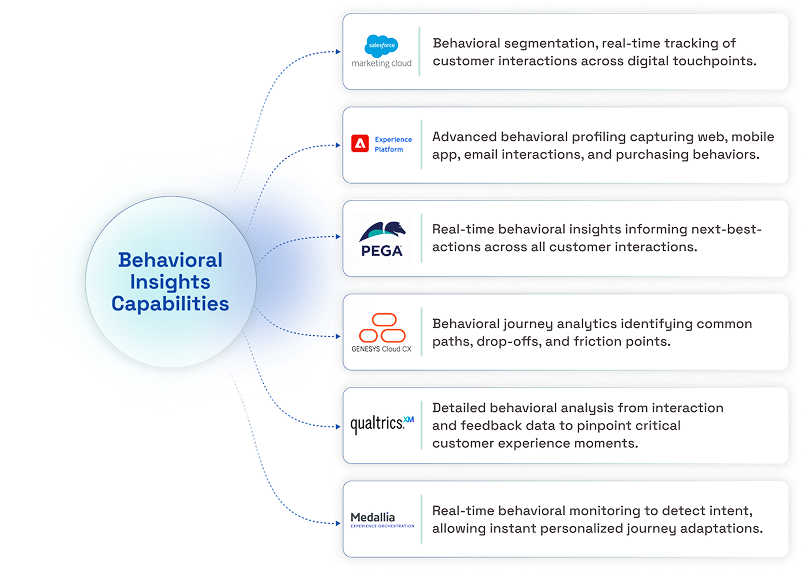
Top B2C platforms use behavioral insights to:
- Identify friction points in the journey: Platforms like Genesys Cloud CX and Qualtrics XM monitor customer behaviors to identify where journeys stall, such as repeated visits to the help center page or abandoned carts, signaling unresolved issues.
- Deepen segmentation precision: Adobe Experience Platform segments customers based not only on traditional attributes but on nuanced behaviors—like frequent cart abandonment or repeated product searches—enabling hyper-targeted communications.
- Instantly respond to behavioral triggers: For instance, Medallia (Thunderhead) captures behavioral signals (e.g., clicking repeatedly on pricing pages) to trigger real-time engagement, such as live chat intervention or personalized offers, turning hesitant shoppers into buyers.
Use Cases and Impact on Engagement & Performance
Enterprise organizations are seeing tangible benefits from these AI-driven journey mapping capabilities. By harnessing sentiment insights, unified data, and omnichannel orchestration, companies can significantly boost customer engagement and business outcomes:
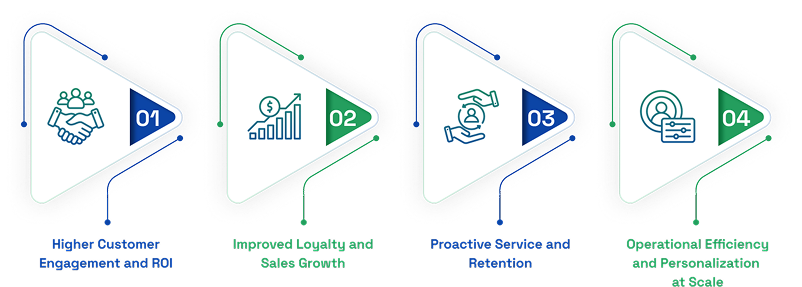
Higher Customer Engagement and ROI: Personalized, well-timed journeys lead to more active and loyal customers.
For instance, companies using Salesforce Marketing Cloud’s Journey Builder report a “53% increase in customer engagement and a 44% increase in marketing ROI” on average.
This is because AI-orchestrated journeys ensure customers receive relevant messages on their preferred channels, which drives more interactions and conversions than one-size-fits-all campaigns.
Improved Loyalty and Sales Growth: Orchestrating seamless experiences across channels translates to greater customer satisfaction and revenue. Medallia (Thunderhead) found that brands executing individualized omnichannel journeys at scale saw notable lifts in brand loyalty and sales.
When every touchpoint, from a social media query to an in-store visit, is connected and informed by past interactions, customers are more likely to trust the brand, repeat purchase, and even spend more per transaction. Consistency builds confidence, which in turn drives growth.
Proactive Service and Retention: Using AI to monitor sentiment and behavior allows companies to intervene early to prevent churn. For example, if a telecom provider’s journey system flags a customer’s repeated complaints (negative sentiment and multiple support calls), it can automatically trigger a retention offer or VIP support call.
Genesys has noted that blending social listening with journey orchestration lets companies respond “with no delays” on the channel the customer prefers, turning potential crises into loyalty-building moments. This closed-loop responsiveness not only salvages at-risk customers but often turns them into advocates.
Operational Efficiency and Personalization at Scale: Automating data integration and decisioning across channels yields efficiency gains. Pega’s users have leveraged its always-on AI to handle millions of customer decisions in real time, which would be impossible manually.
While individual results vary, the common theme is that real-time personalization at scale drives better performance metrics across the board – from email open rates to call resolution times – by delivering what each customer needs when they need it.
---outlined-cta---
Convert Buyers into Loyal Customers Using Data- Get the Resource
How AI-Driven Customer Journey Mapping Tools Revolutionize Insights
Refining Customer Personas with Machine Learning
Machine Learning for Precise Personas: Acts like skilled technicians, refining customer personas dynamically with each interaction—replacing guesswork with actionable insights.
Sentiment Analysis for Emotional Insight: Continuously captures emotional nuances in customer interactions, identifying triggers that influence decisions and allowing businesses to forge authentic connections.
Automated Segmentation for Accuracy: AI-driven segmentation enables precise micro-targeting by analyzing nuanced behaviors, significantly boosting retention. For instance, Xerago's implementation of IBM Predictive Customer Intelligence helped an insurer proactively address lapsing customers.
For example, Xerago implemented IBM Predictive Customer Intelligence for an insurance provider struggling with customer retention. Utilizing AI-driven segmentation, the solution accurately pinpointed customers likely to lapse, automating proactive retention strategies.
The impact was substantial.

The Future of Customer Journey Mapping
Industry trends confirm a decisive shift towards AI.
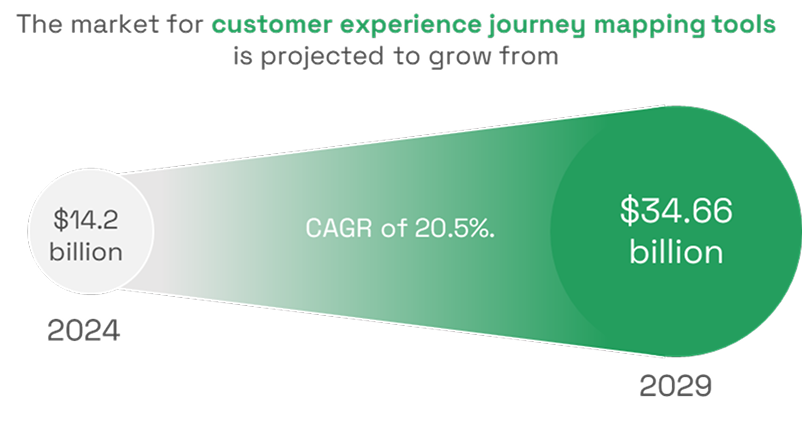
This growth highlights AI-powered mapping tools as not merely advantageous but essential.
As we assert, "If you're not using AI in your user journey mapping tools, you're leaving growth opportunities unexplored. AI doesn't just enhance insight—it revolutionizes customer understanding."
AI-powered customer journey mapping tools with sentiment analysis, unified data, and omnichannel orchestration capabilities are empowering companies to create more personalized, responsive, and profitable customer journeys.
By understanding customer feelings and behaviors (via sentiment and analytics), integrating all relevant data, and acting instantly across channels, these platforms help brands engage customers in the most human yet scalable way.