Customer Journey Optimization: Tools and Platform to Consider

Losing customers at the same step? Bring us one journey problem. We'll fix it on your systems in 5 days.
Customers rarely leave because of one bad moment, they drift away at small points of friction: a form that asks too much, a price that appears too late, a follow-up that never comes. Customer journey optimization is how you find those moments and fix them. It brings together journey mapping, behavioral data, personalization and testing so that every step from first discovery to repeat purchase and advocacy , moves customers forward, lifting conversion, retention and lifetime value along the way.
In 2026 that path is less linear than ever. A buyer might get a product shortlist from an AI assistant, check reviews on social, compare on your site, and finish the purchase on mobile two weeks later. Optimizing the journey means understanding that whole path and acting on it in real time.
This guide covers how journey optimization differs from mapping, the five journey stages, a 6-step optimization framework, the KPIs to track, the tools that make it work, and where AI is changing the discipline.
What is Customer Journey?
The customer journey itself is the complete, interconnected path a customer takes from first awareness of a brand to purchase and beyond. It spans every touchpoint: search results and AI assistants, ads, social, your website and app, email, sales conversations, customer service, and post-purchase follow-up.
Each stage in this journey reflects a customer's evolving needs, expectations, and level of engagement. The main stages of the customer acquisition journey typically include:
The 5 stages of the customer journey
Awareness: When the customer becomes aware of the brand through advertising, social media, or word of mouth.
Consideration: When the customer actively considers the brand's offerings and explores products or services.
Purchase: The decision-making point when the customer makes a purchase.
Post-Purchase Engagement: Interaction after purchase, which could involve customer support, reviews, or follow-up marketing.
Loyalty and Advocacy: Long-term engagement that turns satisfied customers into loyal advocates who may refer others to the brand
B2C customer journeys are shorter but cross more channels and devices.
Journey Mapping Vs Journey Optimization Vs Journey Orchestration
Three terms get used interchangeably, but they are different jobs – and mature teams need all three.
| Journey mapping | Journey optimization | Journey orchestration | |
|---|---|---|---|
| The question it answers | "What path do our customers follow?" | "Where are we losing customers, and why?" | "What should this person see or receive right now?" |
| What you use | Customer interviews, surveys, team workshops | Analytics, funnel reports, customer feedback, A/B tests | Live behavior data, unified customer profiles, decision rules or AI |
| What you get | A journey map document | A list of fixes, test results and KPI gains | Emails, app messages or web content sent automatically to each person |
| How often | Once or twice a year | Every month or sprint | Instantly – each time a customer clicks, browses or drops off |
Mapping shows how the journey should work. Optimization measures how it actually works and improves it. Orchestration acts on each individual customer – thousands of times a day – based on what they just did.
What Is Customer Journey Optimization and Why Is It Important?
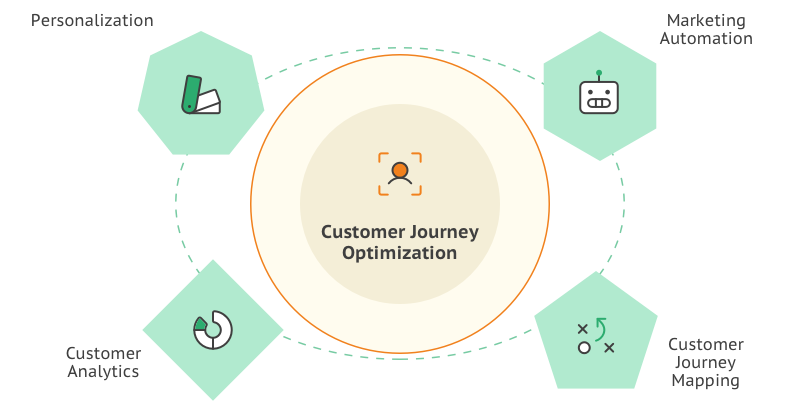
Customer Journey Optimization (CJO) involves actively managing and enhancing each stage and touchpoint in the customer journey to ensure a seamless, consistent, and satisfying experience.
By analyzing and adjusting how customers interact with a brand at every step, businesses can build a personalized customer journey that aligns with individual needs and maximizes satisfaction, leading to stronger customer relationships and improved business outcomes.
Through CJO, companies leverage tools for customer interaction analysis, customer journey mapping, and journey analytics to gain insights into customer behaviors and preferences. These insights help refine each stage of the journey, from the sales customer journey to post-purchase engagement, using customer journey optimizer tools to address any friction points.
Top Benefits of Optimizing Customer Journey
Understanding and mapping this journey enables brands to meet customers' needs at each stage and identify areas where improvements can enhance customer experience and conversion rates. Optimizing the customer journey offers several benefits:
- Upgraded customer satisfaction results in increased customer loyalty and retention.
- Identifying and resolving pain points in the customer journey improves conversion rates from prospects to customers.
- Personalization of customer interactions fosters repeat purchases and enhances customer lifetime value (CLV).
- Utilizing journey analytics provides critical insights into customer preferences and behaviors, enabling data-driven decision-making.
- Leveraging real-time customer data enhances targeted marketing strategies and optimizes resource allocation.
- Customized marketing communications improve engagement rates by aligning with individual customer needs and expectations.
- Cross-channel consistency establishes brand trust and recognition, promoting a seamless customer experience.
- Increased customer retention drives revenue growth through repeat purchases and long-term customer relationships.
5 Customer Journey Optimization Trends In 2026
- Buyers increasingly start with AI assistants and AI search summaries, which can shortlist brands before anyone visits a website. Search Engine Land cites Gartner's projection that AI assistants handle about a quarter of search queries in 2026. Awareness now includes being cited in AI answers.
- A journey map on a slide is no longer enough. Brands now use software that reacts to each customer as they act – for example, sending a reminder the moment someone leaves a form half-filled.
- AI can now suggest a journey, test it before launch, watch how it performs and flag problems. Teams review and approve instead of building everything by hand. Example: the Journey Agent Adobe announced for Journey Optimizer at Adobe Summit in April 2026.
- Clicks don't tell you why someone left. An abandoned cart could mean "too expensive" or "just looking". So the best teams simply ask – one quick question at the right moment – and use the answer to decide what to send next
- More opens and clicks don't always mean more revenue. Judge your journeys by what matters to the business: sales, active customers, customers who stay, and how much they spend over time.
How To Optimize The Customer Journey In 6 Steps
Step 1: Pick one journey, one segment and one goal. Optimizing "the journey" for everyone at once rarely works. Choose a high-value path – say, mobile visitors applying for a credit card, or first-time shoppers checking out on a fashion app and the single outcome you want to improve.
Step 2: Map the touchpoints and stages with real data. List where customers meet your brand: AI and search results, ads, website, app, email, social, sales and service. Then attach measured entry and exit rates to each stage using analytics paths and funnel reports, so the map shows reality.
Step 3: Find the biggest drop-offs and ask why. Rank steps by lost volume × value. Combine behavioral data (session replays, heatmaps) with what customers tell you: surveys, reviews, chat transcripts, call reasons, and short in-journey questions. Behavior shows where people leave; customers tell you why.
Step 4: Prioritize fixes by impact and effort. Score each idea on expected impact, confidence and effort. Quick wins extra form fields, slow pages, unclear pricing, missing trust signals go first. Structural changes such as data integration or new onboarding get a roadmap.
Step 5: Test, personalize and orchestrate across channels. A/B test the top fixes. Use unified customer profiles to tailor content, offers and timing by stage and behavior, and keep the experience consistent as customers switch devices and channels. Set clear arbitration rules so journeys don't compete – a retention message should beat a cross-sell for an at-risk customer.
Step 6: Measure outcomes, then repeat. Track stage KPIs against a baseline, roll out what wins, and revisit the journey at least quarterly or whenever you launch a new channel, product or campaign.
Customer Journey Optimization KPIs by Stage
For each stage, track one main number that shows real business results, plus one or two numbers that explain it. Don't judge success by email opens or clicks alone.
| Stage | Outcome KPI | Supporting signals |
|---|---|---|
| Awareness | Qualified new visitors | Organic and paid CTR, AI-answer citations and share of voice |
| Consideration | Lead or sign-up rate | Engaged sessions, return visits, comparison-page views |
| Purchase | Conversion rate | Form or cart abandonment, time to convert, customer acquisition cost |
| Post-purchase engagement | Activation rate | Onboarding completion, support contact rate, CSAT |
| Loyalty and advocacy | Retention and lifetime value | Repeat purchase rate, churn rate, NPS, referral rate |
Set the baseline before you change anything, and use controlled tests where possible so you can attribute improvement to the change not to seasonality or a campaign running at the same time.
Still losing customers at the same step?
In Xerago's 5-Day Bootcamp, we work on your real systems and data to find the cause and ship a working fix.
If we don't solve it, the Bootcamp is free.
Customer Journey Optimization Tools: What You Need To Map, Measure, Personalize And Automate The Journey
Through Customer Journey Optimization, brands can deliver a seamless customer experience across all channels, increasing loyalty and retention. It also provides a competitive edge by creating a memorable, unique customer journey. Below are the categories of tools that can drive user journey improvement and help manage every phase of the customer journey.
Tools that are involved in Customer Journey Optimization
| Category | What it does | Example tools |
|---|---|---|
| Journey mapping | Visualize stages, touchpoints, pain points | UXPressia, Custellence, Smaply, Lucidchart |
| Customer behavior analytics | Measure paths, funnels, drop-offs | Adobe Analytics, Google Analytics 4, Mixpanel, Hotjar |
| Customer data platform (CDP) | Unify profiles, build real-time segments | Segment, Adobe Real-Time CDP, Salesforce Data Cloud |
| Personalization and orchestration | Decide and deliver the next best experience | CleverTap, Insider, WebEngage, Adobe Journey Optimizer |
| Marketing automation | Nurture and lifecycle programs | Marketo Engage, Salesforce Marketing Cloud Account Engagement, HCL Unica, HubSpot Marketing Hub |
| Experimentation | A/B and multivariate testing | Adobe Target, Optimizely, VWO |
Let's dive into them!
1. Customer Journey Mapping Tools
Customer journey mapping is about visualizing and understanding every stage the customers go through while interacting with a business. By identifying key moments, pain points, and opportunities through mapping, businesses can strategically optimize the behavior and processes along the customer journey,
UXpressia: A cloud-based tool that helps visualize, share, and refine customer journey mapping for teams.
Custellence: It enables collaboration on loyalty program customer journey maps and provides insights through emotion monitoring.
Smaply: Helps visualize and analyze customer journey strategies and touchpoints, fostering better understanding and customer experience enhancement.
Lucidchart: Known for customizable templates and real-time collaboration, enabling brands to capture complex journeys easily.
2. Customer Behavior Analytics Tools
Customer Behavior Analytics involves examining customer data and interactions to understand their preferences, actions, and emerging trends. This helps businesses better cater to their needs and foster stronger relationships resulting in improved conversion rates.
It involves collecting and examining data from various sources such as transaction histories, website interactions, social media engagements, customer surveys, demographic information, and push notification responses.
Adobe Analytics: Provides journey analytics across touchpoints, offering personalized insights for customer journey solution creation
Already on Adobe? Most teams use Customer Journey Analytics as a reporting tool, but it can do much more. Xerago helps you build one CJA view of the journey – online, offline and CRM – shared by marketing, sales and service.
Google Analytics: Monitors real-time customer interactions, supporting user journey improvement through data insights.
Mixpanel: Tracks user behavior in real-time and segments customers based on customer journey strategies, which enhances engagement.
Hotjar: Offers visual tools like heatmaps and session recordings, allowing businesses to fine-tune customer experience optimization by understanding user behavior.
3. Personalization Tools
Personalization tools create a customized customer journey by delivering relevant content based on customer preferences. Personalization in customer journey optimization offers a unified experience by interacting with the individual's preferences which promotes long-term retention and better customer engagement.
Clevertap: Collects and segments data to support personalized customer journeys across multiple channels.
Segment: Enables customer interaction analysis through real-time data collection, aiding in user journey improvement and customer touchpoint optimization.
Insider: Uses AI-driven insights to activate data in real-time, fostering seamless customer experiences with campaigns and supporting customer experience enhancement.
WebEngage: Personalizes engagement across channels, allowing brands to refine customer service optimization and support customer journey solutions.
4. Marketing Automation Tools
Marketing automation facilitates lead nurturing workflows that nurture prospects with relevant content and communications over time, gradually moving them through the sales funnel & campaigns.
Campaigns aim to engage customers through various channels and touchpoints, encouraging them to interact with the brand, explore its offerings, and take desired actions such as signing up for newsletters, visiting the website, or making a purchase.
By automating personalized follow-up emails, triggered based on specific actions or milestones achieved by the prospect, businesses can build trust, establish credibility, and increase the likelihood of conversion.
Marketo Engage: Integrates customer data to enhance customer touchpoint optimization and track the effectiveness of customer retention strategies.
Salesforce Paradot: Manages personalized engagement campaigns, automating touchpoints to maintain a consistent customer acquisition journey.
HCL Unica: Allows marketers to conduct A/B testing, enabling customer experience enhancement through ongoing improvement of the journey.
Hubspot Marketing Hub: Offers features like journey analytics and revenue attribution to maximize conversion rate optimization.
How to Improve Your Customer’s Journey?
Each interaction a customer has with your brand is a chance to build loyalty and trust. Here’s a guide on mapping and improving the customer journey, helping you adapt to the modern customer.
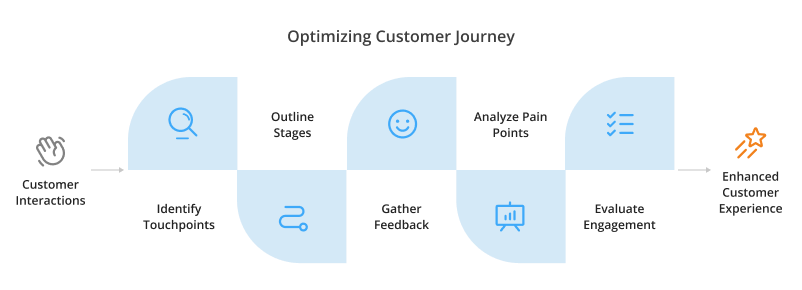
- Identify Key TouchpointsStart by mapping where your customers interact with your brand. These can be your website, emails, social media, or customer service channels. This helps you see where your brand meets your customers and the paths they take.
- Outline Customer StagesEach customer journey has stages: Awareness, Consideration, Purchase, and Loyalty. Understanding these stages lets you tailor your messaging. For instance, in the Awareness stage, focus on educational content rather than hard-sell tactics.
- Gather Customer FeedbackListen to your customers. Feedback from surveys, reviews, and direct conversations reveals what they like, dislike, and want more of. These insights show areas where the journey is smooth—and where it may be losing them.
- Analyze Pain PointsNot every part of the journey will be seamless. Identifying friction points, like a complicated checkout or lack of personalized communication, helps you spot where improvements are needed. This can be as simple as speeding up response times or creating more personalized emails.
- Evaluate Cross-Channel EngagementCustomers don’t stick to one platform. They might browse on mobile, add items to their cart on a laptop, and later complete the purchase on a tablet. Make sure each touchpoint offers a consistent, easy experience. Cross-channel engagement keeps the journey smooth and minimizes drop-offs.
- Review and Update RegularlyCustomer expectations and technology are constantly changing. Regularly revisit your journey map to stay aligned with what your audience values. For example, as more people value fast, personalized service, consider adding live chat or improving your FAQ section.
How You Can Adapt to the Evolving Customer Journey Landscape
The modern customer journey is more complex than ever, with buyers making decisions across multiple devices, channels, and even influencers. Adapting to this journey means thinking beyond traditional steps:
- Invest in Personalization: Customers expect experiences tailored to them. This doesn’t mean overhauling every touchpoint but creating small, meaningful interactions. For instance, sending product recommendations based on past purchases can enhance their experience.
- Encourage Flexibility: Your team’s adaptability is crucial, especially in fast-evolving digital spaces. Hiring people who are open to change and continuous learning can make your brand agile and responsive to shifts in customer needs.
- Balance Technology with a Human Touch: Technology is helpful, but it can’t replace a genuine connection. Use tools to streamline processes but ensure customers feel heard and valued by keeping personal interactions in play.
- Highlight Cross-Channel Consistency: Customers don’t differentiate between online and offline channels; they expect a cohesive experience. Make sure they find the same message and quality whether they’re on social media, your website, or speaking with your support team.
Mapping and improving the customer journey isn’t a one-time task—it’s an ongoing effort that requires listening, adapting, and being proactive. Keep your approach analytical but practical, constantly looking for high-level insights.
Key Take Away
By creating a journey that is consistent, personalized, and responsive, you’re not just adapting to the modern customer but building loyalty and trust that lasts well beyond the initial sale.
Customer journey optimization is essential for providing a seamless, engaging experience across all channels. By leveraging the right customer journey optimizer tools and strategies, businesses can boost loyalty, improve retention, and foster long-term growth.
Embracing customer experience enhancement methods and investing in analytics and automation tools allow brands to stay ahead in a competitive landscape, ensuring a memorable journey for every customer.
XERAGO 5-DAY BOOTCAMP
Bring one customer journey problem.
We work on your real systems and data to find the cause and ship a working fix with no slides, no sandbox.
Frequently Asked Questions
1. What is customer journey optimization?
Customer journey optimization is the continuous process of analyzing each step customers take with a brand and removing friction to improve conversion, retention and lifetime value. It combines journey mapping, behavioral analytics, personalization and testing.
2. What is the difference between journey mapping, optimization and orchestration?
Mapping documents how the journey looks. Optimization uses data and testing to improve it continuously. Orchestration acts on each customer in real time, deciding the next message or experience based on their latest behavior.
3. What are the 5 stages of the customer journey?
Awareness, consideration, purchase, post-purchase engagement, and loyalty and advocacy. Each stage needs its own goals and KPIs, from qualified visitors at awareness to retention and lifetime value at loyalty.
4. Which tools help automate personalized customer journeys?
A customer data platform such as Segment or Adobe Real-Time CDP unifies profiles. An orchestration tool such as Adobe Journey Optimizer, CleverTap, Insider or WebEngage then triggers the next message across email, app, web and ads based on behavior.
5. How is AI changing customer journey optimization?
AI now predicts who will convert or churn, chooses the next best action per customer, and generates content variants for testing. Newer AI agents can also propose, simulate and monitor journeys. It works best on clean, unified customer data.
6. How do you measure customer journey optimization?
Set a baseline for each stage's outcome KPI – conversion, activation, retention, lifetime value – then compare after each change. Use controlled A/B tests so improvements are attributable to the change, not seasonality.
7. How often should you optimize the customer journey?
Continuously: review key funnels monthly, test every sprint, and refresh the full journey map at least quarterly or when you launch a new channel, product or campaign.
Ram Prabhakar
Head of Solutions and Content
Xtelligence Inbox.
Your weekly dose of marketing smarts!
Related Posts