Interactions Correctly?


Why Your Marketing Automation Still Feels Manual


The platform is live. The license is paid. And yet the campaign manager is still building audience lists in a spreadsheet, the QA team is still checking emails manually before every send, and the weekly report still takes three hours to compile in Excel.
This is not a platform problem. Every major marketing automation tool has the features to handle all of this. The problem is that the features are live but not fully working, the workflows are incomplete, the data connections are broken or missing, the team is working around the system rather than through it, and the automation rules that should be running on their own keep breaking and getting fixed manually instead.
The result is a team that owns a sophisticated tool and uses it like a basic email scheduler. The license cost stays fixed. The manual work stays constant. And the gap between what the platform is capable of and what it is actually doing widens every quarter.
Why Automation Platforms End Up Feeling Like Manual Tools
Marketing automation does not deliver value by being switched on. It delivers value when the workflows, integrations, campaign logic, and team processes are built correctly around it. Most implementations do not reach that point; they get far enough to go live and then stop.
The most common reasons a platform feels manual despite being active:
- Incomplete setup - advanced features were scoped for a later phase that never arrived
- Disconnected data - the CRM, website, and purchase systems are not fully connected, so lists get built manually
- Unused features - only a fraction of licensed capabilities are active because nobody has built the workflows to use them
- Poor workflow design - what was built at go-live has gaps and missing logic that the team works around rather than fixes
- Lack of training - the team knows enough to send campaigns but not enough to build the logic that removes manual steps
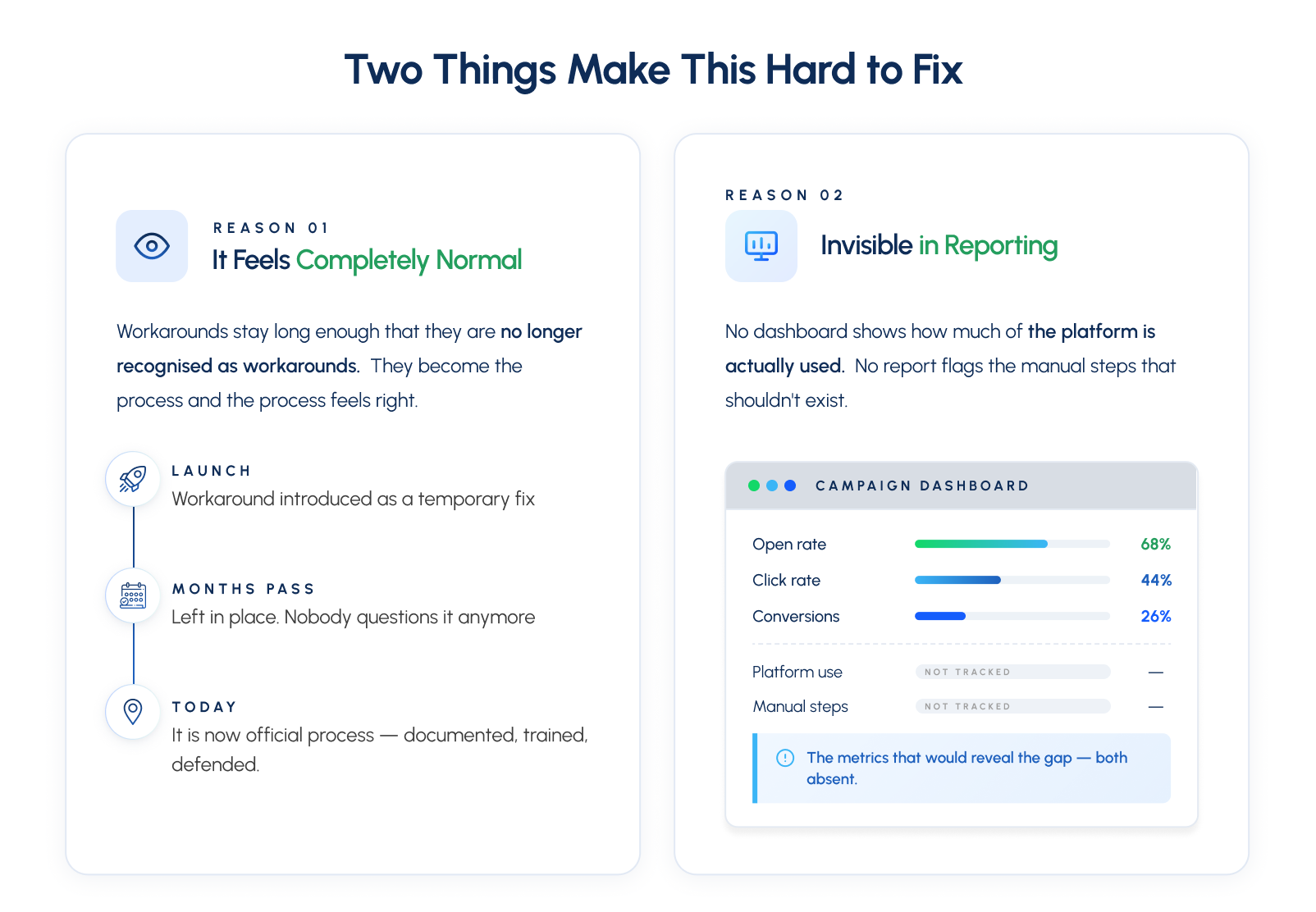
- Accumulated workarounds - each manual fix becomes part of the process until the boundary between platform and manual work disappears entirely
Over time those workarounds solidify into process. A manual step covers a workflow gap. A spreadsheet tracks something the platform should be tracking. An approval chain runs in email because nobody configured it inside the tool. None of these feel like failures as they feel like how the work gets done. And that normalisation is what makes the problem so persistent.
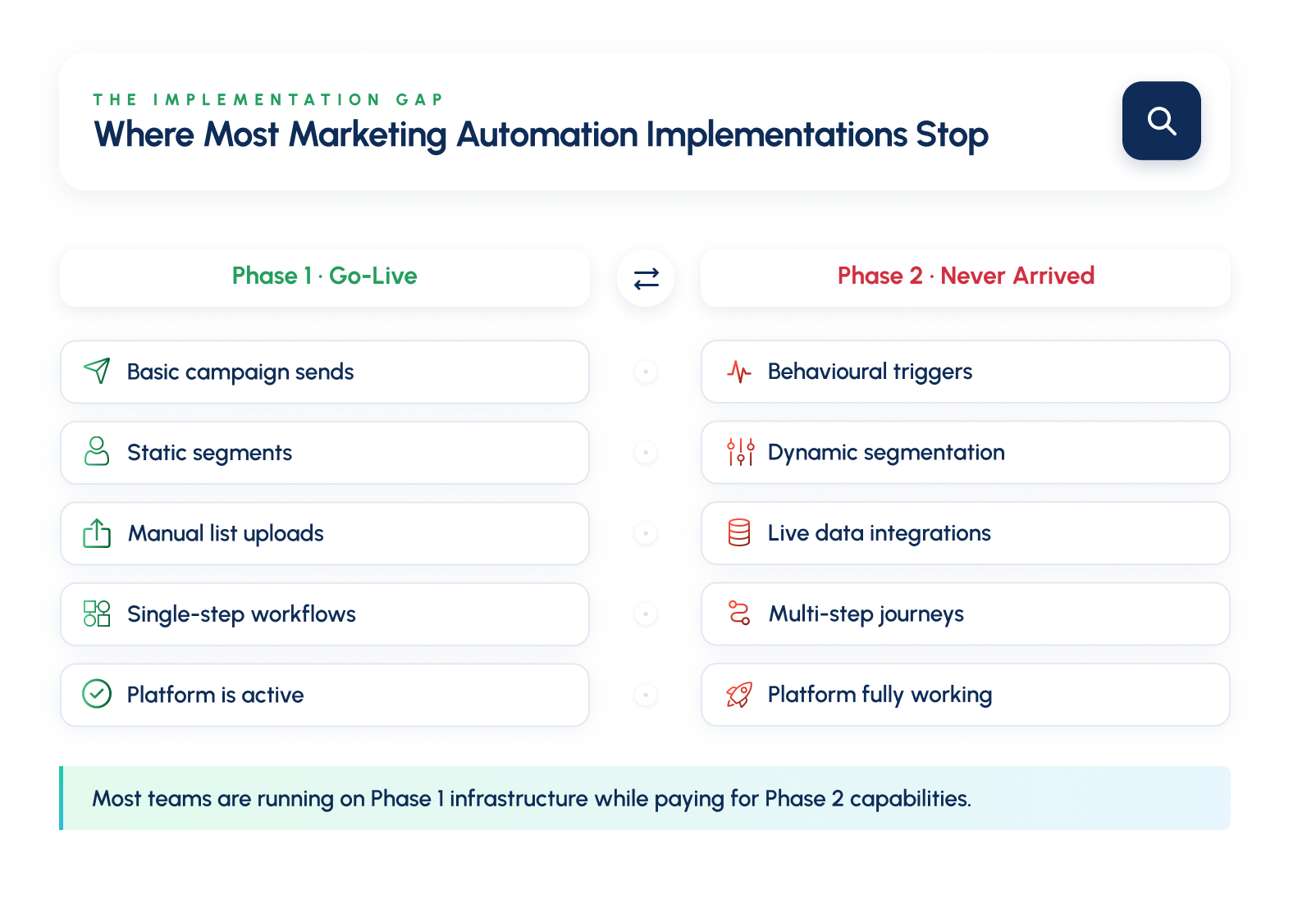
The result is a team where the platform handles the sending and the team handles everything else: The data prep, the QA, the approvals, the reporting. The boundary between what is automated and what is manual is rarely mapped and almost never questioned. Which is exactly why the signs of underuse are so easy to miss until they become impossible to ignore.
How to Tell If Your Platform Is Being Underused
Most teams do not realise how manual their automation has become because the workarounds have been in place long enough to feel normal. The clearest way to check is not to audit the platform it is to audit where the team's time is actually going.
The most immediate signal is campaign launch time. A campaign that consistently takes several days to move from brief to send is not a creative problem. It is a process problem. Every manual step between briefing and launching, pulling a list, rebuilding a segment, running QA outside the platform, chasing approval via email is a step the platform was licensed to handle. When launch time is measured in days rather than hours, the workflow was never built.
Two signals that are harder to miss but easiest to normalise:
- CSV uploads are still happening - every manual list upload is evidence of a data integration gap. The platform cannot see what it needs without someone extracting and importing it manually.
- Reports built in spreadsheets - if campaign reporting requires exporting data and rebuilding it in Excel, the platform's reporting capabilities are not configured. Someone is spending hours each week doing work that should not exist.
Segment behaviour tells its own story. When audiences have to be rebuilt manually before every campaign rather than updating dynamically from live data the segmentation logic is static and disconnected. The team is doing the platform's job for it, every campaign, every time. Dynamic segmentation is a standard feature in every major automation platform. When it is not working, it is not set up.
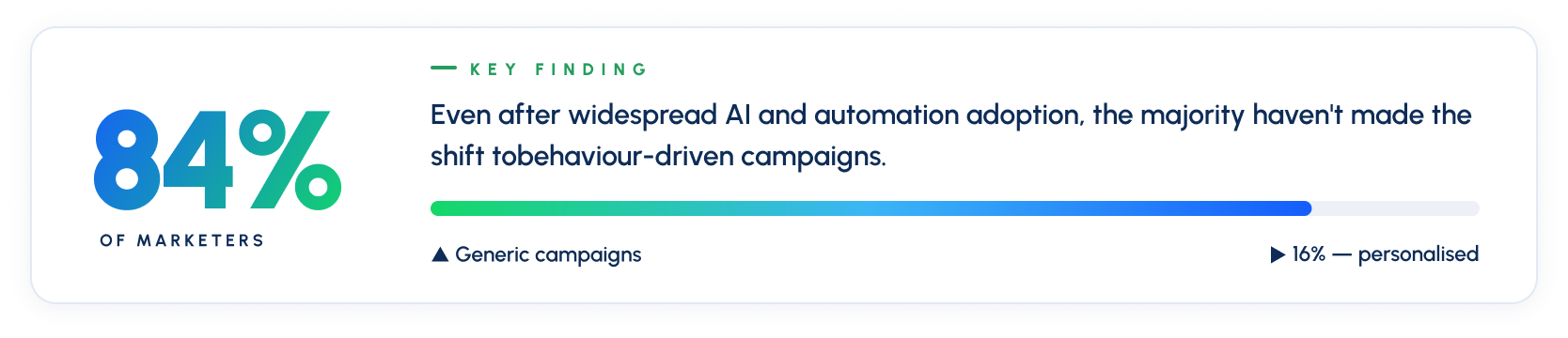
The least visible signal is also the most operationally costly: automation rules that break regularly. A rule that requires manual intervention to fix is a rule that was never built to handle the full range of conditions it would encounter. When rule maintenance becomes a routine part of the team's weekly workload, the platform is not running autonomously; it is being supervised.
Finally, if campaign approvals and pre-send QA are happening in email threads or shared documents rather than inside the platform, the workflow stops at draft. Everything after that is manual overhead that was never eliminated because it was never included in the platform setup to begin with.
Any one of these is a sign. If three or more are familiar, the platform is being significantly underused relative to what the license covers.
The Real Price of an Underused Platform
Marketing automation platforms are not inexpensive. Enterprise licenses typically run into six figures annually. When the platform is being used only for basic campaign sends and everything else is being handled manually the cost-per-feature-used is very high.
The license cost is fixed regardless of how many features are actually in use. A team using 20% of the platform's capabilities is paying for 100% of them. The manual hours spent on list uploads, reporting, QA, and workarounds add an operational cost on top of the license cost. And the campaigns that are not being run because the team does not have capacity after managing all the manual steps represent a revenue cost that does not show up in any budget line.
The total cost of an underused automation platform shows up in more places than the marketing budget reflects:
| Cost Type | Where It Shows Up |
|---|---|
| License waste | Paying for capabilities that are never used |
| Operational overhead | Hours spent on manual list uploads, QA, reporting, and workaround maintenance |
| Headcount cost | Team capacity consumed by manual process instead of campaign strategy |
| Campaign velocity loss | Slower launches mean fewer campaigns run per quarter |
| Missed revenue | Segments not reached, journeys not built, triggers not firing |
| Renewal risk | Platform value is invisible at renewal because nobody has measured what it is actually delivering |
None of these costs appear on a single line in a budget. That is why the problem persists, it is expensive in ways that are distributed across multiple budgets and never fully visible in one place.

Marketing automation is not a software implementation, it's a business transformation initiative. Technology is only one part of it.
The real value is created when customer data flows seamlessly across systems, business processes are redesigned for automation, and teams trust the platform enough to stop relying on manual workarounds.
When manual processes still dominate after go-live, the problem almost always sits in the implementation, not the platform.

Six Automation Fixes That Actually Remove Manual Work
Getting more value from an existing platform is not a technology problem. It is an implementation and operations problem. The platform already has the capabilities. What is missing is the work to connect them properly to how the team actually runs campaigns.
Most individual fixes do not hold because the sequencing is wrong. A campaign process cleanup built on disconnected data will not produce clean results. Team enablement without fixed workflows gives the team more capability to operate a broken process not a better one.
There are six areas where most automation implementations have gaps. Addressed in order, they progressively remove the manual work that has built up since go-live not by replacing the platform, but by finishing what was never completed.
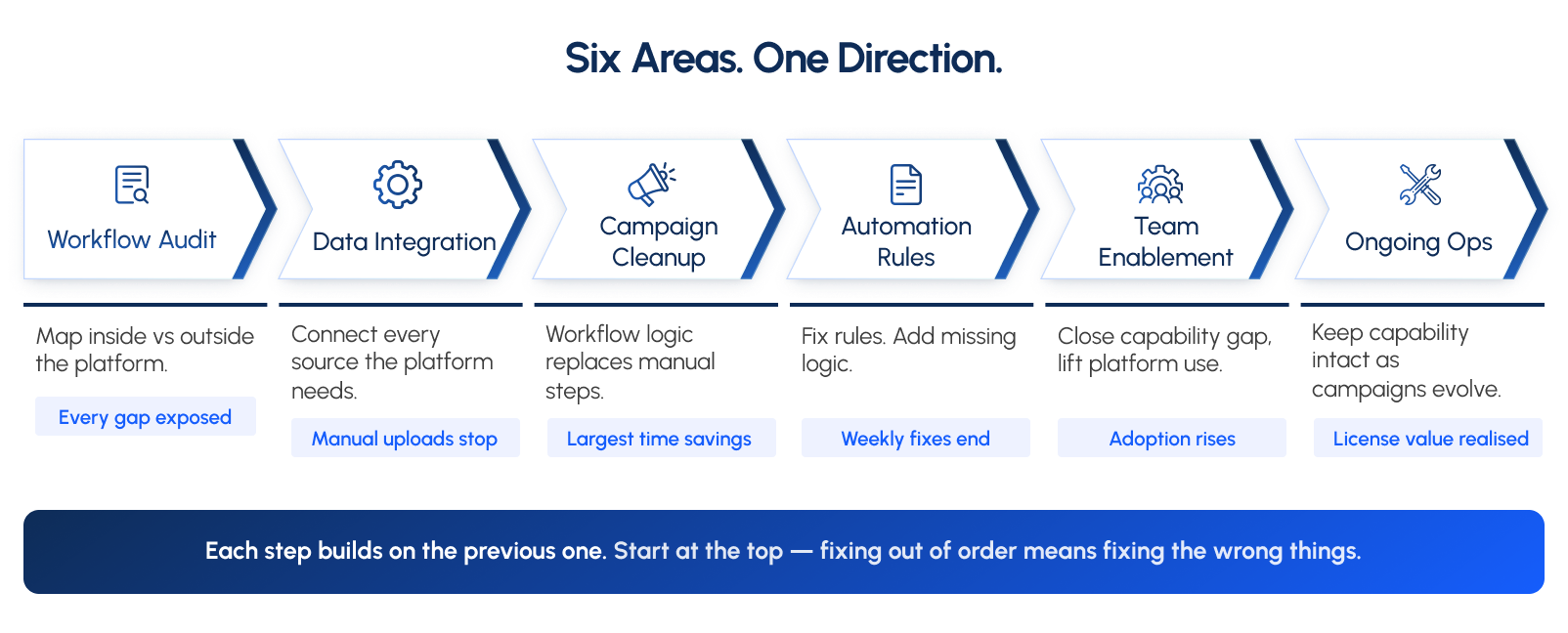
Most teams do not need to start all six at once. The workflow audit and data integration review almost always reveal where the highest-impact gaps are and in most cases, fixing two or three of the right things produces the majority of the improvement.
The sequencing matters more than the speed. A campaign process cleanup built on top of disconnected data will not hold. Team enablement without fixed workflows gives the team more capability to operate a broken process. The fixes compound when done in order. They cancel each other out when done at random.
What this sequence produces when followed is a platform that the team can actually use to its licensed capability. Not a new tool. Not a replacement. The same platform, finally working the way it was supposed to when the contract was signed.
Know your automation is underperforming. Not sure where to start? That is exactly what the audit is for.
What the Team Looks Like When the Platform Works
When all six areas are addressed, the operational picture changes in ways that are immediately visible. Campaigns that took two weeks to launch take two days. not in the platform, but in how the team operates. The tool does not change. The workflows, integrations, and logic built around it do. And that is what determines whether a marketing automation platform delivers on its promise or sits underused behind a growing list of manual workarounds.
The most immediate shifts:
- Campaigns that took two weeks to launch take two days
- Segments update dynamically instead of being rebuilt before every send
- Reports generate automatically instead of being compiled in spreadsheets
- Automation rules run without weekly supervision and manual fixes
- The team's time moves from managing the process to building on top of it
The broader change is harder to quantify but more significant. The platform stops being something the team works around and starts being something they work through.
The license cost that was being paid for capabilities nobody could access starts returning value. The manual overhead that was absorbing team capacity disappears and that capacity goes into campaigns that were never run because there was never bandwidth to build them.
The platform does not change. The implementation around it does. And that is where the value that was paid for at license renewal but never fully captured finally starts to land.
Making the Platform Worth What You Paid For It
We work with brands that already have a marketing automation platform in place but are not getting the value from it that the license cost warrants. The work is not about replacing the platform, it is about fixing the implementation gaps, connecting the data, rebuilding the workflows, and giving the team the capability to run campaigns without the manual steps that are currently slowing them down.
If the platform is live but the campaigns still feel manual, the issue is almost never the tool. It is what was built around it, and what was not.
When the Platform Is Live but the Work Is Still Manual
A leading Indian streaming platform had its marketing automation platform in place but was still running campaigns manually daily execution by hand, reports built from scratch every time, and campaign briefs tracked across email threads and spreadsheets.
The platform was not the problem. The implementation around it was.
That's how we stepped in and:
- Identified recurring campaigns and automated daily and weekly execution inside the platform
- Built a centralised tracking system replacing fragmented brief monitoring
- Created automated report templates eliminating the manual reporting cycle
The team stopped executing and started managing. Capacity that had been absorbed by repetitive manual work shifted to strategy and creative optimisation which is what the platform was always supposed to enable.
The Audit That Changes the Conversation
If your marketing automation platform is live but your campaigns still feel manual, start with an audit of what is actually being handled inside the platform and what is still being done outside it. The gap between those two lists is the implementation work that was never completed and it is where the value the license is supposed to deliver is currently being lost.
That audit is where every xerago engagement begins. Five days to diagnose what is broken, fix what matters most, and leave the team with a platform that finally works the way it was supposed to.
Your automation platform should be doing this work. If it is not, the Bootcamp finds out why and fixes it in five days.
Kaviarasu S
Associate Content Writer
Xtelligence Inbox.
Your weekly dose of marketing smarts!
Related Posts