Interactions Correctly?


Why Multichannel Messaging Fails & How Omnichannel Fixes It


Get Free Marketing Technology Stack Audit Checklist
Multichannel messaging fails because it is built around channel execution. Omnichannel fixes it by building around customer journey coordination.
Most marketing teams assume they are already doing omnichannel. They have email, SMS, push notifications, and in-app messaging all firing from the same platform, all pulling from the same customer data.
- A customer who just purchased receives a discount offer for the product they already bought.
- A customer who raised a support ticket the same morning gets a promotional broadcast that evening.
- A lapsed customer in a re-engagement flow simultaneously receives a post-purchase nurture sequence because another campaign triggered on a different eligibility rule.
Three channels, three different assumptions about where this customer is right now, all triggered from the same CRM, within hours of each other.
This is not a data problem. The CRM is accurate. The campaigns are valid. Every individual system did exactly what it was designed to do. The failure is structural: multichannel architecture was never designed to coordinate across channels at the moment of execution. And that design gap is the reason omnichannel exists.

The Core Difference: Multichannel Execution vs. Omnichannel Coordination
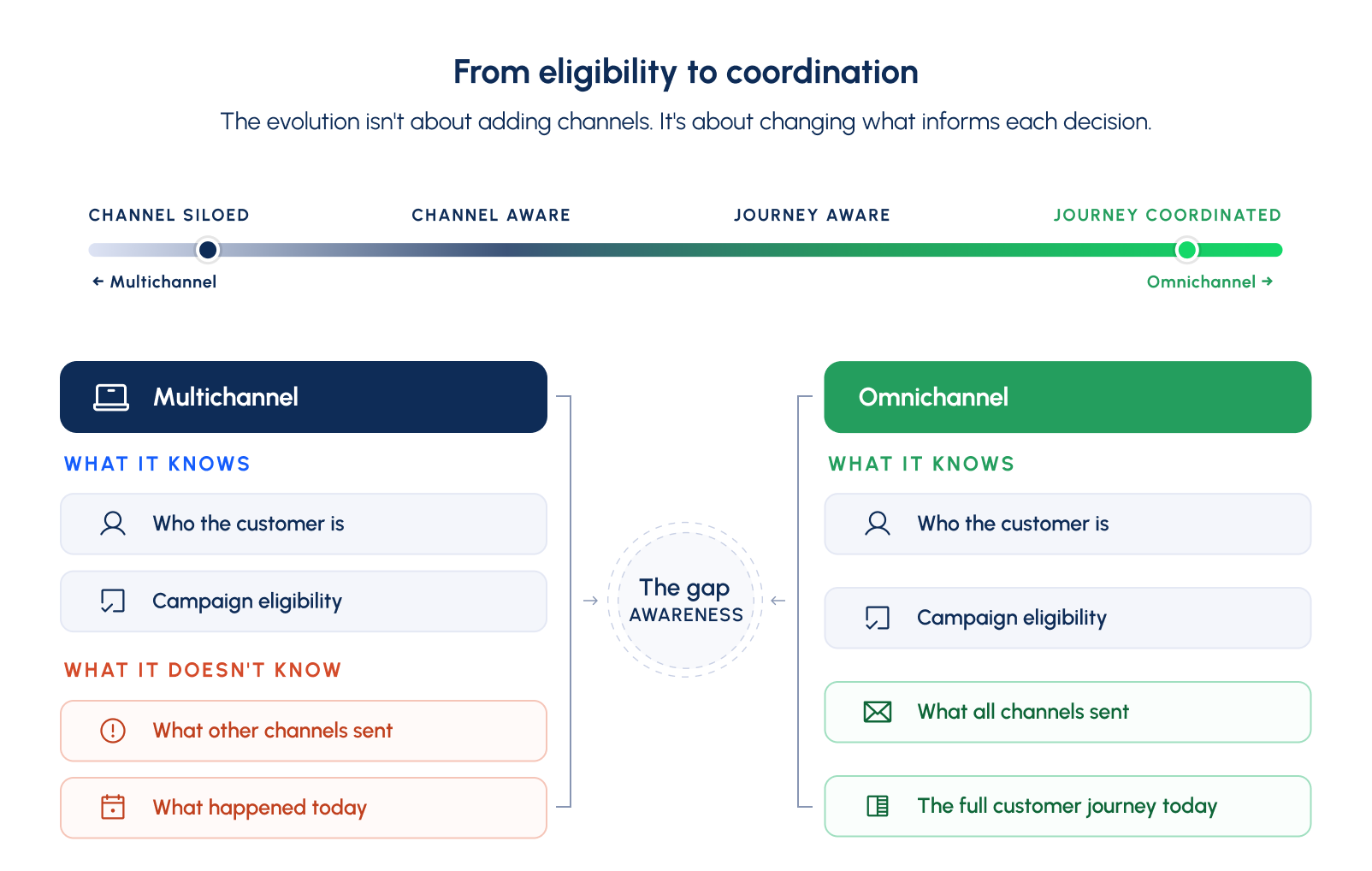
To understand why multichannel fails, you first need to understand what it was actually built to do. Multichannel marketing is, at its core, a channel execution model. Its job is to deliver campaigns efficiently across multiple touchpoints: email, SMS, push, in-app, direct mail. It coordinates within each channel. It does not coordinate between them.
Every channel in a multichannel stack evaluates customer eligibility from the same source, typically the CRM, and then triggers independently. Email decides whether to send. SMS decides whether to send.
Push decides whether to send. None of these decisions are informed by what the others have already done. They share a data source. They do not share awareness.
Omnichannel takes a fundamentally different approach. Rather than organising around channels, it organises around the customer journey. The question is not "is this customer eligible for this campaign?" but "given everything that has already happened to this customer today, across every channel, what is the right next action?" From eligibility-based execution to journey-aware coordination is what separates the two models.
Why Multichannel Messaging Breaks Down
The failure patterns in multichannel architectures are consistent and predictable. They emerge not from bad campaigns or dirty data, but from the structural absence of cross-channel coordination.
Frequency Without a Shared Ceiling
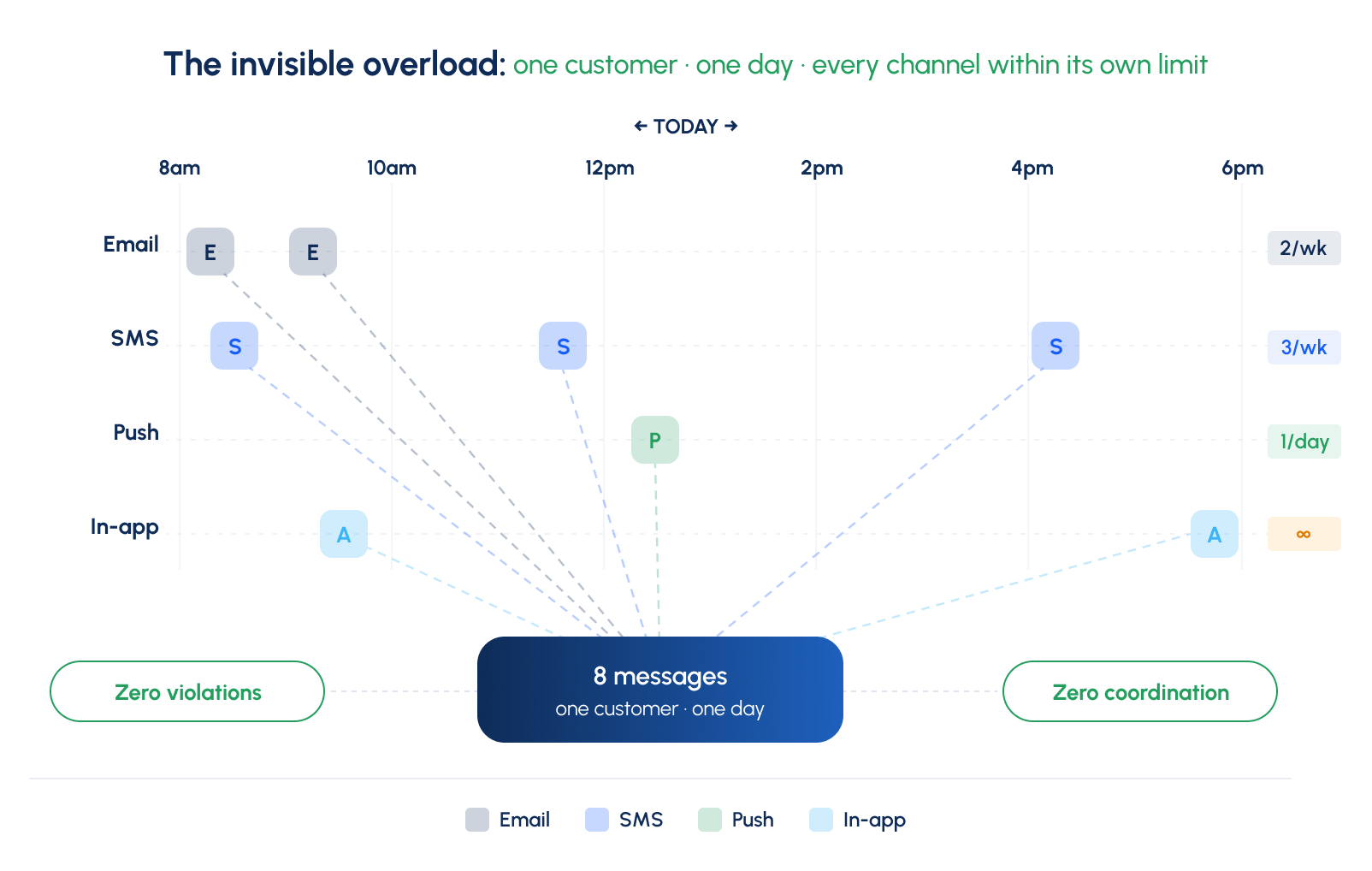
Each channel in a multichannel stack applies its own frequency cap. Email allows two sends per week. SMS has its own limit. Push has its own.
A customer can stay within every individual channel's threshold and still receive eight messages in a single day because no system is counting across all of them simultaneously. The problem is not that any one channel is over-sending. The problem is that no channel can see the combined load the customer is absorbing.
Opt-Outs That Don't Travel
A customer unsubscribes from email. The CRM reflects this, and email stops. But SMS has its own consent check. Push has its own. Unless the opt-out signal propagates instantly and universally across every channel, messages continue through systems that never received the signal. The CRM was updated.
The experience was still broken. This is one of the primary drivers of customer trust erosion in marketing communication, a customer has explicitly said stop, and the brand keeps going.
Campaigns That Don't Know About Each Other
A customer simultaneously qualifies for a re-engagement flow, a post-purchase nurture, and a promotional broadcast because all three evaluate eligibility from the same CRM data and trigger independently.
No campaign is aware that the others are running. The customer receives three messages that make three different assumptions about who they are and where they are in their relationship with the brand, sometimes within the same hour.
The Real Gap Between CRM and Channel Execution
The gap in multichannel architecture is not in the CRM, the channels, or the campaigns. It is in what sits between them at the moment a decision is made. Omnichannel architecture fills this gap by introducing a shared communication activity layer: a unified, real-time record of every message sent to every customer across every channel, queryable by all systems before they trigger the next action.
The distinction from CRM data is critical and often misunderstood:
CRM stores identity - who the customer is, their attributes, preferences, lifecycle stage, and consent status.
The activity layer stores behaviour - that has already been communicated, through which channel, at what time, and how the customer responded.
Three Capabilities Omnichannel Requires
Fixing the multichannel coordination problem is not a campaign management issue, and it is not solved by adding more suppression rules inside individual platforms. Platform-level rules improve execution within a single channel.
They cannot change what happens across channels, because those rules cannot see beyond the platform they live in. Genuine omnichannel coordination requires three structural capabilities.
1. A Unified Communication Record
Every outbound message across all channels needs to be logged at the customer level in a single place, in real time. Not a nightly report reconciled across platforms. A live record that every system can query before it decides whether to send. This is the foundation everything else depends on. Without it, no channel can make an informed decision about whether its message is appropriate given what has already been delivered today.
2. Cross-Channel Suppression Logic
Once visibility exists, frequency caps need to apply across all channels combined, not within each channel independently. State changes must propagate everywhere simultaneously.
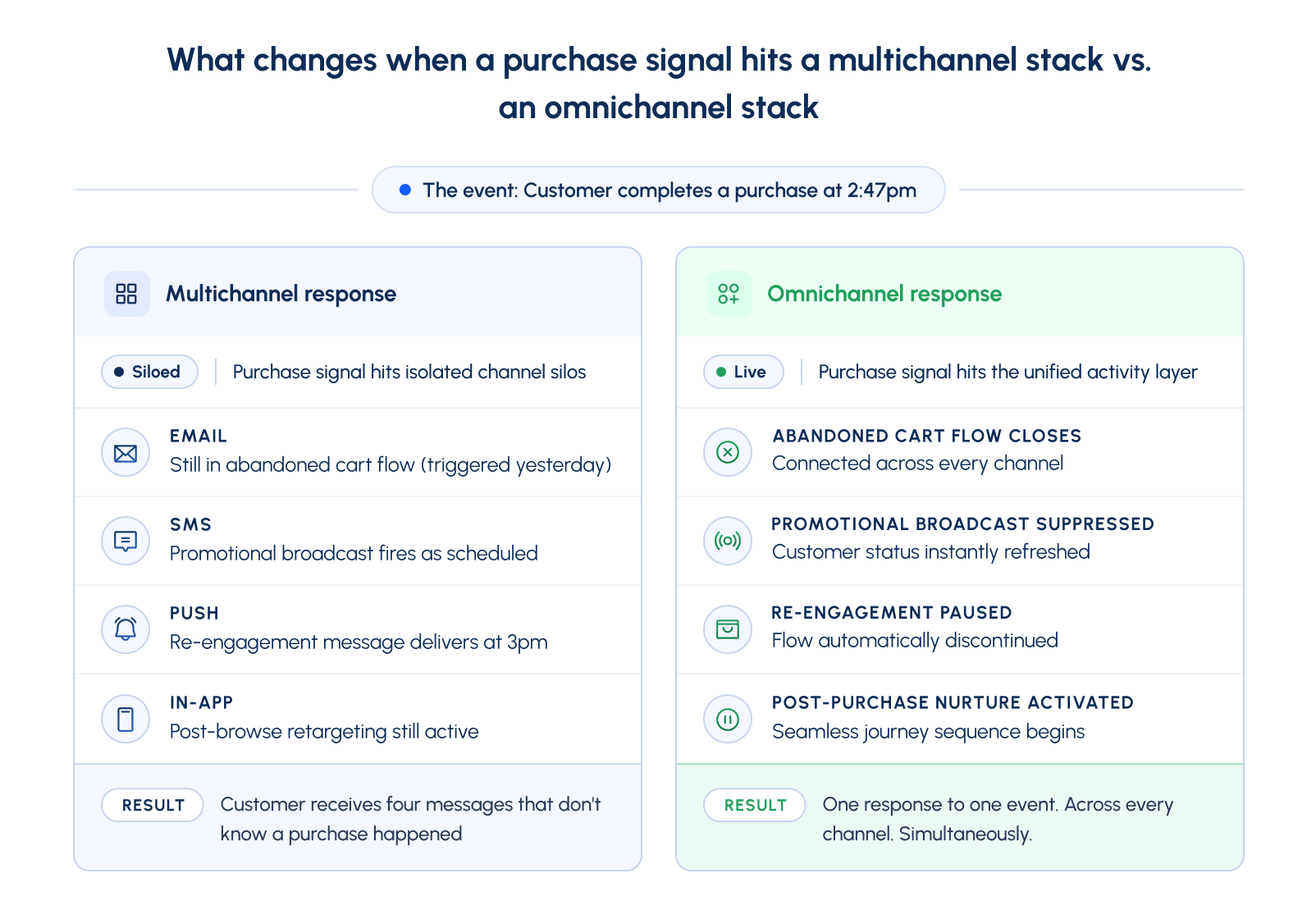
A purchase closes the abandoned cart flow across every channel, not just the one that tracked the conversion. A service ticket pauses promotional messaging across the board.
A high-value action triggers a response at the journey level, not in individual platform silos. These rules cannot live inside individual platforms because individual platforms can only see their own activity.
3. Journey Arbitration
When multiple campaigns are active for the same customer simultaneously, something needs to decide which one leads, which ones hold back, and in what sequence the customer should experience them.
Without arbitration, campaigns run in parallel on eligibility alone, and the customer absorbs the collision of all of them at once. Arbitration is what separates a stack that executes campaigns from one that manages an ongoing conversation with a customer across time.
Three Signs You're Still Running Multichannel, Not Omnichannel
Most teams believe their messaging is already coordinated because their campaigns are planned and their systems are integrated. But integration is not coordination. Integration means systems share data. Coordination means systems share awareness at the moment of execution. Here are three checks that reveal the difference quickly.
Check 1 - Unified message history. Can you pull up a single customer record and see every message sent to them across all channels in the last 72 hours, in one place, without assembling it from multiple reports? If not, your channels are making send decisions without full visibility into the customer's recent experience.
Check 2 - Cross-channel awareness before sending. When a message triggers in one channel, does it evaluate what has already been sent through every other channel? If SMS fires without checking whether email went out two hours ago, every channel is operating in isolation regardless of whether they pull from the same CRM.
Check 3 - Campaign interaction control. When two campaigns are simultaneously active for the same customer, is there a mechanism governing which one takes priority and when the other is sequenced? If both can trigger on the same day without awareness of each other, there is no shared state and no real coordination happening.
If all three checks fail, the CRM is clean, the campaigns are technically correct, the systems are connected and the messaging is still running in silos.
You don't need to build all three capabilities at once. Before scaling omnichannel experiences, build the one layer that gives you visibility into what’s working in as little as five days.
How to Shift From Multichannel to Omnichannel
Moving from multichannel to omnichannel is not a platform replacement and it does not require starting over. It is a sequenced capability build, where each step creates the foundation the next one requires.
Step 1: Make communication activity visible. Every message sent across all channels needs to be logged at the customer level in one place, in real time. This single change transforms what every channel can see before it acts. It is the missing piece in most stacks.
Step 2: Implement cross-channel suppression. Once visibility exists, frequency becomes a property of the customer relationship, not a cap applied independently inside each platform. State changes: a purchase, a support ticket, an opt-out as to propagate everywhere simultaneously. Every channel responds to the same signal at the same time.
Step 3: With suppression in place, introduce the rules that govern campaign priority and sequencing when multiple flows are active for the same customer. This is the step that moves your messaging from campaign execution to conversation management.
The CRM stays foundational throughout. Identity, consent, and segmentation do not change. What changes is what every channel can see at the moment it decides whether to send.
Multichannel messaging only asks: Is this customer eligible for this message?
Omnichannel asks a better question: Given everything this customer has experienced today, what is the right next action?
Without that layer, every channel acts on partial information. Campaigns collide. Customers absorb the collision. The experience breaks down not because the data was wrong, but because no system had the full picture at the moment it mattered.
The shift is not about doing more. It is about making better decisions with what you already have.
Are your channels sharing data or sharing awareness? There's a difference. And it shows up in every customer interaction. We build the coordination layer that closes the gap.
Kaviarasu S
Associate Content Writer
Xtelligence Inbox.
Your weekly dose of marketing smarts!
Related Posts