Interactions Correctly?


Why Your CDP Still Doesn't Stop Cross-Channel Campaign Conflicts


The problem isn't your data. It's the absence of anything deciding what to do with it.
Every organisation that has implemented a CDP has had the same conversation at some point. The platform is live. Profiles are unified. Every channel is reading from the same source of truth. And yet the customer still receives three messages before 9 AM that contradict each other. The email assumes they haven't purchased it. The push notification assumes the cart is still waiting. The SMS welcomes them back like they're a stranger.
The CDP did everything it was supposed to do. The Customer experience is still broken. This is not a data problem. It never was.
89% of marketers said they have challenges creating a single customer view, which is a core reason cross-channel campaigns become uncoordinated. URL:MarTech / Experian study
What a CDP Solves & What It Still Cannot Coordinate
The Customer Data Platform solved a real and significant problem. Before it existed, marketing teams were operating from fragmented, siloed data sets that disagreed with each other at a basic factual level.
The CRM had one version of the customer. The email platform had another. The loyalty system had a third. Decisions were being made on stale, incomplete, and contradictory information and customers felt that every time a brand treated them like a stranger despite years of relationship history.
The CDP fixed this. It became the unified record one profile, continuously updated, accessible to every downstream system. That is genuinely valuable infrastructure, and organisations that invested in it are right to defend it.
But a CDP stores state. It does not manage sequences.
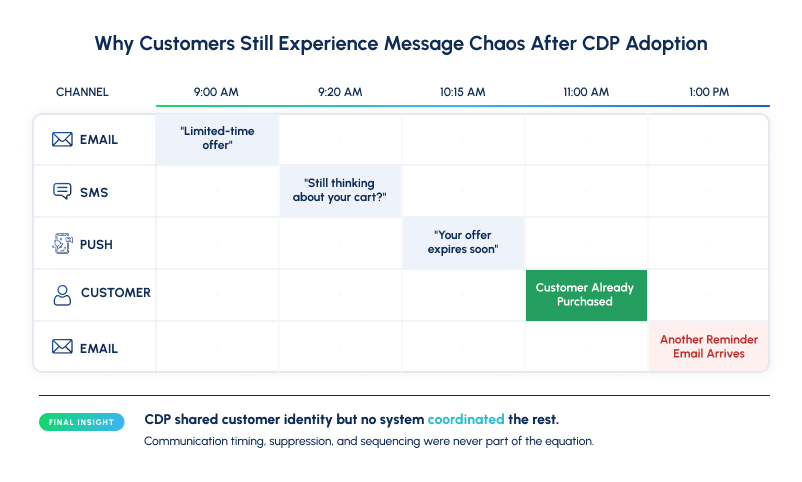
It can tell every channel who the customer is, what they have purchased, and when they last engaged. What it cannot do is tell Email to wait because SMS sent something twenty minutes ago. It cannot tell Push that a conversion already happened this morning. It cannot ask whether this is the right moment, the right channel, or the right message given everything else that has already been said to this person today.
Those are orchestration decisions. And orchestration is not what a CDP was designed to make.
Why Cross-Channel Conflicts Happen Even When the Data Is Right
Cross-channel-campaign conflicts do not happen because teams lack data. They happen because no system is responsible for the conversation.
Every channel in the average marketing stack has its own campaign logic, its own send triggers, its own suppression rules, and its own definition of what success looks like.
Email suppresses a contact after three sends in seven days but SMS has no awareness of that rule. Push fires on cart abandonment but does not check whether email already sent a recovery offer two hours earlier. Web personalisation serves a returning customer segment but does not know the customer just responded to an SMS and is mid-conversation with the brand.
Each channel is reading from the CDP correctly. Each channel is acting on accurate, unified data. And the combined experience is still incoherent because reading the same data is not the same as agreeing on what to do next.
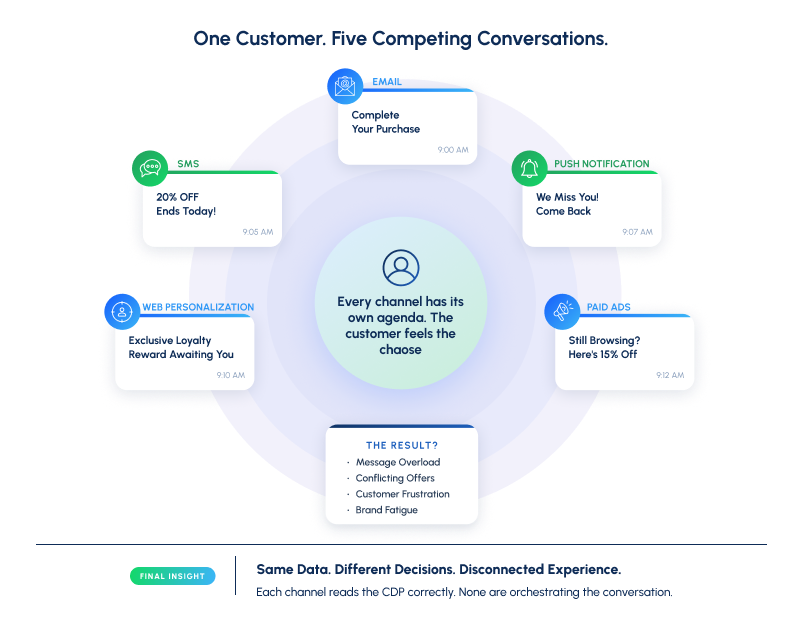
This is the gap the CDP was never designed to close. It is a data layer. It tells you who the customer is and what they have done. It does not govern how every channel should behave toward them at any given moment in real time. That requires a different layer entirely one most marketing stacks do not have.
Why Channel-Level Reporting Misses Cross-Channel Failure
What makes this particularly difficult to fix is that it is almost entirely invisible in standard reporting.
Each channel reports its own performance. Email shows open rates. SMS shows click-through. Push shows engagement. None of these reports surface what the customer experienced across all three simultaneously. The conflict happens in the gaps between channels and those gaps are not owned by any single team, tracked by any single dashboard, or visible in any standard metric.
CX issues are costly: 5% retention lift can raise profits by up to 95%, while acquiring a new customer can cost 5 to 25 times more than keeping an existing one. Source: OnRamp
This is why organisations with sophisticated, well-funded MarTech stacks continue to have this problem years after CDP implementation. The measurement does not reflect the experience. Teams see green dashboards and assume the customer experience is healthy. The customer, meanwhile, is absorbing a fragmented, contradictory sequence of messages and quietly recalibrating their expectations of the brand downward.
No alert fires for that. It surfaces three quarters later in a retention curve that nobody can explain by which point the damage is systemic, not episodic.
The Missing Layer Is Cross-Channel Decisioning
Orchestration is the logic that sits above the channels and governs the conversation. Not the data about the customer, the rules that determine which channel speaks next, when it speaks, what it says, and what every other channel should do while it is speaking.
When orchestration is absent, campaigns conflict because there is nothing stopping them from conflicting. Every channel operates on its own schedule, with its own triggers, optimising for its own outcomes. The CDP ensures they are all looking at the same customer. Orchestration ensures they are all part of the same conversation.
The difficult part is not knowing that Email, SMS, Push, Web, and Ads can all reach the customer. It is deciding which one should act now, which ones should wait, and which ones should be suppressed entirely based on the customer's current state and recent interaction history.
In practice, an orchestration layer does several things that a CDP cannot:
- It manages global suppression. If a customer has already been contacted multiple times today, every channel knows it, not just the one that sent the last message.
- It enforces journey sequencing. When a customer converts, every channel updates immediately. The cart reminder stops, the win-back email is cancelled, and onboarding begins.
- It governs channel priority. When multiple channels can reach the customer at once, orchestration decides which one should lead based on preference, context, timing, and historical performance.
- It creates a shared conversation layer. Every inbound and outbound interaction across Email, SMS, Push, Web, and Ads is written to a unified real-time timeline that all channels can reference simultaneously.
- It coordinates behavior, not just data. A CDP tells systems who the customer is. Orchestration tells every channel how to behave toward that customer in the current moment.
None of this is the CDP's job. The CDP provides the data that makes orchestration possible. Orchestration is what decides what to do with it.
When the Channels Finally Stopped Contradicting Each Other
A financial services provider serving over 100 million customers across insurance, investments, and loans had every major channel in operation email, SMS, digital, and direct. Each was performing. None were coordinated.
We have implemented a centralized orchestration layer that governed execution across all channels simultaneously with sequencing customer lifecycle stages, managing cross-channel suppression, and ensuring no channel acted in isolation.
The impact was measurable and immediate.
- 35% increase in campaign response rates
- 18% improvement in offer uptake
- 20% reduction in campaign deployment time
- 15% lift in multi-channel engagement
The underlying data did not change. The channel mix did not change. What changed was the decision layer above them and with it, the coherence of the customer experience.
Why Unified Customer Data Is Often Mistaken for Orchestration
The reason this problem persists is partly structural and partly a consequence of how MarTech is bought and evaluated.
Tools are purchased with business cases. A CDP strategy has a clear, measurable value proposition unified profiles, reduced data silos, better segmentation.
The business case writes itself. Orchestration is harder to justify in advance because its value is defined by what it prevents rather than what it produces. You cannot easily quantify the revenue impact of a customer who did not receive a contradictory message and therefore did not quietly disengage.
So organisations continue to invest in the layer they can measure and defer the layer they cannot until the retention problem becomes impossible to ignore.
The False Equivalence Comparison as Second Most Useful
A two-column contrast:
| What Organizations Buy | What They Actually Need |
|---|---|
| CDP - unified profiles | Orchestration - coordinated execution |
| Journey builder in single channel | Cross-channel arbitration |
| Measurable value upfront | Value defined by what it prevents |
There is also a category confusion problem. Orchestration features exist inside many marketing platforms: journey builders, automation workflows, campaign schedulers. But these tools typically orchestrate within a single channel or a single platform, not across the entire stack. An email platform's journey builder is excellent at sequencing emails.
It has no visibility into what SMS was sent this morning. Calling this orchestration is technically accurate and practically misleading it gives organisations the impression the problem is solved when the cross-channel coordination gap remains entirely open.
What It Takes to Coordinate Campaigns Across Channels
The fix is not replacing the CDP. The fix is building the orchestration layer on top of it the decision layer that the CDP was never designed to be. Here is what that actually involves, in sequence.
Step 1: Appoint a Conversation Owner
Before any technology decision, answer the organisational question that makes orchestration possible: who owns the customer conversation end to end?
Not the data. Not the channel. The conversation of the full sequence of interactions a customer experiences across every touchpoint, in real time. In most organisations this role does not exist. Email owns email. SMS owns SMS. CRM owns the profile. Nobody owns what the customer experiences when all three speak simultaneously.
This owner, whether it is a Head of CX, a Marketing Operations lead, or a dedicated orchestration function needs authority over cross-channel suppression rules, message sequencing logic, and the governance model that determines which channel leads at any given moment. Without this role, technology alone cannot solve the problem. Every team will continue optimising for its own channel, and the coordination gap will persist regardless of what sits in the stack.
Step 2: Find Where Campaigns Are Overlapping, Conflicting, or Ignoring Suppression
Before building anything, map what is actually happening across your channels today.
Run a cross-channel message audit for a sample of 500 to 1000 customers over a 30-day window. For each customer, reconstruct the full sequence of messages they received: an email, SMS, push, web personalisation, paid retargeting in chronological order. Look for:
Overlap events: the same customer contacted by two or more channels within a short window (under 2 hours is a useful threshold to start with)
Contradiction events: messages that make conflicting assumptions about customer state as a win-back email sent after a purchase, a cart abandonment push sent after a support ticket was raised
Sequencing failures: A promotional message sent while a transactional or service thread is still open
Suppression gaps: Contacts who should have been excluded based on one channel's rules but were not excluded by others
This audit produces two things: a quantified picture of how often coordination is failing today, and a prioritised list of the specific failure patterns to address first. Start with the highest-frequency, highest-impact failures, not the most technically complex ones.
Step 3: Create One Suppression Framework Across Every Channel
The fastest and most impactful first fix is almost always suppression of the rules that determine when a customer should not be contacted, applied globally across every channel, not just within individual platform silos.
There is no single industry-standard suppression model that every marketing platform follows. Platforms implement frequency caps, journey exclusions, consent logic, customer-state rules, and audience suppression differently. That is why enterprise suppression cannot be left entirely inside individual tools: the organisation needs one governance model that every channel follows before a message is sent.
A global suppression framework has three layers:
Frequency caps - the maximum number of times a customer can be contacted across all channels within a defined window. Start with a combined daily and weekly cap. Seven contacts in a day from four different channels is not marketing. It is noise, and it erodes trust faster than almost any other failure mode.
State-based suppression - rules that pause or stop messaging based on customer state changes. A customer who just purchased should exit all win-back and cart abandonment flows across every channel simultaneously, not just the one that tracked the conversion. A customer who raised a support ticket should be suppressed from promotional messaging until the ticket is resolved. A customer who just received a transactional message, a shipping notification, or a payment confirmation should have a cooling-off window before the next promotional contact.
A common conflict appears between triggered and scheduled campaigns. A customer may convert overnight through a triggered journey but still remain inside a promotional audience prepared the day before. Without state-based suppression at the orchestration layer, the scheduled campaign can still reach them the next morning. Both campaigns worked correctly in isolation; the failure happened between them.
Preference-based suppression - rules built from observed channel behaviour. A customer who consistently ignores push notifications but opens every email is telling you something. Build suppression logic that reflects actual engagement patterns, not assumed ones.
This framework lives in the orchestration layer, not in any individual channel platform. Every channel reads from it before sending — not after.
Step 4: Make Customer-State Changes Visible to Every Channel
The technical foundation of orchestration is a centralized event bus, a system that every channel writes to and reads from in real time, so that any state change anywhere in the stack is immediately visible everywhere else.
When a customer purchases, that event is written to the bus. Every channel subscribed to that event email, SMS, push, web personalisation receives it simultaneously and updates its behaviour accordingly. When a customer opens a support ticket, that event is written to the bus. When a customer opts out of SMS, that event is written to the bus and every other channel acknowledges it.
And the event stream cannot stop at digital behaviour. A branch visit, call-centre interaction, offline purchase, sales conversation, or support resolution may materially change what the next marketing action should be. If those events remain outside the orchestration layer, the digital stack continues acting on an incomplete customer state.
Without an event bus, channels operate on delayed, batched data. Email syncs to the CDP overnight. Push reads from a segment that was last refreshed six hours ago. The customer experiences the lag as contradictory behaviour because the channels are literally working from different snapshots of reality at different points in time.
The event bus eliminates this. It creates a single, live conversation thread, a real-time record of what has happened, what has been sent, and what the customer's current state is that every channel can read from and write to at any moment.
If you are already operating a CDP like Segment, mParticle, or Tealium, the event infrastructure may partially exist. The question is whether it is being used for downstream orchestration decisions or only for profile updates. Most organisations use it for the latter. Orchestration requires the former.
Step 5: Decide Which Channel Acts, Waits, or Gets Suppressed
Once suppression is in place and the event bus is live, the next layer is arbitration, the logic that determines which channel leads when multiple channels could legitimately reach a customer at the same moment.
Arbitration answers three questions:
Which channel should send this message? Not based on which team owns the campaign, but based on where this specific customer is most likely to engage, what their recent channel behaviour suggests, and what cadence they have already experienced from other channels today.
When should it send? Not based on campaign scheduling, but based on the customer's own behavioural patterns. Send time optimization within a single channel is common. Coordinated send time logic across channels ensures that the optimal send times for email and SMS do not overlap and create a burst of simultaneous contacts is rare but straightforward to implement once the event bus is in place.
What should it say? The message content should reflect the customer's full conversation state, not just what the sending channel knows. A push notification sent two hours after an email should acknowledge the email context, not repeat the same message verbatim, and not make a contradictory assumption about whether the customer has seen the offer.
Arbitration logic can start simple a set of business rules and evolve toward model-based decisioning as you accumulate cross-channel interaction data. The important thing is that it exists at all. Most marketing stacks have no arbitration layer. Every channel sends when it decides to send, based only on what it can see.
Step 6: Measure Cross-Channel Experience, Not Individual Campaigns
Finally, build the measurement layer that makes coordination failure visible before it becomes a retention problem.
Most analytics infrastructure measures channel performance. What is needed additionally is experience performance metrics that reflect what the customer experienced across channels, not what any single channel produced.
The specific metrics to instrument:
Cross-channel contact frequency - the average number of times a customer is contacted per day and per week across all channels combined. Track this as a distribution, not just an average. The tail customers receiving ten or more contacts in a week is where the damage concentrates.
State contradiction rate - the percentage of messages sent that contradict a known customer state change. A purchase happened; a win-back email was still sent. A support ticket is open; a promotional SMS was still sent. This number should be as close to zero as possible. If it is not close to zero, suppression is not working.
Suppression rate and reason - the number and percentage of potential communications prevented by the orchestration layer, broken down by reason such as frequency cap, recent conversion, active service interaction, journey conflict, consent state, or channel preference. A mature orchestration setup should explain not only what was sent, but what was deliberately not sent and why.
Cross-channel sequence coherence - a measure of whether the sequence of messages a customer receives across channels tells a coherent story. This is harder to automate and may require periodic manual sampling, but it is the closest proxy for what the customer actually experiences.
Silent disengagement rate - the percentage of customers who have stopped responding across all channels without opting out or unsubscribing. This is the earliest signal of trust erosion. Track it at the cohort level and correlate it with contact frequency and contradiction rate to understand what is driving it.
These metrics do not exist in any individual channel dashboard. They have to be built typically by pulling cross-channel interaction data into a central analytics layer and building the views that no single platform produces by default. It is an investment. But it is the only way to make coordination failure visible before it compounds into something irreversible.
How to Roll Out Cross-Channel Orchestration in Practice
For most organisations, the realistic sequencing looks like this:
Month 1: Conversation owner appointed. Cross-channel audit completed. Highest-impact failure patterns identified. Global suppression framework defined and implemented.
Month 2: Event bus validated or built. State-based suppression rules live across all channels. Cross-channel contact frequency metric instrumented and visible.
Month 3: Journey arbitration logic lives for the highest-volume customer journeys. Message content coordination reviewed and updated. Experience metrics dashboard operational.
Quarter 2 and beyond: Arbitration logic extended to cover the full customer journey. Model-based decisioning introduced where data volume supports it. Suppression rules refined based on observed impact on engagement and retention.
This is not a six-week project. But the first suppression rules can be live in days, and the impact on customer experience is visible almost immediately. The goal of the first 30 days is not to build the complete orchestration layer, it is to stop the most damaging coordination failures that are happening right now, while the longer-term architecture takes shape.
Fix the Cross-Channel Conflict, Xerago offers a 5-day Bootcamp to solve one critical campaign coordination problem across channels.
What Changes When Every Channel Follows the Same Decision Logic
Your CDP is not failing. It is doing exactly what it was built to do: store, unify, and surface customer data. The campaign conflicts are not a symptom of bad data. They are a symptom of absent orchestration.
The data layer and the decision layer are two different problems. Most organisations have invested heavily in the first and almost nothing in the second. More channels will not close this gap. Better creativity will not close this gap. A more sophisticated CDP will not close this gap.
An orchestration layer will be one that reads from the CDP, sits above every channel, and governs the conversation the customer actually experiences.
That is the gap between a marketing stack that looks good on paper and a customer experience that actually holds. And that is precisely what xerago is built to close not on top of your existing infrastructure, but inside it, coordinating what you already have into a single, coherent conversation.
Cross-channel coordination is exactly the kind of problem that looks complex from the outside but has a clear, addressable root cause once someone examines the full picture. The suppression gaps, the sequencing failures, the missing arbitration logic these are identifiable, fixable, and measurable. They do not require a platform replacement or a year-long transformation programme.
They require the right diagnosis and a focused sprint to resolve them.
Xerago's Bootcamp is built for exactly this. One complex problem. Five days. A working solution not a deck, not a recommendation, not a roadmap. If cross-channel campaign conflicts are costing you retention and you want to know precisely where the coordination is breaking down and what it will take to fix it, this is where that work gets done.
Cross-Channel Campaigns Working Against Each Other?
Xerago offers Bootcamp designed to solve one critical campaign challenge in 5 days.
Kaviarasu S
Associate Content Writer
Xtelligence Inbox.
Your weekly dose of marketing smarts!
Related Posts