Interactions Correctly?


AEM Has AI and Agents. Is Your Content Metadata Ready for Them?


Not Sure Where to Start With AEM Agents?
Adobe Experience Manager is moving beyond traditional digital asset management.
With agentic capabilities becoming part of AEM Assets, you can increasingly use AI to discover content conversationally, classify and tag assets, recommend relevant content, enforce governance rules, identify duplicates or expired assets, and support content reuse across workflows.
Adobe now positions Experience Manager Assets as an agentic DAM, with capabilities such as Content Advisor Agent helping you discover relevant assets using conversational search.
That creates an obvious opportunity for your business. But it also raises a less obvious question:
Is your content operation giving those agents enough context to make useful decisions?
Having access to AI and agents does not automatically make your content operation intelligent.
An agent may be capable of finding an asset, recommending content or flagging something for governance. But to do that reliably in your business, it needs to understand more than what is visually or semantically inside an asset.
It needs to know what the asset represents, who can use it, where it can be used, whether it is approved, whether its rights are still valid and whether another version has replaced it.
Much of that context comes from metadata.
This means your conversation about AEM agents should not begin only with what the technology can do. We are going to explore much more about this below.
What Is an AEM Agent?
AEM agents represent Adobe's move toward using AI to perform and assist with tasks across content operations rather than requiring users to manually navigate every DAM process.
Instead of relying only on traditional searches, filters, folders and manual workflows, agentic capabilities can help users interact with content through intent.
A marketer might ask:
"Find approved images from our latest Singapore credit card campaign."
A content team might need:
"Show me assets related to this product that can still be reused."
A DAM owner might want to identify:
"Which assets are approaching expiration?"
The value of an agent is therefore not simply that it generates something.
Its value comes from being able to understand a task, interpret available content context and help move the workflow forward.
This is particularly relevant in AEM Assets, where enterprise DAM operations often involve large numbers of assets, markets, campaigns, brands, rights restrictions and approval states.
AEM agents not as isolated AI features, but as capabilities designed to support different stages of the content lifecycle.
From bringing assets into the DAM and enriching them with metadata to discovering, governing, reusing, adapting and activating content, agents can reduce manual effort across multiple points in the lifecycle.
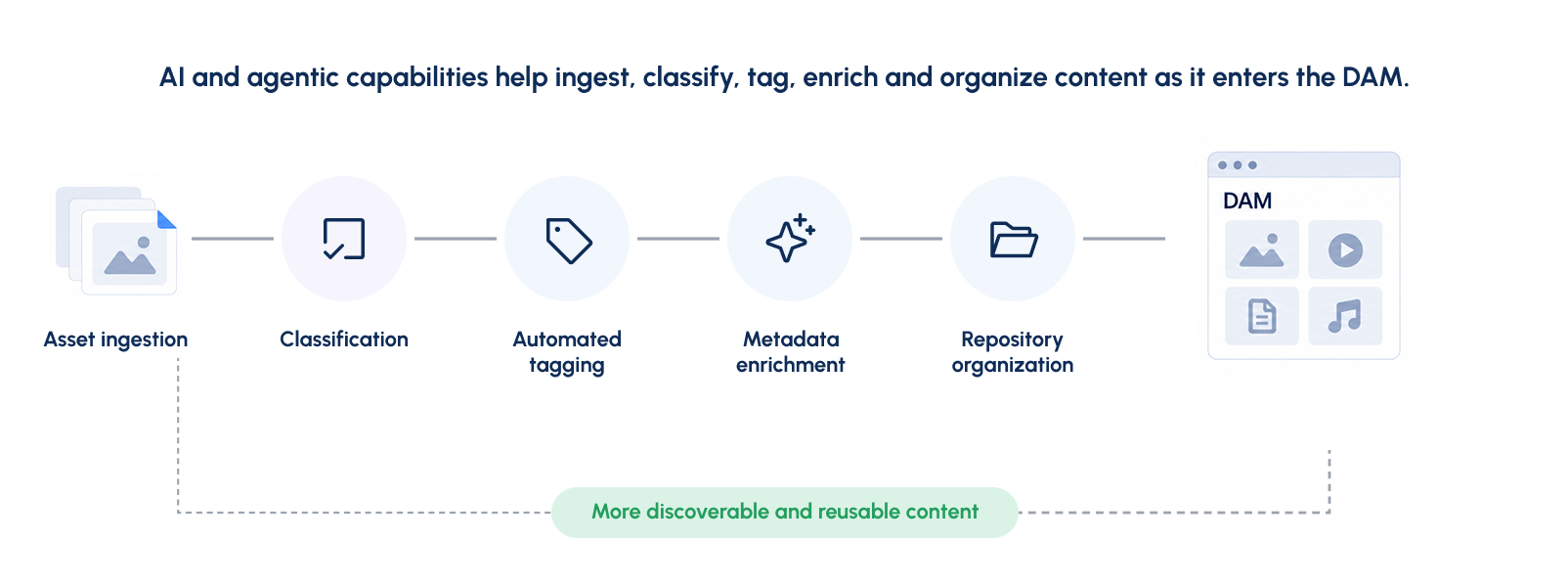
This can reduce the manual work required to make new content discoverable and usable.
The Content Operations Problem AEM Agents Run Into
The friction AEM agents are expected to reduce is already familiar across enterprise content operations.
- Teams can't find approved assets, even when those assets already exist
- Content gets duplicated or recreated because the original wasn't discoverable
- Rights and expiration information is difficult to verify at the point of use
- Metadata is missing, inconsistent, or applied differently across teams
- Content approval and reuse still depend on manual checks
- Content sits unused across disconnected repositories
These may look like separate operational issues, but they expose the same underlying problem: the content environment often lacks the structured context needed to make reliable decisions.
AEM agents can help automate many of these tasks. They can assist with classification, discovery, recommendations, governance and reuse. But automation does not remove the need for the rules behind those activities.
An agent that classifies content still needs a schema to classify against. An agent that checks rights still needs rights data it can read. An agent that recommends approved content still needs a clear definition of what "approved" means.
Why Your Enterprise May Not Be Ready to Adopt AEM Agents Yet
Many organisations already have DAM repositories containing years of accumulated content. The challenge is that content may not always have been structured with agentic workflows in mind.
An organisation may have the following issues across its content environment:
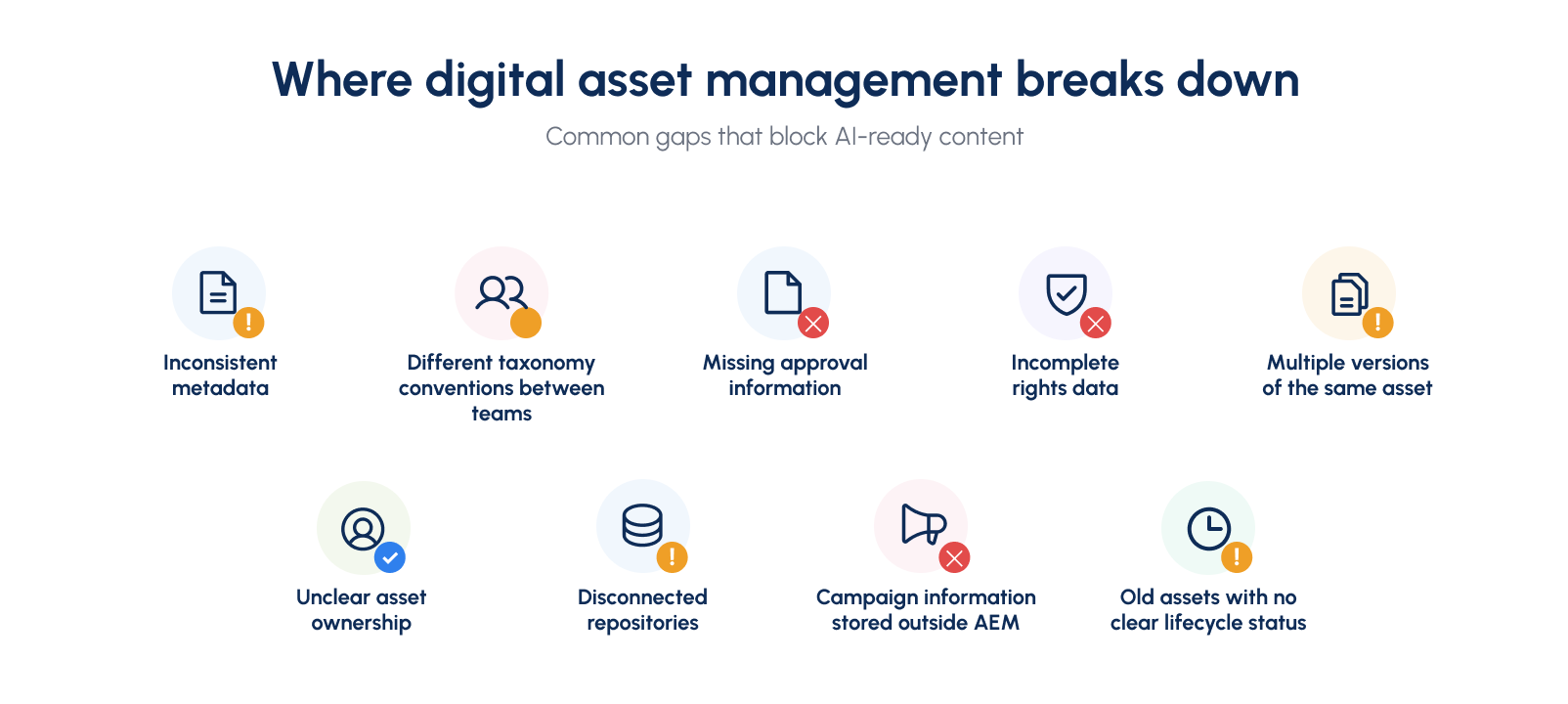
Humans often compensate for these gaps.
An experienced marketer may know which folder contains the latest campaign.
A DAM manager may know which version should be used.
A regional team may know that an image approved globally cannot actually be used in its market.
An agent does not automatically inherit that institutional knowledge. It needs that context to be represented somewhere. That is why metadata becomes more important as AEM becomes more intelligent.
Agents Do Not Just Need Content. They Need Context About Content.
Consider this request:
"Find the latest approved credit card campaign assets for Singapore."
There are several decisions hidden inside one sentence.
| Request | Context the agent may need |
|---|---|
| Credit card | Product metadata |
| Campaign | Campaign classification |
| Singapore | Market metadata |
| Approved | Approval status |
| Latest | Version/revision information |
| Assets | Asset type |
| Available for use | Rights and expiration |
Without this context, an agent may still find content.
But finding something and finding something that the enterprise can confidently use are different outcomes. This is the readiness gap enterprises need to address.
Why Metadata Becomes Critical for AEM Agents
Metadata has traditionally been treated as part of DAM administration. It helps teams organise repositories, search for content and maintain assets.
With agents, its role expands.
Metadata becomes part of the operational context that helps AI determine not just what an asset is, but also how the enterprise expects that asset to be used.
| Metadata | What it helps the agent understand |
|---|---|
| Asset type and topic | What the content is |
| Product | What offering it relates to |
| Campaign | Why it was created |
| Audience | Who it is intended for |
| Channel | Where it can be used |
| Market / region | Where it applies |
| Language | Localization requirements |
| Approval status | Whether it can be used |
| Rights / expiration | Whether it can still be used |
| Brand | Which brand rules apply |
| Owner | Who is accountable |
| Version / revision date | Whether it is current |
| Performance | Whether previous use was effective |
The more decisions you expect an AEM agent to support, the more reliable the surrounding content context needs to become.
But AI Can Create Metadata. Why Do Enterprises Still Need to Prepare It?
AI can absolutely reduce the metadata burden.
AEM capabilities can help with tasks such as:
- Automatic tagging
- Classification
- Metadata enrichment
- Content understanding
- Similarity detection
So the answer is not to manually tag every possible characteristic of every asset before enabling agents. But AI-generated metadata and enterprise-defined context are not the same thing.
AI may recognise that an image contains:
Family → Car → City → Lifestyle
But your business may need to understand it as:
Auto Finance → Acquisition → UAE → Paid Social → Approved
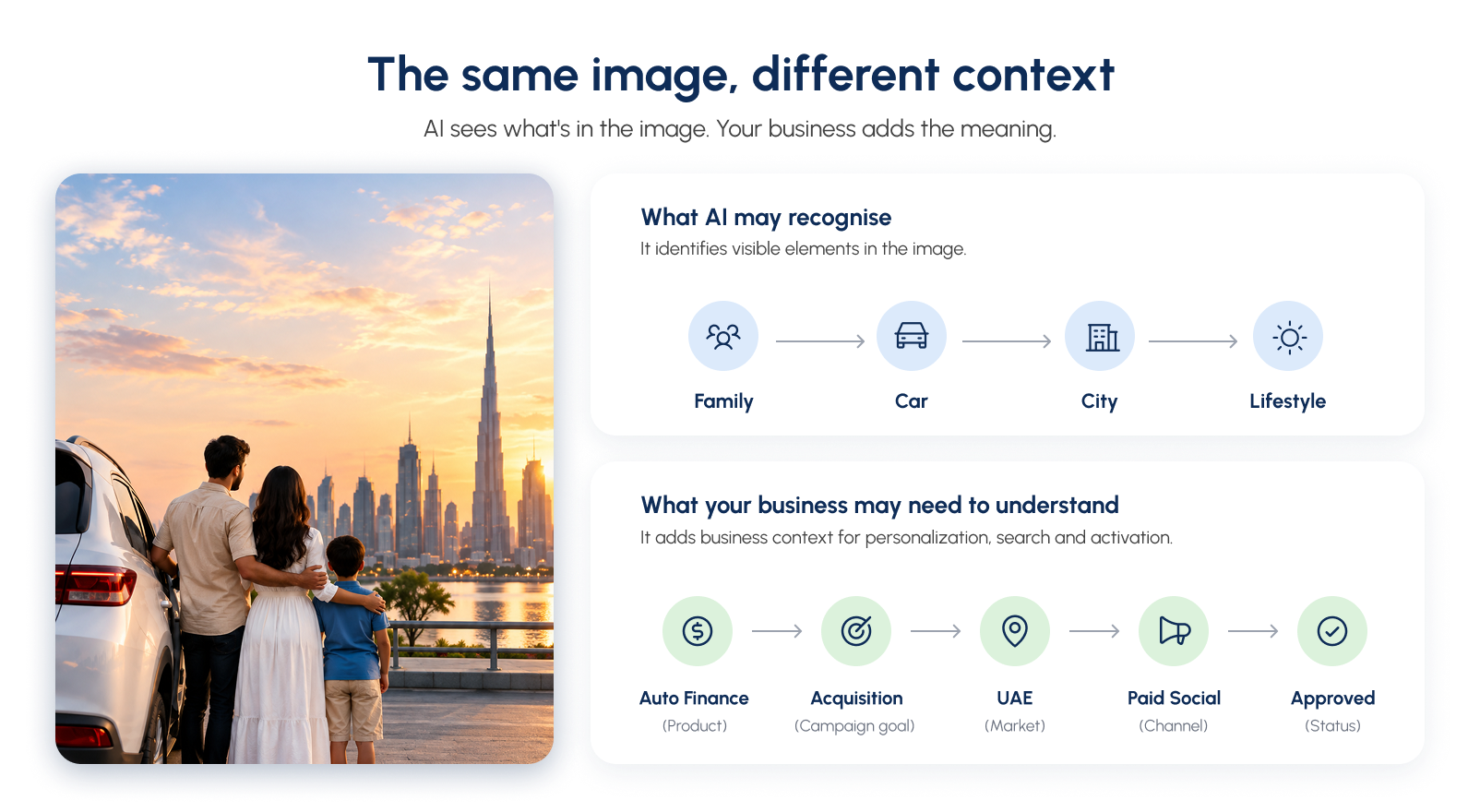
AI can help create the first layer, but the organisation still has to define the business context behind it.
For example, the organisation needs a common taxonomy so that "SME," "Small Business," and "Business Banking" are not treated as unrelated classifications when they refer to the same business area. It needs to define the minimum metadata required for each asset type, such as product, campaign, market, language, audience, channel, and approval status.
The same applies to governance. An asset should have a clear lifecycle status that distinguishes a draft from an approved asset, an active asset from an expired one, and a current master from an older version. Approval also needs an identifiable owner, rather than relying on teams knowing informally who signed off the content.
Rights information needs a similar structure. If an image is licensed only for Singapore until December 2026, the territory, usage restrictions, and expiration date need to exist as usable content data rather than being buried in an email, spreadsheet, or contract.
Reuse also needs defined boundaries. A global campaign asset might be reusable across several markets, while a locally licensed image, regulated product claim, or market-specific disclaimer may not be. The organisation needs to establish those rules so the agent can distinguish between content that is technically available and content that is actually appropriate to use.
This is why AI does not remove metadata governance. AI can understand and enrich content, but the organisation still has to define what that content means, who can use it, where it can be used, and which rules govern it.
How to Audit Your Content & Metadata Before Adopting AEM Agents
The goal of an audit is not to make every asset in the DAM perfect. It is to understand whether the content involved in a specific agent workflow has enough reliable context for the agent to work with.
Consider a common use case: a marketer wants to find the latest approved campaign assets for a Singapore credit card campaign. Use that workflow to test whether your content operation is actually ready.
1. Check Whether the Agent Can Find the Right Content
Start by looking at where the campaign assets actually live. You may find that the final banner is in AEM Assets, the product images are in another repository, the latest video is on a shared drive, and some regional variations are still sitting with an agency.
For an agent expected to find and recommend campaign assets, this fragmented content environment immediately limits what it can see. The first audit therefore establishes which repositories contain the relevant content, which are connected to AEM, and which source should be treated as authoritative.
2. Check Whether the Metadata Gives the Agent Enough Context
Take a sample of assets from that campaign and inspect the metadata.
For example, an approved Singapore credit card banner might need:
- Product: Credit Card
- Campaign: Travel Campaign 2026
- Market: Singapore
- Channel: Paid Social
- Language: English
- Approval Status: Approved
- Rights Expiry: 31 December 2026
- Version: Final v3
- Owner: Cards Marketing
Now compare this with what actually exists in the DAM. One asset may contain the product and campaign but no approval status. Another may say "SG" while another says "Singapore." Older assets may have no expiry information at all.
This is the kind of inconsistency that matters to an agent. The audit should identify whether the metadata required for the specific decisions the agent will make is present and consistent.
3. Check Whether Your Taxonomy Means the Same Thing Across Teams
Metadata can be populated and still be unreliable.
For example, one team may classify the same business area as "SME," another as "Small Business," and another as "Business Banking." Similarly, Singapore might appear as "SG," "Singapore," or "SEA-SG."
A person familiar with the organisation may understand that these values are related. An agent should not have to depend on that assumption.
The audit therefore needs to identify conflicting terms and establish the approved taxonomy the agent should work against.
Need help auditing your content operations before adopting AEM agents? Xerago can support you from assessment through pilot.
4. Check Whether the Agent Can Distinguish Usable Content From Available Content
Finding an asset does not necessarily mean that asset should be used.
Imagine AEM contains four versions of the same campaign banner:
- Banner_v1.jpg – Draft
- Banner_v2.jpg – Approved but expired
- Banner_v3.jpg – Approved for Singapore
- Banner_v3_MY.jpg – Approved for Malaysia
If approval, market, rights and version information are structured properly, the agent has the context needed to surface Banner_v3.jpg for a Singapore request.
If those details exist only in filenames, emails or someone's knowledge, the agent may find the assets but lack the business context needed to determine which one is appropriate.
This is why the audit should explicitly examine approval status, version control, market applicability, usage rights and expiration.
5. Check Whether Someone Owns the Rules the Agent Depends On
Agents can automate classification, discovery and governance tasks, but someone still needs to define what the classifications and rules mean.
For example, if an asset's rights have expired, who decides whether it should be archived? If a new product launches, who adds it to the taxonomy? If an agent suggests the wrong market classification, who corrects it?
The audit should therefore establish ownership for metadata standards, taxonomy, approval rules, rights information and exceptions. Without this, the agent may automate a process whose underlying rules gradually become outdated.
6. Test the Agent Against Real Content Requests
Once the foundations are in place, test the agent with the kinds of requests employees would actually make.
For example:
"Find approved Singapore credit card campaign assets that can be used for paid social and have not expired."
Then inspect the result.
Did it return only Singapore assets? Did it exclude drafts? Did it remove expired content? Did it identify the latest approved version? Did it surface assets appropriate for paid social?
This gives you a much more useful measure of readiness than simply asking whether the DAM has metadata.
How to Prepare Your Content and Metadata for AEM Agents
You do not need to clean the entire DAM before using an AEM agent. Start with one workflow where the current content operation is creating visible friction.
For example, assume marketers are struggling to find the latest approved campaign assets. Start by defining what the agent would need to know to solve that problem correctly: which campaign the asset belongs to, which product and market it applies to, whether it is approved, whether the usage rights are still valid, and whether it is the latest version.
Then prepare only the metadata required for those decisions. In this case, that might be campaign, product, market, approval status, rights expiry, version, and owner. Apply those fields consistently to the relevant campaign assets, remove or identify duplicate and outdated versions, and define which asset should be treated as the approved source.
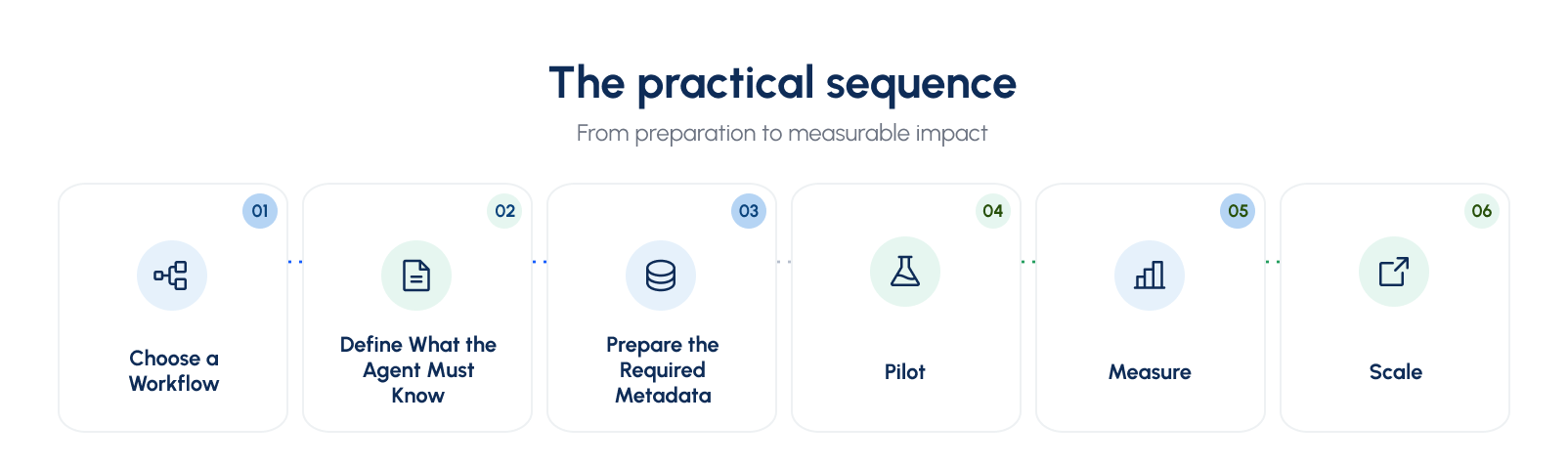
Make one valuable workflow reliable, prove that the agent improves it, and then scale from there.
How AEM Agents Improve Content Operations
The real value of AEM agents comes from taking over defined steps in the content lifecycle that previously depended on someone manually searching, checking, classifying, or handing content off.
For example, conversational asset discovery allows a marketer to ask for the latest approved campaign asset in plain language instead of knowing the exact folder, naming convention, or filter combination.
Automated classification and tagging can automatically add metadata such as asset type, topic, product, or campaign when new content enters AEM, instead of relying on teams to tag every asset manually.
Agents can also provide contextual recommendations, surfacing relevant approved assets based on the campaign, audience, market, or channel rather than relying on the requester to already know what exists.
At the governance layer, they can help identify expired, duplicate, or noncompliant assets before those assets are reused, and check brand rules and usage rights against recorded metadata at the point of use.
The same capability extends into reuse. An approved asset can be identified as the source for a new variation, while its relationship to the original asset, approval status, and usage rules remain part of the workflow.
Agents can also support ingestion and repository maintenance as content enters the DAM instead of allowing metadata gaps and duplicates to build up into periodic cleanup exercises.
Once the right asset is identified and approved, it can be moved into the next workflow with less manual coordination between content, campaign, and activation teams.
Frequently Asked Questions
Do AEM agents require perfect metadata to work?
No. Metadata does not have to be complete or perfect before adoption. What's needed is an agreed taxonomy, defined required fields, clear ownership, and governance rules as AEM's agentic and AI capabilities can help enrich metadata over time once that foundation exists.
What's the first step before adopting AEM agent capabilities?
Running an honest audit against the operational conditions an agent depends on, repository scope, metadata schema, taxonomy consistency, source authority, and ownership, rather than piloting broadly across the full content library.
Which AEM agent use case should organizations start with?
A single high-friction workflow with a measurable problem, such as finding approved campaign assets. Starting narrow makes it possible to define minimum metadata requirements and measure improvement before expanding.
How is success measured during an AEM agent pilot?
Discovery time, reuse rate, tagging effort, and governance exceptions are the core metrics. These indicate whether the agent capability and the underlying content operation are actually working together, not just whether the tool is technically running.
Can AEM agents fix inconsistent metadata on their own?
Adobe's agentic and AI capabilities can help enrich and maintain metadata, but they still depend on an underlying taxonomy, required fields, and governance rules defined by the organization. An agent cannot originate the operating rules it's meant to apply.
Want to Know Which AEM Agent Use Case You Should Start With?
As an Adobe Partner, Xerago can assess your current repository, metadata, and content workflows to identify the use case with the clearest measurable value.
Kaviarasu S
Associate Content Writer