Interactions Correctly?


How AEM Helps Enterprises Overcome Content Personalization Challenges


Solve Your AEM Personalization Challenges
No one can fix a personalization backlog by generating more content faster. Personalization does not have to mean creating a completely different page, asset, or campaign for every audience.
Adobe Experience Manager provides the content foundation for personalization at scale. It enables teams to create reusable experiences, govern assets, define targeted content, and connect with Adobe Target and Adobe Experience Platform.
The real question is not whether AEM supports personalization, but how to use it without creating unsustainable content-production demands.
How do you use AEM's personalization capabilities without turning every new audience, channel, or customer journey into another content-production request?
That requires treating personalization as an operating model rather than simply a content-creation exercise.
AEM provides the content foundation. Adobe Target can provide experimentation and decisioning. Adobe Experience Platform can contribute behavioral signals, audiences, and customer profiles. Governance and measurement determine whether the entire model remains sustainable.
Here is how those pieces fit together.
AEM Can Support Personalization But Personalization Is Not One Feature
In reality, effective personalization depends on several capabilities working together. You need the right content, audience data, decisioning, delivery, and measurement.
A scalable personalization model should answer five practical questions:
- What experience should change?
- What content should be shown instead?
- Who should receive that experience?
- What decides which variation gets delivered?
- How will we know whether the change created value?
AEM supports personalization through reusable Experience Fragments, Content Fragments, ContextHub, and Adobe Target.
Here is how the personalization workflow looks.
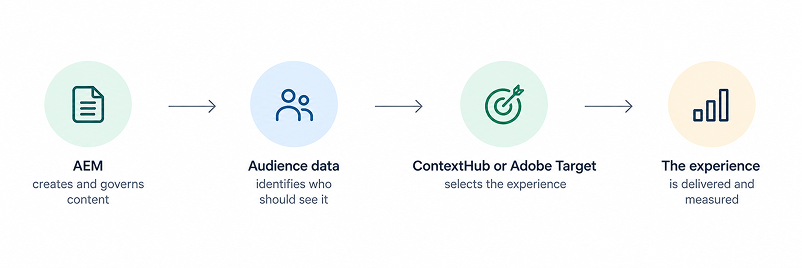
This makes AEM more than just a tool for creating personalized content. It gives teams a practical foundation for building, managing, and delivering personalized experiences at scale.
1. Create Reusable AEM Experiences Instead of Rebuilding Pages
AEM's first big advantage for personalization is that it lets teams create content variations without rebuilding entire pages.
If every personalization idea means creating a new landing page, campaign page, or digital experience from scratch, production quickly becomes a bottleneck.
With reusable content models, AEM helps teams make targeted changes while keeping the underlying page structure intact.
Experience Fragments
Experience Fragments are one of the most useful ways AEM helps teams personalize experiences without rebuilding entire pages from scratch.
They allow marketers and content teams to group related components into a single, reusable experience.
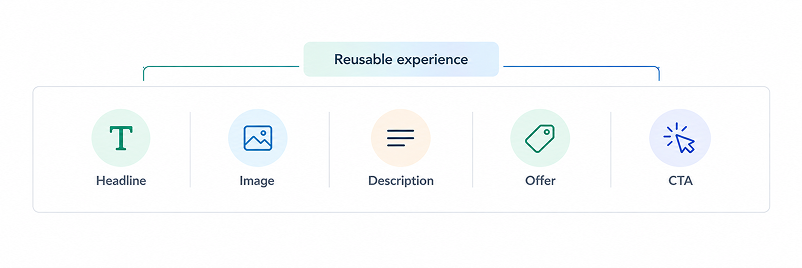
Instead of treating each of these elements as separate pieces of content, teams can manage them together as one coordinated content block. That block might represent a promotional banner, product recommendation, campaign message, registration prompt, or other experience that needs to appear consistently across multiple pages or channels.
For example, a financial services company might create an Experience Fragment promoting a new credit card. The fragment could include:
- A headline written for existing customers
- An image of the card
- A short description of the benefits
- A limited-time offer
- A CTA such as "Apply now"
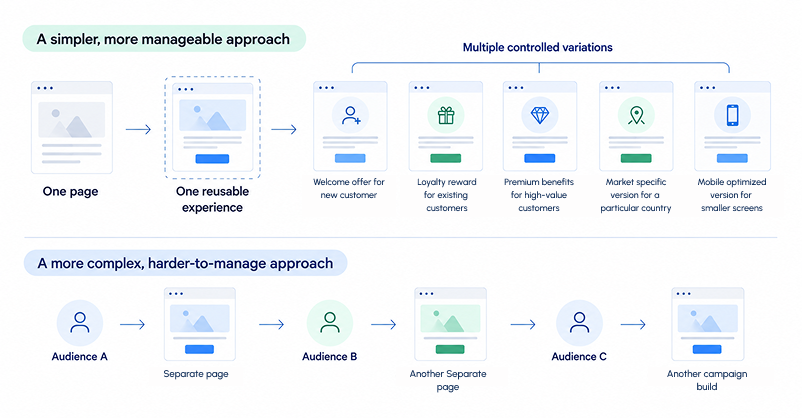
The same page does not need to be duplicated for every audience. Instead, the core page can remain consistent while the Experience Fragment changes based on the visitor.
A team might create variations such as:
- A welcome offer for new customers
- A loyalty reward for existing customers
- A premium benefits message for high-value customers
- A market-specific version for a particular country
- A mobile-optimized version for smaller screens
That distinction becomes increasingly important as personalization expands. If every audience variation requires a new page, teams quickly end up maintaining large numbers of nearly identical pages. Those pages then need to be reviewed, translated, approved, updated, measured, and eventually retired.
Experience Fragments help keep the variation focused on the part of the experience that actually needs to change.
For instance, the main product page might remain the same for everyone, while only the promotional message changes. A returning customer could see a loyalty offer, while a first-time visitor sees an introductory offer. The product information, navigation, layout, and supporting content can remain consistent.
This approach provides several practical benefits:
- Less duplication: Teams do not need to copy entire pages for small content differences.
- Faster production: Marketers can create and update reusable experiences more efficiently.
- Better consistency: The same approved message can appear across multiple locations.
- Simpler governance: Teams can review and approve a focused content block instead of an entire page.
- Easier maintenance: Updating the fragment can update every approved location where it is used.
- More flexible personalization: Different variations can be created for audiences, markets, campaigns, or channels.
If your organization is looking to use AEM Experience Fragments to support personalization without increasing content-production complexity, Xerago can help.
Experience Fragments can also be useful when the same experience needs to appear beyond a single AEM page. Depending on the implementation, they can support reuse across sites, channels, and Adobe Target activities. This allows teams to manage the content in AEM while using targeting and experimentation capabilities to determine which variation should be shown to a particular audience.
Adobe specifically notes that personalization can be defined for an Experience Fragment and then reused. In practical terms, this means teams do not necessarily need to configure the same audience variation every time the fragment appears. Once the relationship between the audience and the experience has been established, the fragment can be reused in other relevant locations.
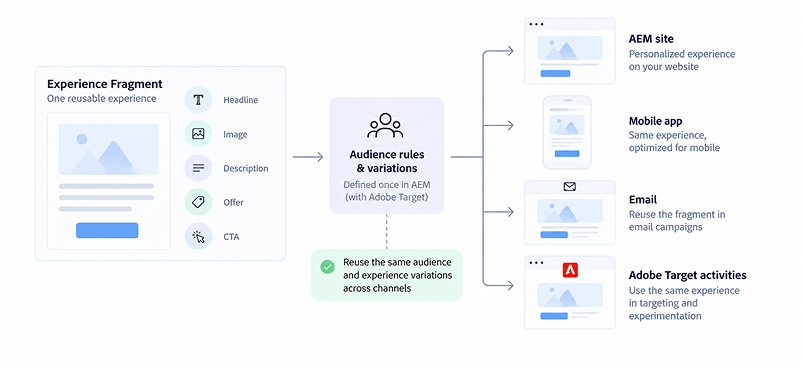
The important point is that Experience Fragments do not eliminate the need for content strategy or governance. Teams still need to decide which variations are meaningful, which audiences should receive them, and how the content should be approved and measured.
Their value is that they give teams a practical structure for managing those variations.
Instead of creating an entirely new page for every personalization idea, teams can ask:
Which part of this experience needs to change, and can we manage that change as a reusable fragment?
That question helps keep personalization focused, efficient, and easier to scale.
For example, instead of creating three separate product pages for:
- New customers
- Existing customers
- High-value customers
The core product page can remain consistent while a reusable promotional Experience Fragment changes based on the audience.
2. Use Content Fragments for Structured and Headless Experiences
Not every personalized experience lives on a traditional web page.
Today, you move between apps, portals, commerce experiences, connected devices, and other headless channels. AEM Content Fragments help you manage structured content centrally and reuse it across these different experiences without tying it to a specific page or presentation layer.
With AEM as a Cloud Service, you can export Content Fragments as JSON to Adobe Target. Adobe Target can then use that content in experimentation and personalization activities across headless channels.
In practical terms, you manage the content centrally in AEM while each delivery layer determines how to present it.
For example, a bank might manage one approved credit-card offer in AEM. That offer could include the headline, eligibility details, promotional rate, terms and conditions, image, and call to action. You could then use the same governed content in:
- The public website
- A mobile banking app
- An online account-opening journey
- A customer service portal
- A personalized email or campaign landing page
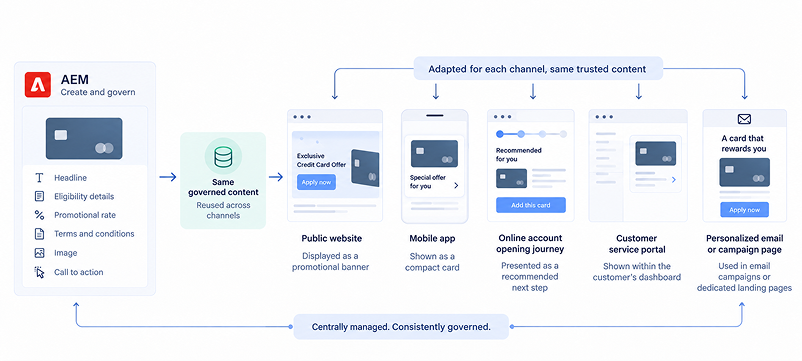
The presentation may change for each channel. The website might display the offer as a promotional banner, the mobile app might show it as a compact card, and the account-opening journey might present it as a recommended next step. However, the underlying offer remains centrally managed and governed in AEM.
This is especially useful when you need the same message, product detail, or offer to appear across several digital experiences. Instead of creating and maintaining separate copies for every channel, you can manage one approved source and reuse it wherever it makes sense. If the promotional rate changes or the offer expires, you can update the central content and reduce the risk of outdated information remaining in one of the connected experiences.
3. Use AEM Assets to Create the Governed Content Foundation
Reusable components alone do not solve the personalization problem.
The assets inside those experiences also need to be easy to manage.
As personalization grows, teams often need more combinations of:
- Images
- Product information
- Promotional messages
- Markets
- Languages
- Audience segments
- Channels
- Campaign variations
Without clear governance, this can quickly become hundreds or thousands of assets with unclear ownership. Teams may also struggle to identify which version is approved, current, or appropriate for a specific audience or channel.
This is where AEM Assets becomes part of the personalization operating model.
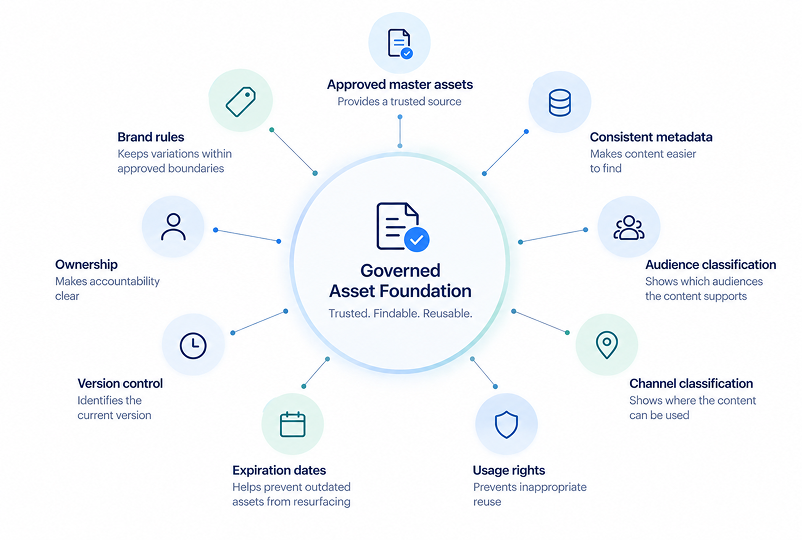
Personalization cannot scale safely when content is scattered across shared drives, inboxes, agency folders, and duplicate campaign repositories.
AEM Assets provides the governed content layer behind the personalized experience.
Its role is not simply to
store more content. It is to: make approved content easier to find, understand, govern, reuse, and adapt.
4. Use Metadata to Make Content Personalization-Ready
Personalization works best when you can quickly understand what content you have and where you can use it.
That makes metadata an important part of the personalization architecture.
For every reusable asset or experience, you should be able to answer questions such as:
- What does this content contain?
- Which product does it support?
- Which audience is it intended for?
- Which markets is it approved for?
- Which channels can use it?
- Which languages does it support?
- Is it still current?
- Who owns it?
A content library is only useful when you can find the right content and trust that it is approved for use. Metadata provides the information needed to make that possible.
This becomes even more important as personalization grows.
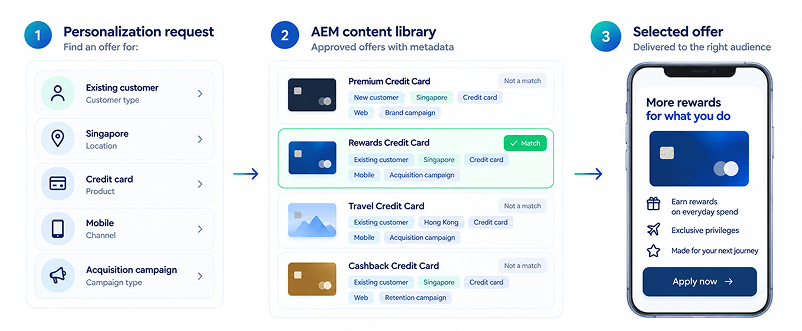
Good metadata makes that search faster and more accurate.
It also helps prevent a common source of unnecessary production, creating new content simply because nobody could find what already existed.
5. Define Who Should See the Experience
Once reusable content exists, AEM can help answer the next question:
who should receive which experience?
The right approach depends on how advanced the personalization needs to be.
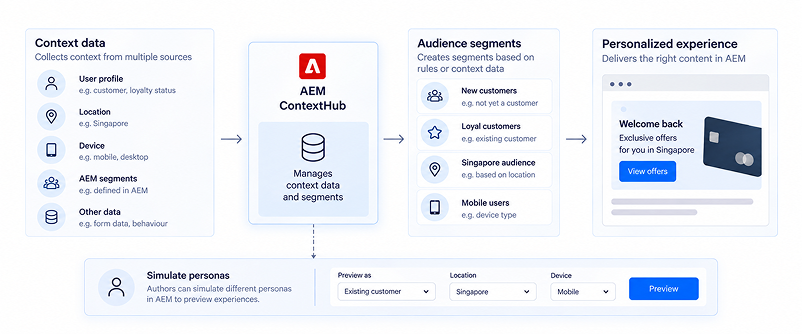
AEM ContextHub
AEM includes ContextHub, which supports context-based segmentation and personalization within AEM.
Adobe describes ContextHub as a framework for managing context data and segments.It also lets authors simulate different personas while reviewing experiences.
ContextHub works well for straightforward personalization based on known rules or AEM-managed segments.
Adobe Target
For more advanced experimentation and targeting, AEM can integrate with Adobe Target.
AEM can use Target as its targeting engine, allowing Target audiences to determine which personalized experience a visitor sees.
This expands personalization beyond simple content variation.
The question changes from:
"Which component should change?"
to:
"Which experience should this audience receive, under which conditions, and how should we test whether it works?"
Why Personalization Still Becomes a Content-Production Problem
Even with the right technology, personalization increases the demand for content.
Every additional combination of:
Audience × Channel × Journey × Product × Market can create another possible content variation.
For example, a single campaign might require different messaging for new customers and existing customers, separate versions for mobile and desktop, localized content for multiple markets, and additional variations for different products or stages in the customer journey.
If an organization produces every variation independently, the model eventually becomes difficult to sustain.
The challenge is not limited to the initial production effort. Each new variation also creates an ongoing operational responsibility. For every asset, teams should be able to immediately identify as listed below.
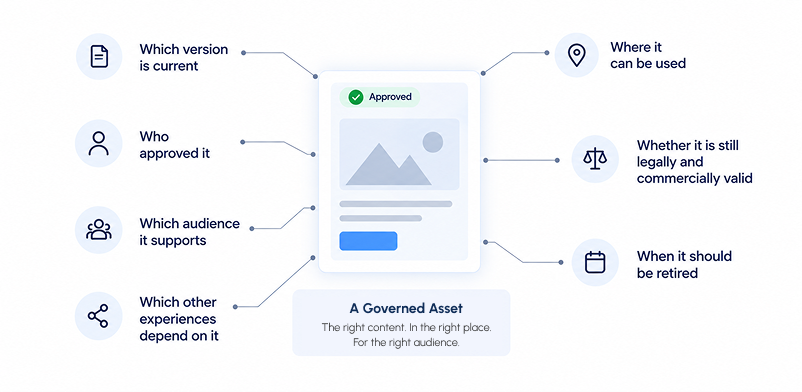
Over time, this can create duplicated content, inconsistent messaging, outdated offers, unclear ownership, and unnecessary review cycles. Personalization may improve the customer experience in one area while creating operational complexity behind the scenes.
That is why AEM's reuse capabilities matter.
Experience Fragments, Content Fragments, reusable components, and governed assets allow teams to create a smaller number of approved content foundations and adapt them for relevant audiences and channels. Instead of rebuilding an entire page for every segment, teams can often change only the experience element that needs to be different, such as the headline, offer, image, recommendation, or call to action.
AEM's value in personalization is not simply that it can display different content to different people.
The larger opportunity is its ability to become the governed content foundation for a broader personalization ecosystem.
- AEM can create and manage reusable experiences.
- AEM Assets can help govern the content behind them.
- ContextHub can support context-driven experiences.
- Adobe Target can test and determine which experiences should be delivered.
Adobe Experience Platform can provide richer audiences, behavioral signals, and unified profiles.
Measurement can then determine whether the personalized experience improved the customer outcome. Adobe's current personalization documentation describes this connected model across AEM, Target, and Experience Platform.
The objective should not be to produce an unlimited number of personalized assets.
It should be to create a system where a governed base of reusable content can support many relevant experiences without multiplying production at the same rate.
That is where AEM becomes more than a place to manage pages and assets.
Looking to Get More Out of Your Adobe Experience Manager Investment?
Xerago works with enterprise teams to close the gap between AEM Assets' capabilities and how the platform is actually configured, defining metadata schemas, tagging structures, and governance rules that make AEM Assets function as a true reuse layer.
As an Adobe Experience Manager service provider, Xerago supports implementation, optimization, and ongoing managed services for teams looking to get more value from their existing AEM investment.
FAQ
Can AEM support personalization?
Yes. AEM supports targeted experiences directly and can integrate with Adobe Target and Adobe Experience Platform for experimentation, behavioral targeting, audience-based experiences, and known-user personalization.
What role do Experience Fragments play in personalization?
Experience Fragments allow marketers to create reusable groups of content and components, develop audience-specific variations, and reuse those experiences across relevant pages and channels. They can also be used within Adobe Target personalization activities.
Can AEM content be used in Adobe Target?
Yes. Experience Fragments and Content Fragments created in AEM can be used within supported Adobe Target activities for experimentation and personalization.
Can AEM support headless personalization?
Yes. AEM Content Fragments can be exported to Adobe Target as JSON and used for headless experimentation and personalization scenarios.
Does AEM automatically determine the right personalization strategy?
No. AEM provides the capabilities to create, govern, target, and activate personalized content. The organization still needs to determine which customer moments matter, define meaningful audiences, establish governance, and measure additional value.
Should every experience be personalized?
No. Personalization adds operational and technical complexity. Use it where a differentiated experience has a clear customer or business purpose and where the impact can be measured.
Kaviarasu S
Associate Content Writer