Interactions Correctly?


Modernizing MarTech Strategy with Cloud: Trends and Challenges
Authored by Ram Prabhakar
Published: February 23, 2024 | Updated: January 28, 2025
Introduction
Enterprises face the daunting task of acquiring insights on complex customer journeys, which involves collecting data from various sources and analyzing the entire spectrum of data to identify areas for improvement in campaigns and digital experiences. The whole process can be challenging and time-consuming.
Managing an ever-growing MarTech ecosystem and leveraging growing volumes of data to create meaningful reporting processes has become increasingly difficult for marketing and the IT teams that support them. Consequently, cloud solutions have become crucial to support agility, flexibility, complexity and the growing volumes of data.
As the digital realm becomes increasingly complex, organizations are turning to the cloud to modernize their MarTech strategies. This shift brings forth a new wave of possibilities, from cloud-native applications to serverless computing and AI-powered analytics. However, these opportunities come with a plethora of challenges.
This article will explore the emerging trends shaping the MarTech landscape and delve into the challenges that businesses face when implementing cloud-based solutions. Furthermore, we will discuss strategies for modernizing MarTech strategy with cloud.
Get Your [ Free guide Today] and ensure your MarTech migration is a success!
Download NowThe Growing Adoption of Cloud
The cloud represents the future for major enterprises, presenting irresistible technical, business, and cost advantages. Embracing the cloud enables leaders in both business and technology to steer IT toward creating value and ensuring customer satisfaction.
The benefits of migrating MarTech to cloud include:
- Speed and Agility
- Higher Performance
- Data Resilience
- Improved User Access
- Cost-efficiency
Growing Adoption of Cloud: Statistics
- Cloud adoption will continue to grow at a compound annual growth rate (CAGR) of 16.3% between 2021 and 2026. Markets and Markets
- 95% of data workloads will be hosted in the cloud by 2025, up from 30% in 2021. Gartner
- Companies can save 15-40% on infrastructure costs by migrating to the cloud. BCG
Emerging Trends in MarTech: A Cloud-Centric Approach
Cloud-Native Applications
One of the most significant trends in modernizing MarTech is the adoption of Cloud-native technologies. Cloud-native technologies leverage the scalability and flexibility of cloud infrastructure, enabling marketers to deploy applications faster and more efficiently. With microservices architectures and containerization, cloud-native applications are designed to be lightweight, portable, and highly scalable, providing marketers with the agility to adapt to rapidly changing market conditions.
Serverless Computing
Serverless computing represents a paradigm shift in MarTech architecture. Instead of managing servers, organizations can focus on writing code, leaving the cloud provider to handle infrastructure scaling and maintenance. This not only reduces operational overhead but also enables marketers to develop and deploy applications with greater speed and efficiency. Serverless computing is particularly advantageous for handling sporadic workloads, ensuring resources are allocated dynamically based on demand.
AI-Powered Analytics
The integration of artificial intelligence (AI) into MarTech is transforming how businesses analyze and leverage data. Cloud-based AI services enable marketers to gain actionable insights from vast datasets, enhancing customer segmentation, personalization, and predictive analytics. Machine learning algorithms can identify patterns, detect anomalies, and optimize marketing strategies in real-time, providing a competitive edge in today's data-driven marketing landscape.
Edge Computing
Emerging on the horizon of MarTech trends is edge computing. This involves processing data near the source of generation, reducing latency and enabling real-time decision-making. In the context of MarTech, the integration of edge computing with cloud-based strategies can enhance the efficiency of data-intensive applications, ensuring faster response times for personalized customer interactions. By bringing computation closer to the data source, the integration of edge computing with cloud strategies complements the overall architecture, offering a distributed framework that is well-suited for latency-sensitive MarTech applications.
The integration of edge computing into MarTech strategies signifies a shift towards more responsive and localized processing, opening new avenues for real-time analytics and personalized customer experiences while seamlessly complementing cloud-centric approaches.
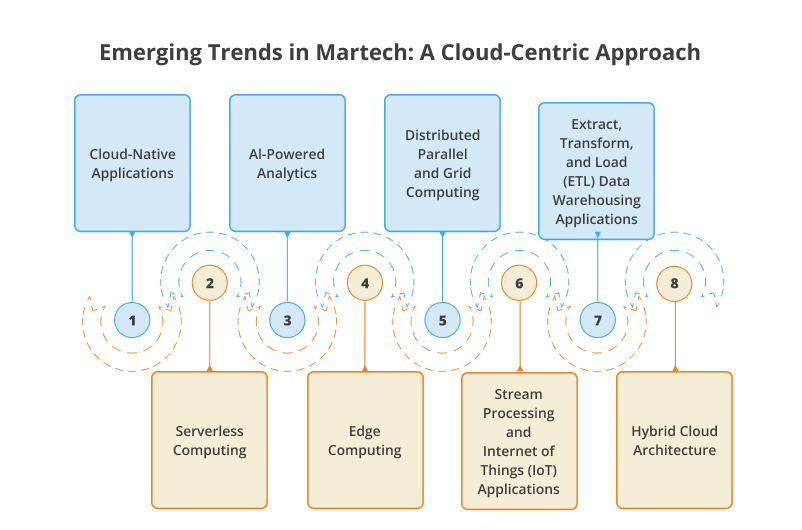
Distributed Parallel and Grid Computing
The utilization of distributed parallel and grid computing is gaining prominence in MarTech. This approach involves breaking down complex tasks into smaller, parallel processes, enhancing computational efficiency and scalability. Distributed parallel and grid computing in the cloud enable enterprises to handle large-scale data processing, ensuring optimal performance for resource-intensive applications.
Stream Processing and Internet of Things (IoT) Applications
Stream processing and IoT applications are becoming integral to MarTech strategies. Cloud-based stream processing allows real-time analysis of data streams, enabling enterprises to make instant decisions and adjustments. Integrating IoT applications with cloud services enhances data collection from connected devices, providing valuable insights for targeted marketing and personalized customer experiences.
Extract, Transform, and Load (ETL) Data Warehousing Applications
ETL data warehousing applications are pivotal in managing and processing vast datasets for MarTech purposes. Cloud-based ETL solutions streamline the extraction, transformation, and loading of data into warehouses, facilitating efficient analytics and reporting. This approach enables enterprises to derive meaningful insights from diverse data sources in a centralized and scalable manner.
Hybrid Cloud Architecture
Hybrid cloud architecture is gaining prominence in MarTech strategies, particularly for data management. Combining the benefits of public and private clouds, hybrid solutions offer greater flexibility. Enterprises can leverage the scalability of public clouds for resource-intensive tasks while retaining sensitive data on a private cloud for enhanced security. This approach provides a balanced solution, allowing organizations to optimize performance, security, and cost-effectiveness in their MarTech operations.
The integration of hybrid cloud approaches further expands the possibilities for enterprises, offering a nuanced and adaptable solution that addresses the unique needs of their MarTech ecosystem.
Challenges in Modernizing MarTech with Cloud
This is particularly evident in the realm of marketing, where teams consistently deploy a diverse set of cloud-based applications to monitor and track information, automate routine tasks, govern data, and scale their marketing efforts.
While the adoption of cloud technology is prevalent in an organization's MarTech stack, there are crucial considerations to bear in mind during this transition:
Data Security: IT teams must prioritize secure data movement, encryption, and supported authentication methods. Additionally, factors such as data governance, disaster recovery, and business continuity should be integral to the cloud strategy.
Historical Data: The migration process necessitates careful management of historical and legacy data to meet data retention requirements and support historical reporting needs.
Data Integration: Although the cloud facilitates easy access to systems and services, integrating with other data sources and reporting from Business Intelligence (BI) tools may pose challenges.
Performance: The performance of a cloud platform is influenced by the number of users, queries, and the volume of data. Bandwidth and latency issues can potentially impact performance.
Operational Agility: Adopting smaller initiatives for cloud migration can contribute to a smoother digital transformation strategy. A phased approach enables organizations to continue business operations and scale gradually as they incorporate more cloud solutions.
During the migration process, ensuring data quality and consistency across multiple sources is paramount. Traditional data architectures often fall short in supporting data integration capabilities that adequately address security, governance, and agility concerns. Therefore, organizations must prioritize these aspects when they migrate MarTech to Cloud.
Mastering MarTech Migration: Strategies to Ensure a Smooth Transition
Download NowBest Practices for Mitigating Challenges in MarTech Migration to the Cloud
By implementing these best practices, organizations can navigate the challenges associated with migrating MarTech to the cloud, ensuring a secure, efficient, and seamless transition that enhances overall operational effectiveness.
Data Security: Prioritize Robust Security Measures
Encryption at Rest and in Transit: Implement robust encryption mechanisms to ensure the security of data both at rest and in transit. This prevents unauthorized access during storage and transmission.
Multi-Factor Authentication (MFA): Enforce MFA to add an extra layer of security, requiring users to authenticate through multiple verification methods.
Regular Security Audits: Conduct frequent security audits to identify vulnerabilities and address them promptly. This proactive approach ensures ongoing data protection.
Comprehensive Data Governance: Establish comprehensive data governance policies to define and enforce data management practices. Clearly outline data ownership, access controls, and compliance measures.
Disaster Recovery and Business Continuity Planning: Develop and regularly test robust disaster recovery and business continuity plans to ensure data resilience in the face of unforeseen events.
Historical Data: Careful Management for Seamless Transition
Data Inventory and Classification: Conduct a thorough inventory of historical and legacy data, classifying it based on relevance, sensitivity, and retention requirements. This classification informs decisions on what data to migrate and what to archive.
Data Mapping and Documentation: Create detailed data mapping and documentation to track the movement and transformation of historical data during migration. This ensures a smooth transition and aids in addressing any discrepancies.
Purge Redundant Data: Eliminate redundant or obsolete data during migration to reduce the volume and improve the efficiency of the process.
Data Integration: Ensure Seamless Connectivity
API-First Approach: Adopt an API-first approach to data integration, facilitating seamless connectivity between cloud-based MarTech applications and other data sources.
Middleware Solutions: Utilize middleware solutions to bridge the gap between different systems, ensuring compatibility and streamlining data flow.
BI Tool Compatibility: Choose cloud-based MarTech solutions that seamlessly integrate with common Business Intelligence tools. Compatibility ensures that data reporting and analytics remain uninterrupted.
Performance: Optimize for Scalability and Efficiency
Scalable Architecture: Design a scalable architecture that can accommodate fluctuations in the number of users, queries, and data volume. Cloud platforms offer scalability features that can be leveraged for optimal performance.
Content Delivery Networks (CDN): Implement CDNs to distribute content geographically, reducing latency and improving overall performance for users across different locations.
Regular Performance Monitoring: Establish regular performance monitoring protocols to identify and address bottlenecks promptly. Continuous monitoring ensures optimal platform performance.
Operational Agility: Phased Approach and Testing for Smooth Transition
Pilot Testing: Conduct pilot tests with smaller initiatives before full-scale migration. This allows organizations to identify and rectify issues on a smaller scale, ensuring a smoother transition.
Iterative Deployment: Adopt an iterative deployment approach, gradually moving different components of the MarTech stack to the cloud. This phased strategy minimizes disruption to ongoing business operations.
Employee Training and Change Management: Invest in comprehensive training programs and change management initiatives to prepare employees for the new cloud-based MarTech environment. Ensuring that teams are well-equipped minimizes resistance and facilitates a more agile transition.
Conclusion
In the ever-evolving landscape of marketing technology, the integration of cloud solutions has become a catalyst for innovation and efficiency. As enterprises grapple with the complexities of managing diverse MarTech ecosystems and analyzing vast volumes of data, the cloud emerges as a transformative force, offering unparalleled agility, flexibility, and scalability.
The modernization of MarTech through cloud adoption presents a myriad of opportunities and challenges for organizations. With the right approach, businesses can harness the power of the cloud to drive digital impact, enhance customer experiences, and stay competitive in an increasingly dynamic digital marketplace.
Adopt cloud for flexibility, cost savings and Maximize martech impact
Schedule a call with usLooking for MarTech consulting? We drive growth with optimized marketing tech.
Speak to a Martech ConsultantGlobal Office Locations
2570 N. First Street, Suite 200,
San Jose, CA 95131