Interactions Correctly?


What Is Multi-Touch Attribution and How Does It Work?


Improve Marketing Attribution with Accurate Tracking Data
Every click, swipe, and scroll leaves a digital footprint. That’s why understanding how customers interact with your brand across different channels is vital. Each interaction provides a glimpse into the customer journey, but seeing the full picture requires the right tools and insights.
Enter multi-touch attribution, a way for marketers to see how multiple touchpoints across different marketing channels help turn leads into customers. It helps you understand which touchpoints across channels contribute the most to driving results. By using this approach, you can learn more about your customers, improve your marketing plans, get better returns on your spending, and grow your business.
In this guide, we’ll break down what multi-touch attribution is, why it’s important, how it works in a way that’s easy to understand, and the tools used.
Looking to Understand What Your Customers Want? Download Our Guide To Implement CJA
What Is Multi-Touch Attribution?
Multi-touch attribution is a marketing attribution method used to assign credit to multiple touchpoints a customer interacts with before converting. It focuses on understanding how each touchpoint along the customer journey contributes to their decision to make a purchase or take a specific action.
Here’s an example:
- A customer first comes across a product through a social media ad.
- Then, they visit the company’s website to learn more.
- Finally, they make a purchase after receiving a promotional email.
Each of these touchpoints—social media, website, and email—is part of the journey and plays a role in the conversion process.
Unlike single-touch attribution models, multi-touch attribution gives a complete view of the entire customer journey. It assigns appropriate credit to each touchpoint, enabling you to make smarter, data-driven decisions. By accurately attributing credit to each touchpoint, you can fine-tune your strategies and allocate resources where they’ll have the most impact.
Benefits of Multi-Touch Attribution
Multi-touch attribution helps businesses understand how each step in a customer’s journey impacts their decision to buy. Multi-touch goes beyond traditional attribution methods by revealing hidden patterns in how customers behave, making it easier to spot what works and what doesn’t. This approach helps businesses make smarter choices, like where to spend their budget or how to improve campaigns.
In this section, we’ll look at the key benefits of multi-touch attribution and show how it can help you get better results for your business.
Multi-touch attribution does more than just show the impact of each touchpoint. It also reveals how one channel influences another. For example, it can show how engaging with a brand on social media leads to more people searching for the brand or visiting the website directly.
It also helps you see how people use different devices, like switching between desktops, smartphones, and tablets. This lets you improve your campaigns to give customers a smooth and consistent experience no matter what device they’re using.
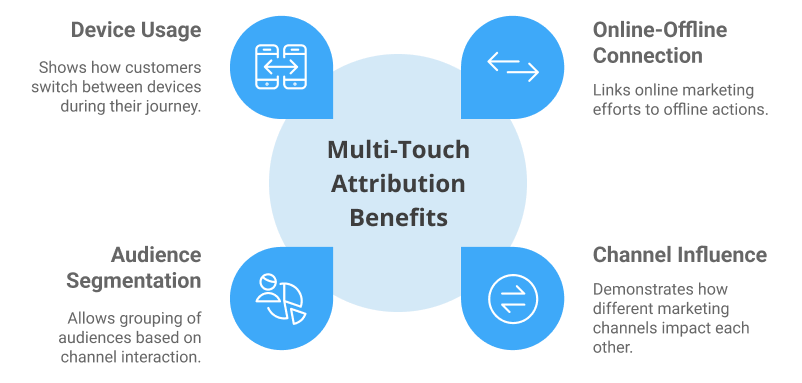
You can also group your audience based on how they interact across different channels. By understanding which groups are the most valuable, you can create messages and offers that match their interests. This makes your marketing more personal, increases engagement, and boosts conversions, helping you get better results for your efforts.
Another big win is connecting online and offline actions. Multi-touch attribution can link things like in-store purchases or phone calls to the online touchpoints that led to them. This gives you a complete picture of your customer’s journey and helps you measure the success of all your marketing efforts.
How Multi-Touch Differs from First-Touch and Last-Touch Attributions
Understanding the key differences between multi-touch attribution and single-touch attribution models helps you develop a comprehensive marketing strategy. Here’s a sneak peek into multi-touch vs. first-touch vs. last-touch attributions.
| Multi-Touch Attribution | First-Touch Attribution | Last-Touch Attribution |
|---|---|---|
| Analyzes the entire customer journey and considers all touchpoints involved. | It focuses solely on the initial interaction a customer has with the brand, attributing the entire conversion to this touchpoint. | Last-touch attribution centers on the final interaction before conversion, assigning full credit to this touchpoint. |
| It recognizes that customers interact with various channels before making a purchase decision. | It provides insight into the entry point of the customer journey. | It highlights the touchpoint that directly leads to the desired action. |
| It aims to assign credit to each touchpoint based on its contribution to the conversion | All credit for the conversion is given to the initial touchpoint. | Last-touch attribution credits the last interaction before conversion with the entire conversion value |
| Provides a nuanced understanding of customer behavior and channel interactions throughout the entire journey. | Offers insight into how customers initially discover the brand and enter the sales funnel | Provides clarity on the touchpoint that directly leads to conversion, offering insights into immediate conversion drivers |
Types of Multi-Touch Attribution Models
Multi-touch attribution comprises various models, and each offers unique insights into customer behavior and marketing effectiveness. Let's have a closer look at these models in depth:
Linear Attribution Model
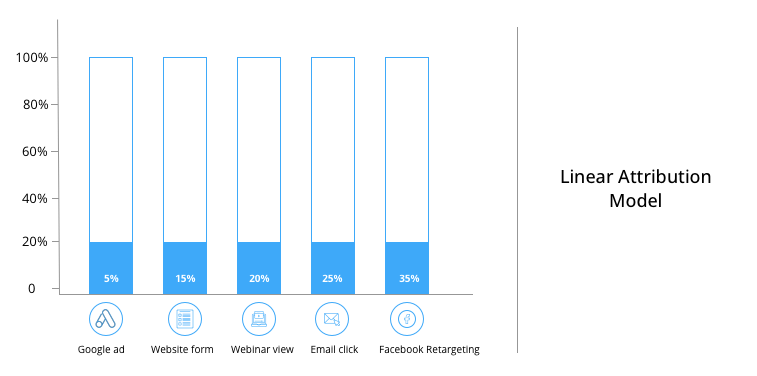
In the linear model, every touchpoint along the customer journey receives equal credit for the conversion.
This approach offers a simplistic yet balanced view of the customer journey and acknowledges the contribution of every interaction.
However, it may fail to capture the varying levels of influence that different touchpoints exert on the conversion process.
Time Decay Attribution Model
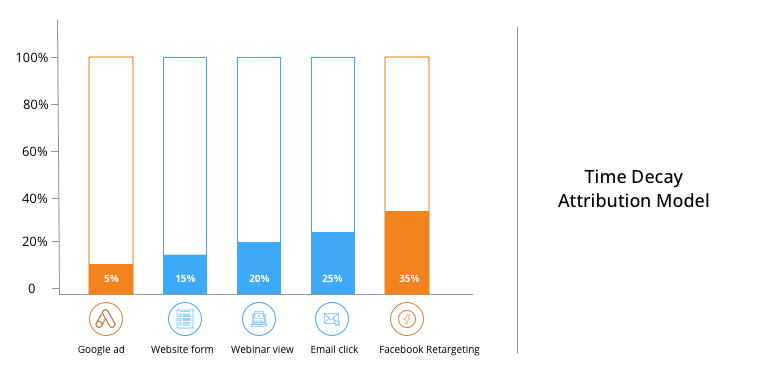
The time decay model gives greater importance to touchpoints that happen nearer to the conversion and reflects the decreasing impact of earlier interactions.
It recognizes the typical trend in customer behavior, where interactions closer to conversion tend to have more impact.
It might not fully appreciate the significance of early touchpoints in creating awareness and consideration, especially in longer purchase cycles.
Position-Based (U-Shaped) Attribution Model
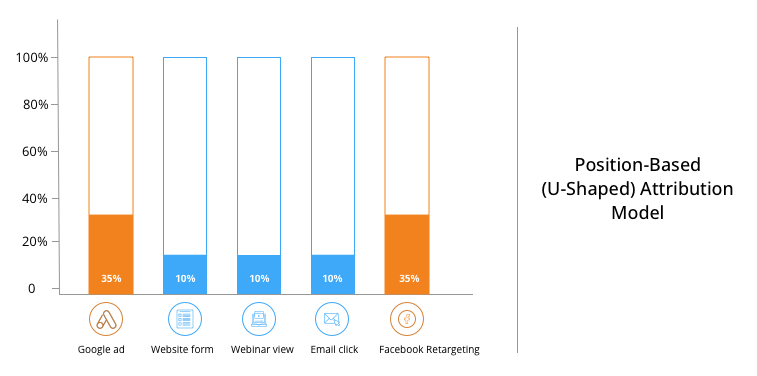
The U-shaped model divides credit between the first and last touchpoints and assigns less credit to intermediate ones.
It understands the importance of both the initial touchpoint that starts the customer journey and the final touchpoint that triggers conversion.
However, it might underestimate the contributions of intermediate touchpoints that nurture leads and guide customers through the sales funnel.
W-Shaped Attribution Model
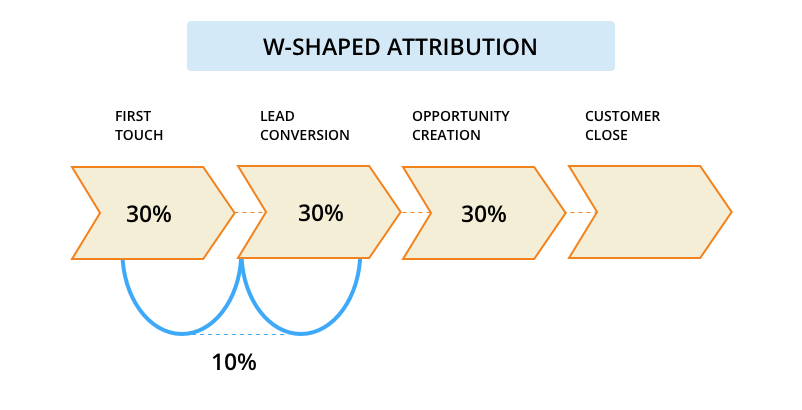
The W-shaped model assigns credit to three key touchpoints: the first touch, the lead creation touch, and the opportunity creation touch.
This attribution model recognizes critical milestones in the customer journey, including initial awareness, lead generation, and conversion.
Despite its detailed analysis, it might miss considering the impact of additional touchpoints that play a role in engaging and retaining customers beyond the conversion event.
Full Path Attribution Model
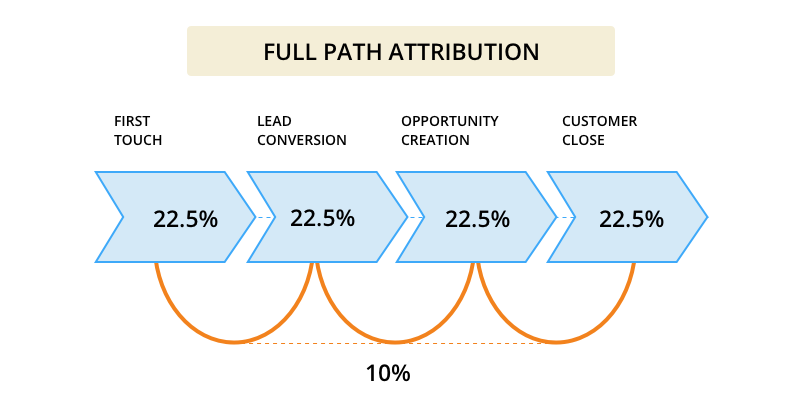
The full path model analyzes every touchpoint in the customer journey leading to conversion and assigns credit based on each interaction's significance.
It offers a thorough insight into how various channels contribute to conversions, which enables you to refine marketing strategies effectively.
However, due to its complexity, it demands advanced analytics capabilities to track and analyze the multitude of touchpoints involved in intricate customer journeys.
How Does Multi-touch Attribution Work?
Multi-touch attribution allows you to dissect the intricate web of customer interactions across various touchpoints and channels.
At its core, it operates through a series of interconnected processes.
Understanding How Customers Engage
To truly understand your customers' needs, it's essential to track their interactions with your website comprehensively.
- Begin by meticulously measuring their engagement with your website.
- Gather data on their entry points, time spent on site, page visits, and other relevant attribution metrics and KPIs.
- Utilize diverse sources to track individual campaigns and capture a comprehensive view of customer interactions.
Sorting and Grouping Data
Once you've collected a substantial amount of data through analytics, it's time to organize it into meaningful categories.
- Identify the initial key touchpoints that introduce customers to your brand. These could include sources like paid advertisements, organic search results, or social media posts.
- Next, categorize interactions that contribute to lead generation, such as webinar registrations, eBook downloads, or content engagement metrics.
- Finally, examine touchpoints that lead to conversions, such as product purchases, demo requests, or sales inquiries.
Picking the Right Model
By utilizing the insights gleaned from data analysis, you can now make informed decisions about attribution models. By understanding which touchpoints significantly contribute to customer conversions, you can allocate credit across your marketing channels more effectively. Whether opting for a linear, time decay, or algorithmic model, your choice should align closely with the unique dynamics of your customer journey.
Multi-Touch Attribution Analysis
After assigning credit to touchpoints, it’s time to analyze the attribution data collected and draw useful insights:
- Identify Trends: See which channels consistently drive engagement and conversions.
- Spot Weak Links: Find touchpoints that may not be performing well and look for ways to improve them.
- Optimize Campaigns: Use the data to adjust your marketing strategies, focusing more on high-performing channels.
Multi-touch attribution analysis helps you understand not just what works but why it works, so you can make smarter decisions.
Tools for Multi-touch Attribution
When it comes to tackling the complexity of multi-touch attribution, having the right tools is important. Let's explore three platforms that offer strong capabilities for tracking and analyzing customer interactions across various touchpoints:
Adobe Analytics
- Adobe analytics platform utilizes attribution modeling techniques to assign credit to different touch points along the customer journey. This enables them to understand the relative impact of each channel on conversions.
- With customizable reports and dashboards, it provides deep insights into channel performance, audience segmentation, and conversion paths.
- Adobe Analytics provides real-time data tracking that enables you to make timely decisions and adapt strategies on the fly.
Google Analytics (GA)
- Features data-driven attribution (DDA), which uses machine learning to assign credit based on the actual contribution of each touchpoint.
- GA excels in cross-device tracking, enabling you to understand how customers move between different devices before converting.
- Google’s tracking capabilities help you analyze the entire customer journey from product discovery to purchase.
HubSpot
- One of the top attribution platforms, Hubspot provides a unified platform for all marketing activities to track customer interactions across various channels in one place.
- The platform offers lead attribution features to attribute leads to specific marketing campaigns and channels.
- Its intuitive dashboard and customizable reports make it easy to visualize data, identify trends, and optimize marketing strategies for maximum impact.
Challenges of Multi-touch Attribution
- Digital Focus: Traditional marketing attribution methods primarily focus on digital touchpoints. They overlook the impact of offline interactions such as in-store visits and word-of-mouth recommendations. This limitation results in an incomplete understanding of the customer journey, which results in misattributed conversions and inaccurate insights.
- Cookieless Tracking: The demise of third-party cookies and the introduction of cookieless tracking pose significant challenges to multi-touch attribution. Businesses face hurdles in tracking online customer behavior and attributing conversions accurately due to reduced data availability and reliance on first-party data.
- Model Complexity: Choosing the appropriate attribution model is significant for accurately assigning credit to different touch points along the customer journey. However, the complexity of customer journeys and the multitude of available attribution models make it challenging to select the most suitable approach and allocate credit to different channels, especially when attributing conversions to a single touchpoint.
- Data Integration: Integrating data from various platforms and channels can be a daunting task due to the disparate nature of data sources. Each platform may use different metrics and formats that lead to inconsistencies and difficulties in aggregating and analyzing data effectively.
Multi-touch attribution reveals how customers interact with your brand across various channels. By giving credit to every touchpoint along the customer journey, it provides you valuable insights into customer behavior to optimize your marketing strategies effectively. Despite challenges like tracking offline interactions and choosing the right attribution model, implementing a multi-touch attribution approach can significantly improve ROI and drive business growth.
Ram Prabhakar
Head of Solutions and Content
Xtelligence Inbox.
Your weekly dose of marketing smarts!
Related Posts