Interactions Correctly?


The Ultimate Guide to Building the Perfect Martech Stack for Your Business


Get Free Marketing Technology Stack Audit Checklist
The Martech industry has accelerated significantly in recent years. In 2025, it is projected to exceed $465 billion in value, with over 11,000 tools currently available across the global market. This rise is fueled by companies wanting better ways to understand and engage with customers while keeping their marketing efficient and data-driven.
As your business keeps growing and you have more customers, tasks, and marketing needs to handle, things can get pretty complicated. That's where a MarTech Stack comes in.
Think of it as a handy toolset for your marketing. It makes everything easier and smoother. So, as your company expands, you can still keep everything running without a hitch. Let's take a closer look at MarTech Stacks to see how they can strengthen your marketing and keep your business on the right track.
As your business expands, Martech services become essential for simplifying tasks, enhancing customer experience, and managing marketing with ease.
What is a MarTech stack?
A Martech Stack, or Marketing Technology Stack, is a collection of diverse tools and technologies marketing professionals use to streamline, measure, and improve their marketing efforts. It's not a single integrated system but an assembly of specialized software solutions.
What Are the Key Components of a MarTech Stack?
In building a robust marketing technology (martech) stack, several key components play pivotal roles beyond the foundational martech tools like CRM, CMS, email marketing, analytics, and social media management. Beyond these, a comprehensive martech stack incorporates advanced functionalities such as:
- Data Management Platforms (DMPs) are essential for collecting and organizing audience data to fuel targeted advertising and personalized marketing efforts. Customer Data Platforms (CDPs) unify diverse customer data sources, enabling a holistic view of each customer for tailored marketing strategies.
- Conversion Rate Optimization (CRO) Tools utilize A/B testing and user behavior analysis to optimize website and landing page conversions, ensuring every visitor has a smooth journey to becoming a customer.
- Project Management Tools streamline collaboration across marketing teams, ensuring projects are executed efficiently and deadlines are met seamlessly.
- Marketing Attribution Tools provide insights into the effectiveness of various marketing channels, attributing conversions to specific campaigns and helping optimize budget allocation.
- Mobile Marketing Tools encompass SMS campaigns, in-app messaging, and mobile analytics, crucial for engaging with audiences on the go effectively.
- Finally, robust APIs and integrations ensure that these tools work harmoniously, facilitating seamless data flow and enhancing overall marketing efficiency.
- By integrating these advanced components into your MarTech stack, you not only streamline operations but also empower your team to deliver targeted, data-driven marketing campaigns that resonate deeply with your audience.
How to build a Marketing Tech Stack?
Your marketing tech stack is like a toolbox for successful marketing. It helps you reach the right people and get the job done. Here are the steps to build yours:
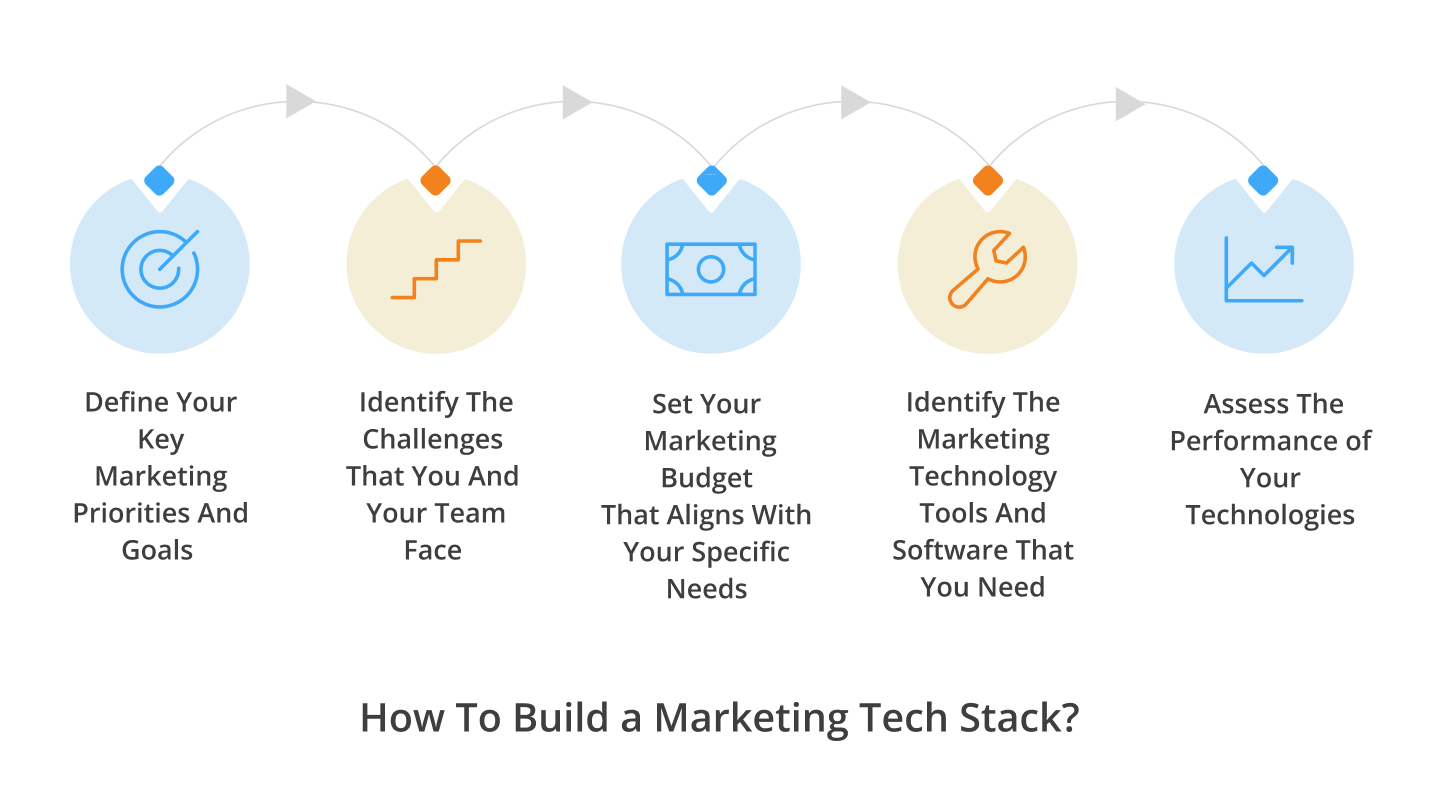
Define your key marketing priorities and goals
First, pinpoint your main marketing strategies and goals. Your goals are like targets you aim for, and your strategies are the plans you use to hit those targets.
For instance, if you want to get more people to visit your website through search engines, that's a goal. To achieve it, you'd use a strategy called search engine optimization (SEO) to make your site more search engine-friendly.
If you aim to generate more leads and sales, you should improve your website's user experience. Your goals and strategies guide your choices when building your marketing technology stack.
Identify the challenges that you and your team face
As you consider the tools for your marketing tech stack, it's important to reflect on the hurdles your team faces during the implementation and management of campaigns.
Whether it's the complexity of conducting effective keyword research for your content strategy or the challenge your sales team encounters in tracking client information, these obstacles must be addressed.
In your quest to build the ideal martech stack, solutions to these current challenges should be a top priority, ensuring that your tools not only align with your goals and primary strategies but also streamline your operations and enhance overall productivity.
Set your marketing budget
As you explore various tools for your marketing tech stack, it's important to have a clear grasp of your financial constraints. There's no one-size-fits-all answer, as the right choice depends on how well it aligns with your specific needs and what your budget allows.
You can choose to allocate your budget for the entire marketing strategy or set specific budgets for individual tools on a monthly, quarterly, or yearly basis. Since most marketing platforms operate on monthly subscriptions, creating a monthly budget is a practical and manageable choice.
Download Your [Free Guide Now] to Guarantee a Smooth MarTech Migration!
Identify the marketing technology tools and software that you need
Now it's time to research tools for your marketing tech stack. Start by looking for helpful blog posts and articles to get an idea of what's available.
For instance, if you need better keyword research, find lists of top keyword research tools. To manage customer data effectively, look for the best customer relationship management (CRM) platforms.
Next, create a list of potential tools based on your team's suggestions and similar options. Explore websites like G2 and Capterra to find tool categories. Additionally, check out real reviews, case studies, and pricing options to ensure a tool aligns with your needs before diving into specifics like cost.
Assess the performance of your technologies
Assess the marketing technology platform you've chosen and see how well it works for your business. Many times, you can try these tools for free for a limited period to make sure they help you achieve your goals. This way, you can experiment with various platforms without any extra costs.
After making your selections, sign up for these tools and make use of any available onboarding. Regularly assess your marketing tech stack's performance, ideally every six to 12 weeks, to ensure it aligns with your ambitious marketing goals.
If your current platform falls short, cancel the subscription and explore better options. By continuously evaluating and adapting your chosen technologies, you can create an ideal marketing tech stack that boosts your business revenue.
Over time, tools can become outdated, overlap in function, or fall out of alignment with business goals. Running a MarTech audit helps you make sure every tool is working at its best, contributing to seamless processes and effective marketing. Here’s a simple guide to auditing your MarTech stack, so you can spot gaps, streamline resources, and ensure you’re getting the most value out of each tool.
How to Select the Right Tools in the MarTech Stack?
Choosing the right tools is critical to the success of your MarTech stack optimization. But with so many different tools available, it can be difficult to know where to start.
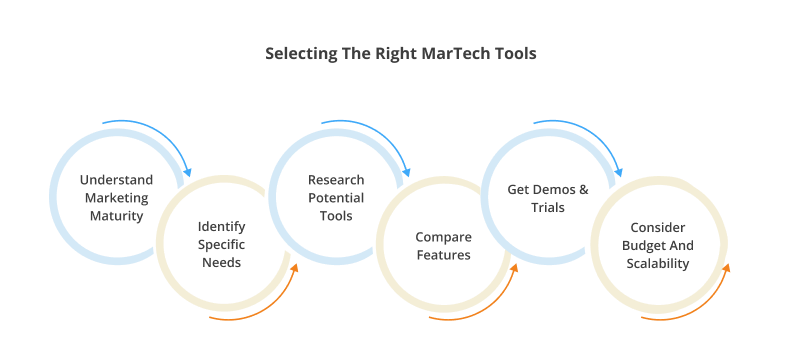
Here are a few tips to help you choose the right Martech tools for your specific requirements.
- Understand your marketing maturity and capabilities
- Identify your specific needs and requirements
- Research potential tools and compare features
- Get demos and free trials
- Consider budget and scalability
Platforms for Marketing Stack
There are a wide variety of marketing technology tools available, and the best tools for your business will depend on your specific needs and goals. However, there are a few general types of MarTech tools that you may want to consider for your marketing stack.
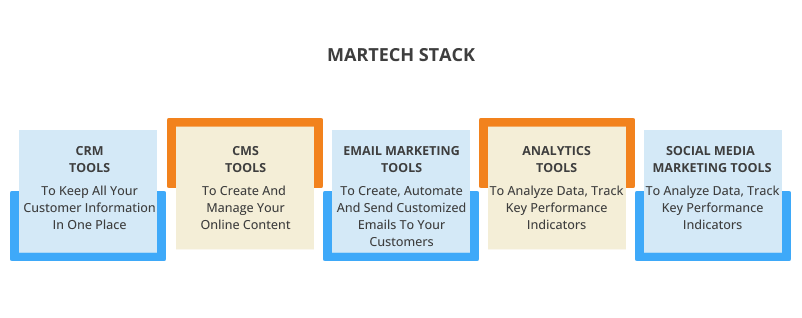
Customer Relationship Management(CRM) tools:
It is like a digital organizer that keeps all your customer information in one place. It helps you keep track of people interested in your business and guides them towards becoming loyal customers.
With a CRM, you can store data about your customers, like their contact info, what they've bought, and how they prefer to hear from you. This helps you understand your audience better and improve your marketing.
Some popular CRM software platforms include:
- Salesforce
- HubSpot CRM
- Zoho CRM
Content Management System (CMS) Tools
A Content Management System (CMS) is like the control center for your website. It helps you easily create and manage all your online content, whether it's blog posts, web pages, or videos. With a good CMS, you can see the big picture of how your content is made, shared, and tracked.
One of the best things about a CMS is that it lets different people or teams work on different parts of your website without things getting messy. Any changes you make in one place will be reflected everywhere else, making sure your website is always in sync.
Some popular CMS platforms include:
- WordPress
- Drupal
- Webflow
Email Marketing Tools
Email marketing is another vital strategy for online growth. You can collect people's email addresses on your website and then use email marketing tools to send them messages that encourage them to take action. These tools help you design your emails and can even automate the sending process.
Some popular email marketing tools include:
- Mailchimp
- Constant Contact
- HubSpot Marketing Hub
Analytics Tools
Analytics tools are your way of checking how well your marketing is doing. With these tools, you can understand the size of your audience and where they're coming from – whether it's through search engines, social media, or other channels.
They also show you how people engage with your content, like which pages they visit, how long they stay, and what actions they take. Some popular website analytics tools include:
- Google Analytics
- Adobe Analytics
- Matomo
Social media marketing tools
Social Media Marketing Tools help you create, schedule, and understand the impact of your posts on platforms like Instagram, Twitter, Facebook, TikTok, and Pinterest. With these tools, you can manage conversations, post directly to various networks, and connect with your audience where they hang out.
Marketers rely on them to schedule and publish posts, track engagement, and analyze the performance of their social media efforts. Some popular social media management tools include:
- Hootsuite
- Sprout Social
- Buffer
Common Challenges Businesses Face Without Implementing a MarTech Stack:
Without the right MarTech stack integrations in place, businesses face several challenges related to marketing efficiency and effectiveness.
These include:
1. Inefficient Marketing Operations and Efforts:
Without a well-integrated martech stack, businesses often encounter a series of operational and strategic hurdles that limit marketing effectiveness. These challenges can directly impact customer engagement, budget efficiency, and long-term growth.
2. Limited Personalization:
Without MarTech tools, it's tough to create personalized marketing that speaks to individual customer needs. This often results in generic, less interesting content. Engaging with customers on their preferred channels becomes harder. As a result, customers might lose interest and switch to competitors.
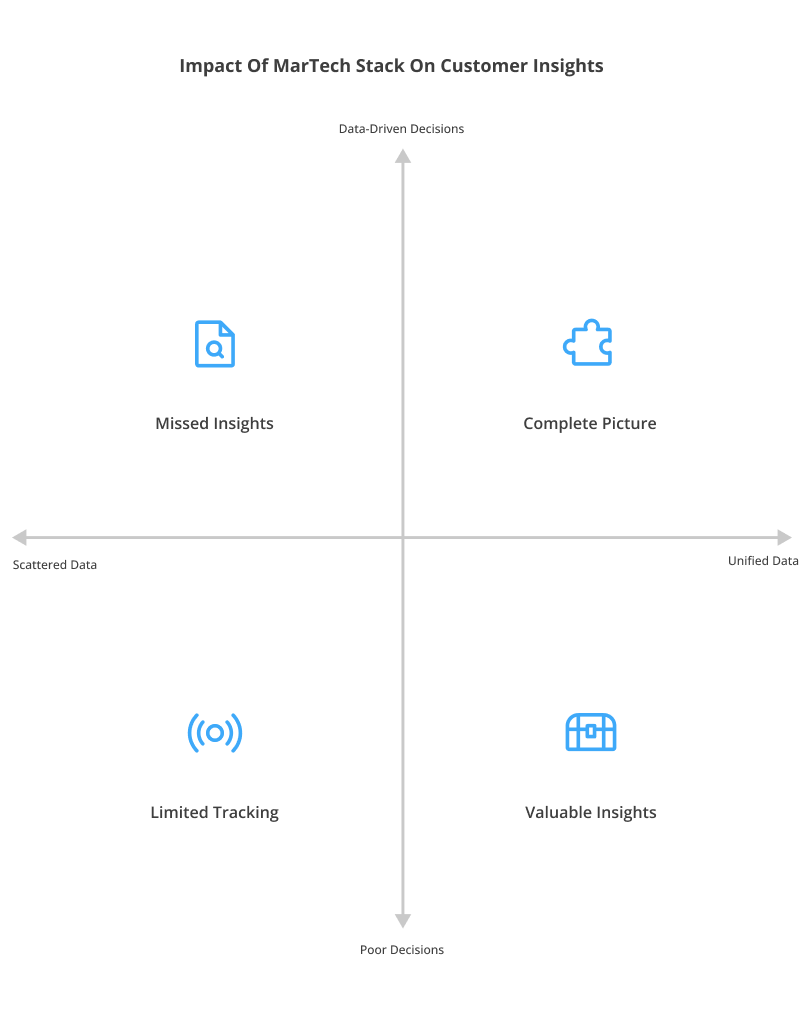
3. Data Silos & Missed Customer Insights:
When you don't have a unified MarTech stack, your customer data is scattered in different places. This makes it difficult to see the complete picture of how your customers are interacting with your business. Collecting data from various sources without MarTech means data sits scattered and unused.
This limits the ability to make data-driven decisions. Without a MarTech stack, it's hard to track customer behavior. Businesses miss valuable insights about what their customers want, need, and expect.
4. Slow Response Time
Businesses may find it hard to react quickly to trends or customer feedback. This lack of agility can lead to missed opportunities and slow growth.
5. Wasted Marketing Budget and Investment
Without MarTech, tracking what works and what doesn’t is tough. This can lead to wasted spending on ineffective campaigns.
6. Lost Competitiveness
Competitors using MarTech can personalize their approach, respond quickly, and make smarter decisions. Businesses without it might struggle to keep up.
Already Have a MarTech Stack? Here’s How You Can Run an Audit to Ensure Optimal MarTech Stack Utilization
With over 14,000 MarTech tools available, businesses can quickly accumulate tools they don’t fully use or need. A MarTech audit helps identify what’s working, what’s redundant, and where improvements can be made.
Steps to Conduct a MarTech Audit
- Inventory Tools: List each tool and its purpose.
- Identify Overlaps: Remove duplicates that add clutter.
- Evaluate Integration: Ensure tools work seamlessly together for efficient data flow.
- Assess Usage: Confirm that each tool is used effectively by your team.
- Measure Performance: Check if each tool delivers value, such as better insights or smoother automation.
- Review Data Quality: Confirm tools provide accurate, high-quality data.
- Stay Updated: Keep tools current with new features and support.
A MarTech audit ensures every tool in your stack is purposeful, aligned with goals, and optimized for smooth operation. This approach helps businesses stay organized, reduce costs, and enhance marketing effectiveness.
What Are the Ways to Scale Your Marketing Stack?
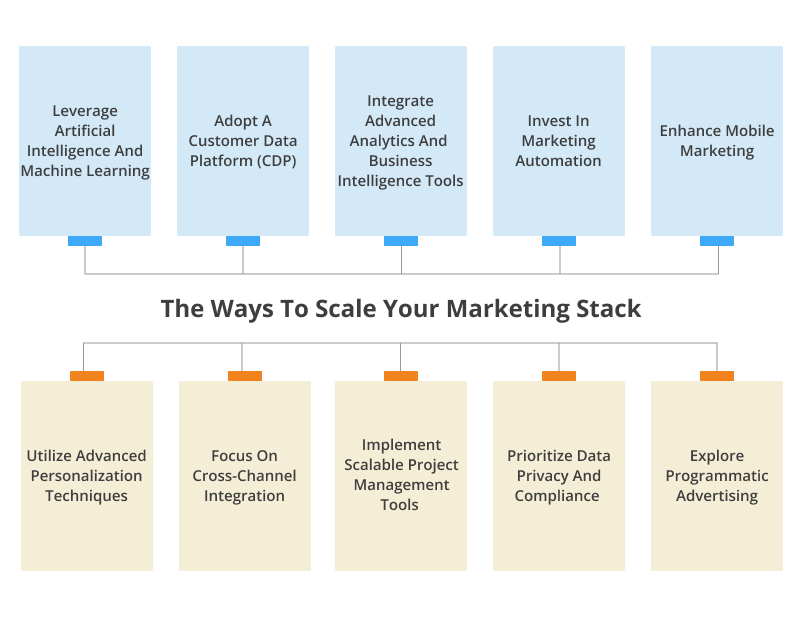
Scaling your marketing stack requires strategic planning and integrating advanced technologies to enhance efficiency, data utilization, and customer engagement. Here are some insightful ways to scale your marketing stack:
- Break Down Silos: Addressing process, technology, and operations gaps is the key to a holistic, customer-centric approach. Here's how businesses can adopt a modern approach to achieve customer centricity:
- Unify Data Sources: Use CDPs to integrate data from multiple channels (CRM, website, POS, etc.) and create a unified customer profile.
- Seamless Cross-Channel Integration: Ensure your Martech stack supports cross-channel orchestration so all customer interactions are aligned.
- Activate Customer Intelligence: Use the data to anticipate customer needs, delivering tailored content, offers, and services in real time.
- Embrace Automation: Strategic automation optimizes workflows and delivers consistent customer experiences across all touchpoints.
- Leverage Artificial Intelligence and Machine Learning: Implement AI-driven tools to automate complex tasks, such as predictive analytics, personalized content recommendations, and chatbots for customer service. Machine learning can analyze large datasets to identify patterns and optimize marketing strategies in real time.
- Adopt a Customer Data Platform (CDP): Utilize a CDP to centralize customer data from various sources, providing a unified view that enables precise targeting and improved customer experiences.
- Integrate Advanced Analytics and Business Intelligence Tools: Use advanced analytics platforms to gain deeper insights into customer behavior, campaign performance, and market trends. Business intelligence tools can help visualize data and inform strategic decisions.
- Invest in Marketing Automation: Expand your marketing automation capabilities to include sophisticated workflows that nurture leads through the entire sales funnel, handling multi-channel campaigns, personalized email sequences, and dynamic content.
- Enhance Mobile Marketing: Optimize your stack for mobile engagement by integrating SMS marketing, push notifications, and in-app messaging, ensuring personalized and timely messages to mobile users.
- Utilize Advanced Personalization Techniques: Implement engines that use behavioral data and customer preferences to deliver highly targeted content and offers, including dynamic website content, personalized email campaigns, and individualized product recommendations.
- Focus on Cross-Channel Integration: Ensure seamless integration between all components of your marketing stack, from CRM and CMS to social media and analytics tools, allowing for consistent messaging and a unified customer experience across all touchpoints.
- Implement Scalable Project Management Tools: Use project management platforms that can scale with your team's needs, facilitating collaboration, streamlining workflows, and managing complex marketing campaigns efficiently.
- Prioritize Data Privacy and Compliance: As you scale, ensure that your marketing stack complies with data privacy regulations such as GDPR and CCPA. Implement robust data governance practices and use consent management platforms to build trust with your audience.
- Explore Programmatic Advertising: Invest in programmatic advertising platforms that use algorithms and real-time bidding to purchase ad space, allowing for more precise targeting and efficient use of advertising budgets.
Optimizing Your Martech Stack: From Assessment to Strategic Automation
Having an efficient martech stack is key to improving your marketing success. By evaluating your current tools, improving performance, creating strong reporting systems, and using smart automation, you can intensify your marketing efforts. Below, we look at each important step to help you upgrade your marketing technology setup.
Martech Stack Assessment: Evaluating Your Current Setup
Assessing your MarTech stack involves a systematic review to identify strengths, weaknesses, and areas for improvement. Begin with an inventory and audit of all tools and platforms within the stack. Evaluate each tool's functionality and its alignment with current business needs and marketing goals. Assess integration capabilities to ensure seamless operation across systems. Analyze costs versus ROI to determine the stack's financial impact on marketing efforts. Gather user feedback and input from stakeholders to understand usability, effectiveness, and satisfaction levels with existing tools. Here’s how to implement this assessment.
- Define Assessment Objectives: Outline your goals (streamline operations, improve integration, reduce costs, enhance performance).
- Develop a Framework: Establish evaluation criteria (functionality, integration, cost, user satisfaction, security) and a scoring system.
- Gather Data: Collect detailed information about each tool (features, pricing, user base) and financial data (costs, ROI).
- Conduct the Assessment: Assemble an evaluation team, perform audits, and hold feedback sessions.
- Analyze Findings: Identify strengths, weaknesses, and opportunities for improvement.
- Develop a Roadmap: Create an action plan with steps to optimize the stack, timeline, and budget.
- MarTech Implementation: Prioritize actions, assign responsibilities, and provide necessary training.
- Monitor and Review: Schedule regular reviews, track KPIs, and maintain a feedback loop with users and stakeholders.
Martech Stack Evaluation: Optimizing for Performance and Efficiency
Once assessed, evaluating the Martech stack focuses on optimizing performance and efficiency to meet business objectives. Ensure alignment with overall business goals and marketing strategies. Evaluate scalability to accommodate future growth and adaptability to changing marketing needs. Review data security measures and compliance with industry regulations. Provide ongoing training and support to maximize tool utilization and effectiveness. Implement continuous improvement processes based on feedback and performance metrics to refine and enhance the Martech stack over time.
Alignment with Business Goals and Marketing Strategies: Ensure each tool directly supports specific business objectives such as lead generation, customer retention, or campaign optimization.
Scalability and Adaptability: Evaluate the stack's ability to scale with business growth and adapt to evolving marketing needs and technologies.
Data Security and Compliance: Review and enhance data security measures to protect customer information and comply with industry regulations like GDPR, CCPA, and others relevant to your industry.
Training and Support for Team Effectiveness: Provide continuous training and support to maximize team proficiency in using Martech tools effectively.
Continuous Improvement through Feedback and Metrics: Implement a structured feedback loop to gather insights from users and stakeholders and Analyze performance metrics to identify areas for improvement and make informed decisions to refine and enhance the Martech stack.
Building a Robust Marketing Reporting Stack
A Marketing Reporting stack is crucial for monitoring and analyzing marketing performance effectively. Utilize Analytics Tools to collect and analyze data, tracking key performance indicators (KPIs) and campaign metrics. Dashboard Platforms visualize data through customizable dashboards, providing real-time insights and facilitating informed decision-making. Reporting Software generates comprehensive reports that communicate marketing ROI and effectiveness to stakeholders, enabling strategic adjustments and optimizations to market strategies.
Utilizing Analytics Tools
- Implement robust analytics tools to collect and analyze data from various marketing channels.
- Track KPIs such as conversion rates, customer acquisition costs, and ROI to measure campaign effectiveness.
Dashboard Platforms for Real-time Insights
- Utilize dashboard platforms to create customizable dashboards that visualize key metrics and performance trends.
- Enable real-time monitoring to promptly identify opportunities and challenges for marketing campaigns.
Reporting Software for Comprehensive Insights
- Use reporting software to generate detailed reports that communicate marketing ROI and effectiveness.
- Enable stakeholders to make informed decisions and strategic adjustments based on comprehensive insights.
Strategic Adjustments and Optimization
- Facilitate strategic adjustments and optimizations to marketing strategies based on data-driven insights.
- Improve campaign performance and allocation of resources through continuous monitoring and analysis.
Empowering Marketing Efforts with a Strategic Marketing Automation Stack
A Marketing Automation stack enhances marketing efficiency by automating repetitive tasks and workflows. Email Marketing Automation automates email campaigns, segmentation, and personalization to engage customers effectively. Lead Management and Nurturing streamline lead generation and conversion processes, improving conversion rates and sales effectiveness.
Campaign Management tools automate workflows for social media, content marketing, and digital advertising campaigns, ensuring consistent and targeted messaging. Integration with CRM systems facilitates seamless data sharing and communication across departments, enhancing overall marketing performance and customer relationship management.
Email Marketing Automation for Engagement
Automate email campaigns, segmentation, and personalization to increase customer engagement and retention. Utilize behavioral triggers and dynamic content to deliver relevant messages at the right time.
Lead Management and Nurturing for Conversion
Streamline lead generation and nurturing processes to improve conversion rates and sales effectiveness. Implement lead scoring and automated follow-ups to prioritize and nurture leads through the sales funnel.
Campaign Management Automation
Automate workflows for social media, content marketing, and digital advertising campaigns to ensure consistent messaging. Schedule posts, monitor performance, and optimize campaigns based on real-time data and insights.
Integration with CRM Systems
Integrate with CRM systems to centralize customer data, streamline communication, and improve targeting. Enhance customer relationship management by providing a holistic view of customer interactions and preferences.
Enhancing Marketing Efficiency and Effectiveness
Increase marketing efficiency by reducing manual tasks and improving workflow automation. Drive strategic decision-making and optimize marketing strategies based on data-driven insights and performance metrics.
What’s Next? Martech Stack Trends to Watch in 2025
As marketing needs evolve, so should your martech stack. Staying current with the latest Martech stack trends ensures your strategy remains sharp, agile, and relevant. Here are some standout trends shaping the way businesses are building and optimizing their stacks this year.
1. From all-in-one to modular setups
Marketing teams are moving away from bulky, rigid platforms in favor of more flexible, modular stacks. This approach allows businesses to plug in tools that meet specific needs without overhauling their entire system — making it easier to scale or adapt when strategies shift.
2. AI is now baked into the core
AI has moved beyond basic automation. It’s now driving real-time insights, smarter segmentation, and sharper campaign personalization. Tools powered by platforms like Salesforce Einstein and Adobe Sensei are becoming staples in modern marketing technology stacks, helping teams work faster and target more precisely.
3. Unified revenue stacks are becoming the norm
More businesses are aligning their sales, marketing, and support teams through shared platforms. This unification helps eliminate data silos, improves customer handoffs, and provides clearer visibility into performance — all of which lead to more coordinated and effective growth strategies.
4. Sustainability is influencing tech choices
Companies are beginning to evaluate their martech tools not just by features or ROI, but by ethical standards. That includes energy efficiency, data privacy practices, and vendor transparency. Tools that meet sustainability criteria are gaining preference across industries.
Conclusion
In summary, a Martech Stack is like an idol toolset for your business's marketing. It helps you organize and boost your marketing efforts, making things run smoothly even as your company grows. It's not one big system, but a bunch of smart software working together.
These tools handle tasks like managing customer info, creating content, sending emails, checking how your marketing is doing, and handling social media. They're like your trusted sidekicks in the world of marketing. To pick the right tools, understand what your business needs, involve your team, and watch how well they work. With the right tools in your belt, you can overcome common marketing challenges and keep your business growing strong.
Ready to build or optimize your MarTech Stack? Xerago helps businesses navigate the complexities of MarTech, from creating seamless customer journeys to enhancing marketing efficiency with smart tools and automation. Contact our experts today to learn how we can help you implement a modern CX Stack that drives customer satisfaction and boosts ROI.
FAQ
1. How do I start building a MarTech stack for my business?
Start by identifying your goals. Are you focusing on lead generation, customer engagement, or brand awareness? Then map out your current challenges and find tools that directly support those needs. Begin with core tools like a CRM, CMS, analytics, and email platform—then build from there as your business grows.
2. What are the most essential tools in a MarTech stack?
That depends on your goals, but typically, you’ll want to have:
- A CRM to manage customer relationships
- A CMS for managing web content
- An email marketing tool for campaigns
- An analytics platform to track performance
- A social media management tool to engage with your audience
These form the foundation, and you can layer in tools like CDPs, A/B testing, and marketing automation as needed.
3. How do I know if a tool fits into my existing stack?
Look at integration. The best tools are the ones that “talk to” the rest of your stack. Check if they can share data easily, automate workflows, and fit with your existing processes. Read reviews, request demos, and involve your tech team to make sure everything will run smoothly together.
4. How often should I audit my MarTech stack?
Every 6 to 12 months is a good rhythm. Tech evolves quickly—so it’s important to check if your tools are still helping you meet your goals, if there are newer, more cost-effective options, or if anything is causing inefficiencies.
5. Can small businesses benefit from a MarTech stack?
Absolutely. You don’t need an enterprise budget to build a smart stack. Even a simple setup with a free CRM, basic analytics, and an email platform can make a big difference. It’s all about choosing tools that scale as you grow.
Ram Prabhakar
Head of Solutions and Content
Xtelligence Inbox.
Your weekly dose of marketing smarts!
Related Posts

Marketing Transformation