Interactions Correctly?


Google Tag Diagnostics Doesn't Guarantee Measurement Health. Here's Why


Xerago TrueMeasure Detects, Diagnoses, & Fixes Tracking Errors Automatically
Marketing teams often treat a Google Tag Diagnostics status as proof that their conversion data is trustworthy. If the tag fires and no warnings appear, the assumption is that the number in the dashboard is correct.
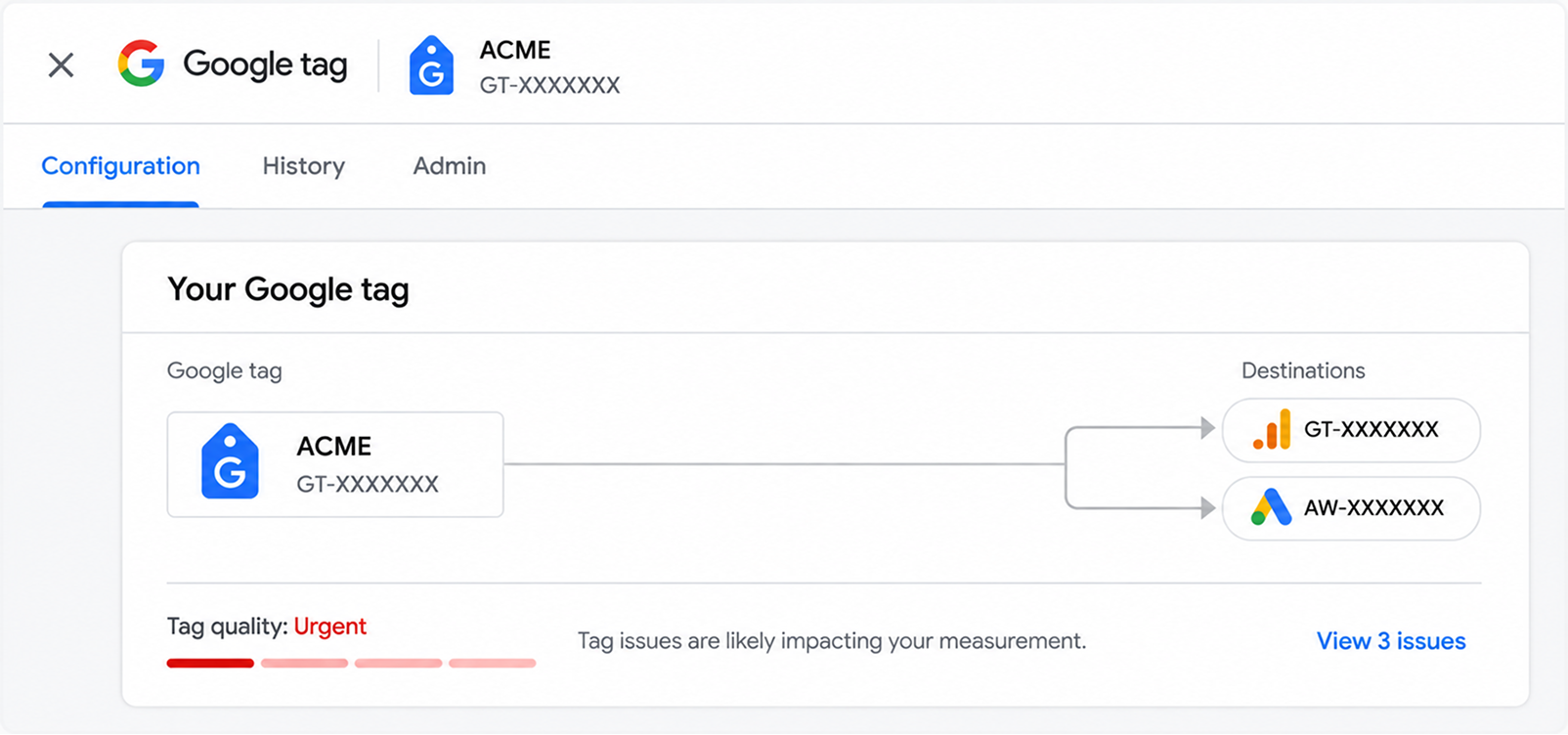
That assumption is worth checking. A tag can be present, firing, and technically valid while it still captures the wrong action, the wrong value, or the wrong business outcome. Tag health and measurement health are related, but they are not the same thing.
Google Tag Diagnostics has made technical monitoring easier and more accessible. It has not changed what marketers need to verify before using conversion data to guide campaign decisions.
Google Tag Diagnostics Raised the Baseline
Google Tag Diagnostics checks a tag's technical implementation directly inside Google Ads and Google Tag Manager, flagging issues like untagged pages, missing conversion linkers, incorrect command order, missing consent signals, and invalid transaction IDs.
Two things follow from that:
- It caught problems teams used to find manually, and late. A broken conversion tag could sit unnoticed for weeks, quietly undercounting results or feeding bad signals into automated bidding, until someone traced a reporting anomaly back to the cause, often after the budget was already spent.
- \\It's also made "clean status" easy to mistake for "nothing to check."\\As native monitoring gets more reliable, and Google's 2026 enhanced-conversions update pushes this further with end-to-end diagnostics across tag and API inputs, a team that sees no warnings can start assuming there's nothing left to verify.
Google Tag Diagnostics is designed to answer a narrow operational question: is the tag firing and sending data as configured? It does not confirm whether the configuration itself reflects the right events, values, consent logic, or measurement requirements.
A tag can be technically healthy and still be tied to the wrong customer action, an incorrect conversion value, or a business outcome that does not matter. A healthy status does not confirm that:
- The event represents the intended customer action.
- The correct conversion value or business meaning is attached.
- Important steps in the customer journey are being measured.
- The event is recorded consistently across analytics and advertising platforms.
- The signal is useful for the decision it is meant to support.
- The implementation will continue working correctly after future site releases.

Five Ways a Healthy Tag Can Still Produce Unhealthy Measurement
A tag can pass every technical check in Google Tag Diagnostics and still report the wrong thing to the business. Here are five examples of how that happens.
- A video play is labeled as a form submission. The tag fires correctly and consent signals are intact. But the event was mapped to the wrong interaction during implementation, so a passive engagement gets counted as a high-intent lead action. Campaigns optimizing toward this event end up chasing video views, not actual leads.
- A page load is treated as meaningful engagement. The tag reports "success" the moment a page renders, regardless of whether the visitor actually interacted with the content. Technically, the tag works as configured. The configuration itself measures the wrong thing, and the resulting engagement numbers overstate how many visitors did anything beyond opening a page.
- A purchase tag fires, but the wrong value or currency is passed. Diagnostics confirms the tag fired and data was received. It does not check whether the value parameter matches the actual transaction amount or currency. In a multi-region campaign, this can mean revenue gets reported in the wrong currency or with the wrong figure attached, which silently distorts ROAS calculations and budget allocation decisions across markets.
- The final conversion is captured, but abandonment points are missing. A completed purchase or signup shows up cleanly. But if the steps where users drop off aren't tracked, the team has no visibility into where the funnel is actually losing people; only where it succeeds. This limits the ability to diagnose why conversion rates are flat or declining, even when the final event looks healthy.
- An event is collected correctly but never used in reporting or optimization. The tag is technically sound, the data reaches Google, and everything shows green. But if no one connects that event to a dashboard, a bid strategy, or a reporting model, the measurement exists without doing any work. This is common after a platform migration or a reporting redesign, when older events keep firing but stop feeding anything the team actually looks at.

Conversion differences across platforms don't always mean tracking is broken, as each platform may use different attribution and counting rules. The key is to understand and reconcile unexplained differences. Tag Health confirms technical tracking, while Measurement Health confirms whether the data is accurate and meaningful.

The Core Difference Between Tag Health vs. Measurement Health
Tag health and measurement health answer fundamentally different questions.
Tag health tells you whether tracking is technically working. Measurement health tells you whether the tracking is actually capturing the right behavior, meaning, and business value.
A technically healthy tag does not automatically mean your measurement is healthy.
| Tag Health Asks | Measurement Health Asks |
|---|---|
| Is the tag present? | Is the right interaction being measured? |
| Did it fire? | Did it fire for the correct behavior? |
| Was data received? | Was the correct meaning and value received? |
| Is the configuration valid? | Does it support a defined business decision? |
| Is there a technical warning? | Is there a material blind spot? |
Tag health is a prerequisite for measurement health. The measurement of health requires someone to know what the business is trying to measure and compare that against what's actually being collected.
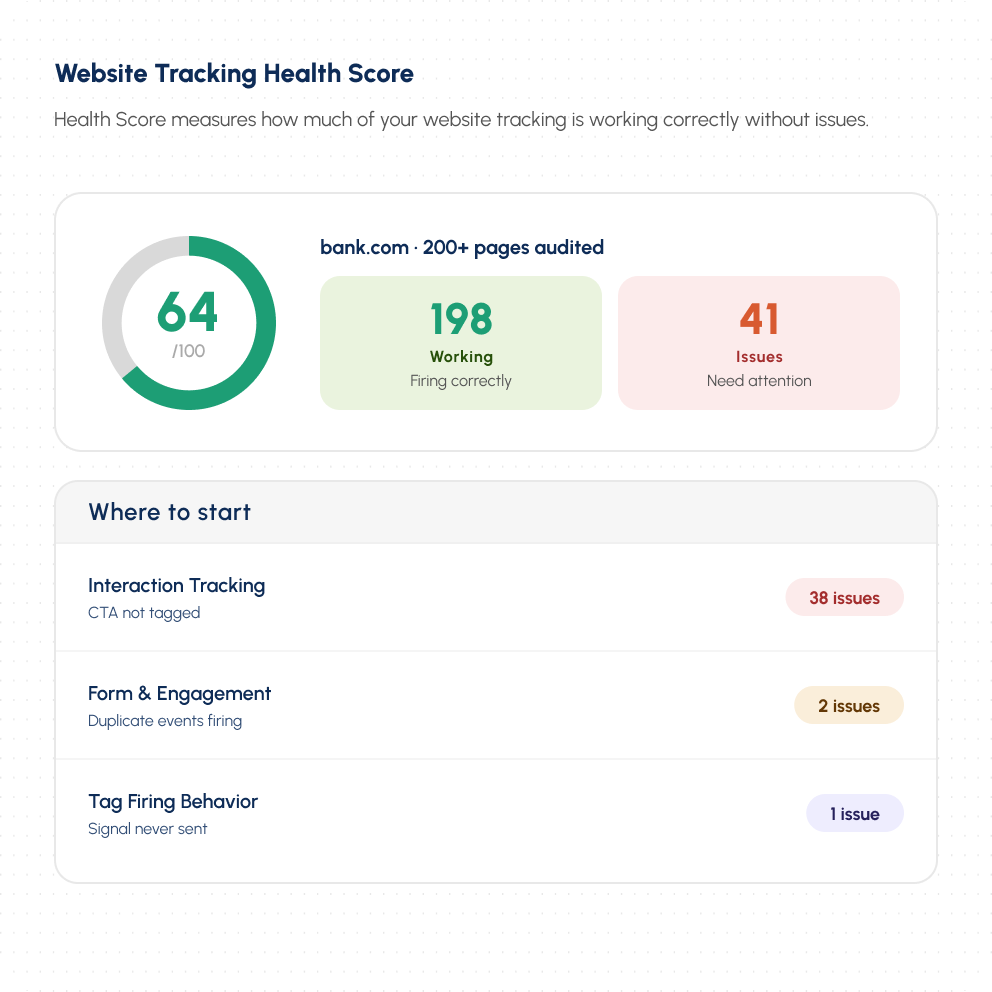
Curious what your own tracking health score looks like?
The Six-Part Framework for Evaluating Measurement Health Across Technical, Semantic, and Business Dimensions
The distinction between tag health and measurement health above is a useful mental model, but applying it in practice requires something more concrete to check against. Measurement health is generally assessed across six dimensions.
- Technical operation: the tag fires reliably and delivers data as configured. This is the layer Google Tag Diagnostics and similar native tools are built to evaluate tag presence, firing order, consent signals, and recent data receipt. It confirms delivery, not meaning.
- Semantic accuracy: the event captured genuinely represents the intended customer action. A tag can fire correctly and still be attached to the wrong interaction a video play counted as a form submission, for instance so this dimension generally requires comparing the fired event against a documented definition of what the action was supposed to be.
- Journey completeness: meaningful steps in the customer journey not just the final conversion are being tracked. A completed purchase can be captured accurately while earlier steps, such as cart abandonment or failed checkout attempts, go unmeasured, leaving the team without visibility into where prospective customers drop off.
- Business relevance: the data collected maps to a decision the business actually needs to make. An event can be technically valid and semantically accurate while still being disconnected from any campaign, budget, or optimization decision in which case it's generally of limited practical use regardless of how cleanly it's tracked.
- Cross-platform consistency: the same event is represented consistently across analytics and advertising platforms. Differences in attribution windows, deduplication logic, or platform-specific counting rules can cause the same underlying action to be reported differently in, say, GA4 versus an ad platform, even when both are individually diagnostic-clean.
- Continuous validation after change: measurement accuracy is re-checked after releases, campaigns, or site updates, not assumed to hold indefinitely. A site redesign, a new checkout flow, or a tag-management update can silently break semantic accuracy or journey completeness without ever triggering a technical warning, which is generally why this is treated as a recurring check rather than a one-time task.
A Practical Workflow for Validating Tracking
- Select one campaign-critical conversion.
- Define the business outcome it is meant to represent.
- Document the expected action, event, parameters, value, and consent behavior.
- Test successful, failed, abandoned, and duplicate journeys.
- Compare collection across analytics platforms, ad platforms, and the source-of-truth system.
- Revalidate after launches and site changes.
This workflow is generally applicable regardless of tooling, though the manual effort involved tends to scale with the number of conversions and platforms a team maintains.
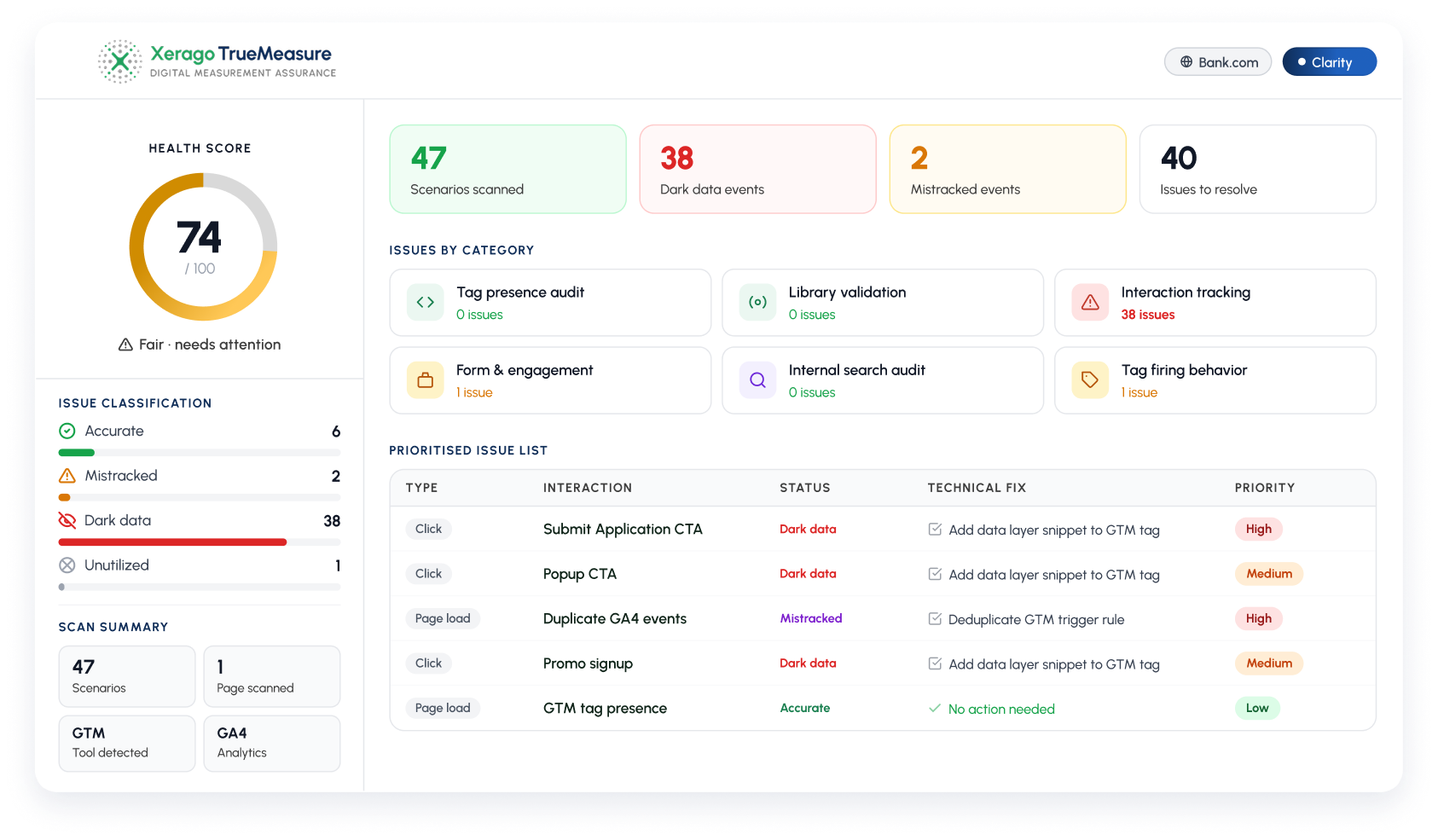
Xerago's TrueMeasure is built to work alongside existing analytics and tag-management tools, not in place of them. Its role generally centers on:
- Web-and-app auditing: reviewing implementations across both surfaces rather than one in isolation.
- Business-intent validation:checking whether a captured event matches the customer action it's meant to represent.
- Cross-platform measurement assurance: comparing how the same conversion is represented across analytics and advertising systems.
- Impact-based prioritization: helping teams identify which measurement gaps are material to a business decision, rather than treating every discrepancy as equally urgent.
- Remediation support: assisting in resolving identified gaps once they're found.
Before allowing a conversion metric to shape budget or optimization decisions, it's worth verifying both its technical health and its business meaning, treating the diagnostic as one layer of assurance rather than the whole picture.
FAQs
If my Google Tag Diagnostics status is healthy, does that mean my conversion data is accurate?
Not necessarily. A healthy status confirms that a set of technical conditions, tag presence, firing order, consent signals, recent data receipt, are being met. It does not confirm that the event represents the intended customer action or carries the correct value, which is a separate check.
Can a tag pass all of Google's diagnostic checks and still track the wrong thing?
Yes. A tag can be technically valid, present, firing, delivering data, while measuring an unintended action, such as a page load being counted as meaningful engagement. This is generally described as a semantic accuracy gap rather than a technical fault.
Does this mean Google Tag Diagnostics isn't a reliable tool?
No. Google Tag Diagnostics is functioning as designed and remains a useful platform-level check for common implementation issues. The distinction being drawn here is about scope, not reliability, the tool evaluates technical delivery, and measurement health additionally requires checking business meaning.
How often should measurement health be revalidated?
Generally, after any site release, app update, or major campaign launch, since implementation changes can silently affect what an event actually captures, independent of whether the tag itself remains diagnostic-clean.
Is measurement health a one-time audit or an ongoing process?
It is generally treated as an ongoing process rather than a single audit, since journeys, platforms, and implementations change over time. Continuous validation after change is one of the six components of a measurement-health check.
Does TrueMeasure replace the need for Google Tag Manager or GA4?
No. TrueMeasure is designed to work alongside existing analytics and tag-management tools, extending validation to business-intent and cross-platform consistency rather than replacing native tagging infrastructure.
What's the difference between a discrepancy across platforms and a broken tag?
Not every cross-platform discrepancy indicates broken tracking as differences in attribution windows, deduplication logic, or platform-specific counting rules can also produce mismatches. Determining the cause generally requires comparing collection methodology across platforms rather than assuming either side is faulty.
Kaviarasu S
Associate Content Writer
Xtelligence Inbox.
Your weekly dose of marketing smarts!
Related Posts