Interactions Correctly?


How Do You Fix Frequency Capping When the Problem Lives Between Platforms, Not Inside Them?


Frequency caps are set on every channel. Customers are still burning out. The problem is not the cap setting. It is where the cap is enforced.
Every channel tool enforces frequency independently. Email counts its own sends. Paid social counts its own impressions. Push counts its own notifications. None of them count what the others have already delivered to the same customer. A customer can receive twelve brand contacts in 48 hours while every individual channel remains within its own limit. No rule is broken. The customer disengages anyway.
The cap is working at the channel level. The damage is happening at the relationship level. Until frequency is measured and enforced where the customer journey experiences it across all channels combined as the cap will keep passing its own audit while producing the wrong outcome.
Why Per-Channel Caps Cannot Solve a Cross-Channel Problem
Each channel tool was built to manage its own sends. The frequency cap inside email is an email rule. It has no access to what SMS sent this morning or what display retargeting served yesterday. It enforces a limit on the data it can see which is only its own.
This creates a fundamental mismatch between how frequency is managed and how it is experienced. The table below makes that gap concrete.
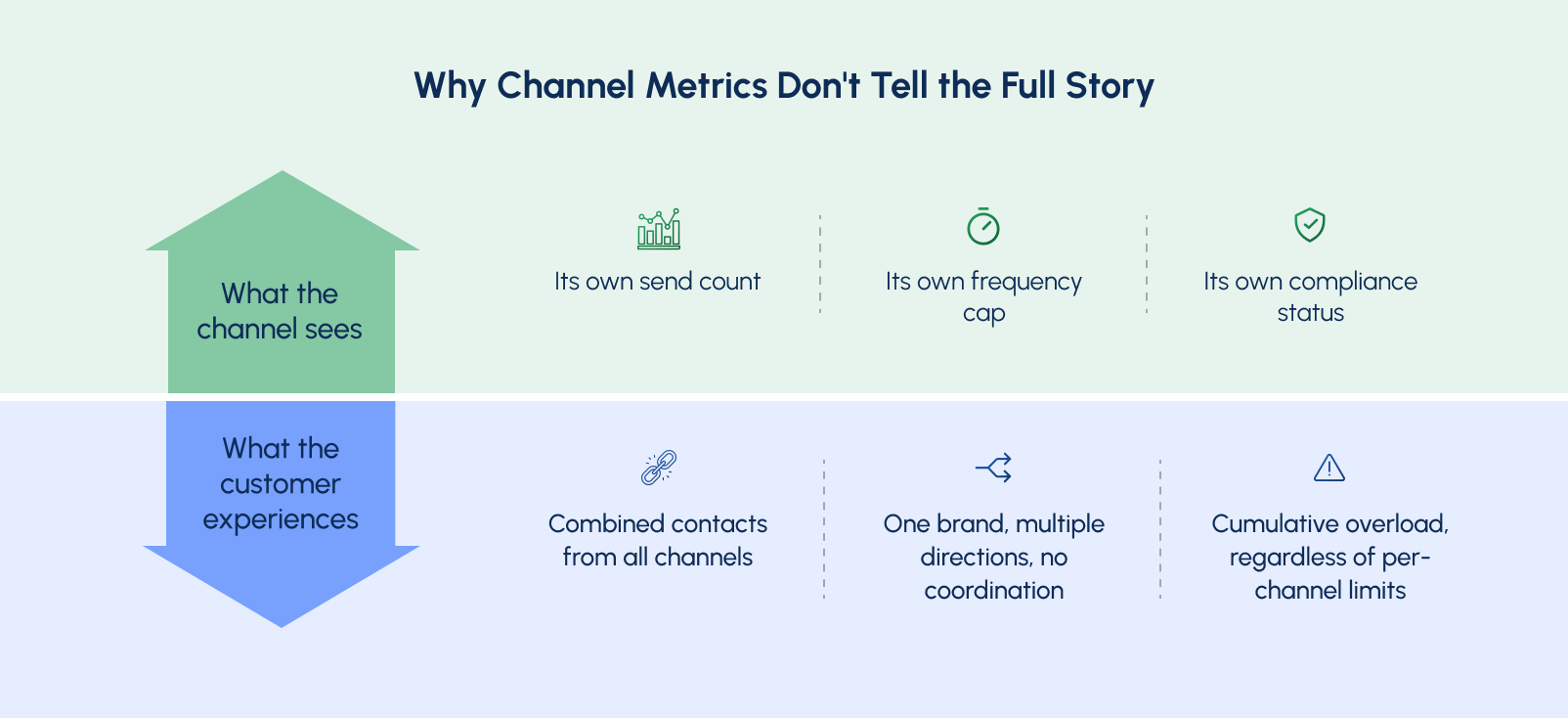
The customer does not separate these streams. When the combined load exceeds what feels reasonable, they disengage regardless of whether any single channel technically over-sent.
Where Cross-Channel Frequency Breaks Hardest
Frequency failure in multichannel stacks rarely shows up in platform dashboards. Every channel reports within limits. Every campaign passes its own compliance check. The breakdown only becomes visible when you look at what the customer actually received across all channels, in sequence, on the same day.
The Moments Where Every Channel Is Right and the Customer Is Done
1. Paid and owned channels firing on the same day. A lifecycle email triggers in the morning. Push fires on a behavioural event in the afternoon. Retargeting serves a display ad in the evening. All three evaluated eligibility independently. All three stayed within their own limits. The customer received three brand contacts before midnight. No system was aware of the others.
2. Re-engagement campaigns targeting active customers. A re-engagement sequence triggers for a customer showing no email activity in 30 days. The same customer has been clicking paid social ads and responding to push throughout that period. The sequence measures inactivity on one channel and draws a conclusion the cross-channel picture directly contradicts then adds to a contact load that was already sufficient.
3. Post-conversion suppression with a delay. A customer converts. Owned channels update and suppress the relevant flows. The paid retargeting pixel does not receive the conversion signal until the next batch sync in 12, 24, sometimes 48 hours later. Display ads for a product already purchased continue serving in that window. The paid channel frequency cap is not violated. The experience is still wrong.
The Common Thread
These are not three separate problems. They are three expressions of the same structural gap:
- Every individual channel performed correctly within its own rules
- No platform dashboard flagged a problem because no platform had full visibility
- The customer absorbed the failure of a system that could not see itself whole
- Paid and owned channels share a customer but not a frequency ceiling
- A single-channel inactivity signal is not a cross-channel conclusion
- A batch sync gap between owned and paid infrastructure is not a configuration error it is a structural consequence
- Platform-level suppression rules can only see platform-level activity
- The coordination gap lives between platforms and that is where the fix has to live too
The fix is not more suppression rules inside individual platforms. Platform-level rules can only see platform-level activity. The coordination gap lives between platforms and that is where the solution has to live.
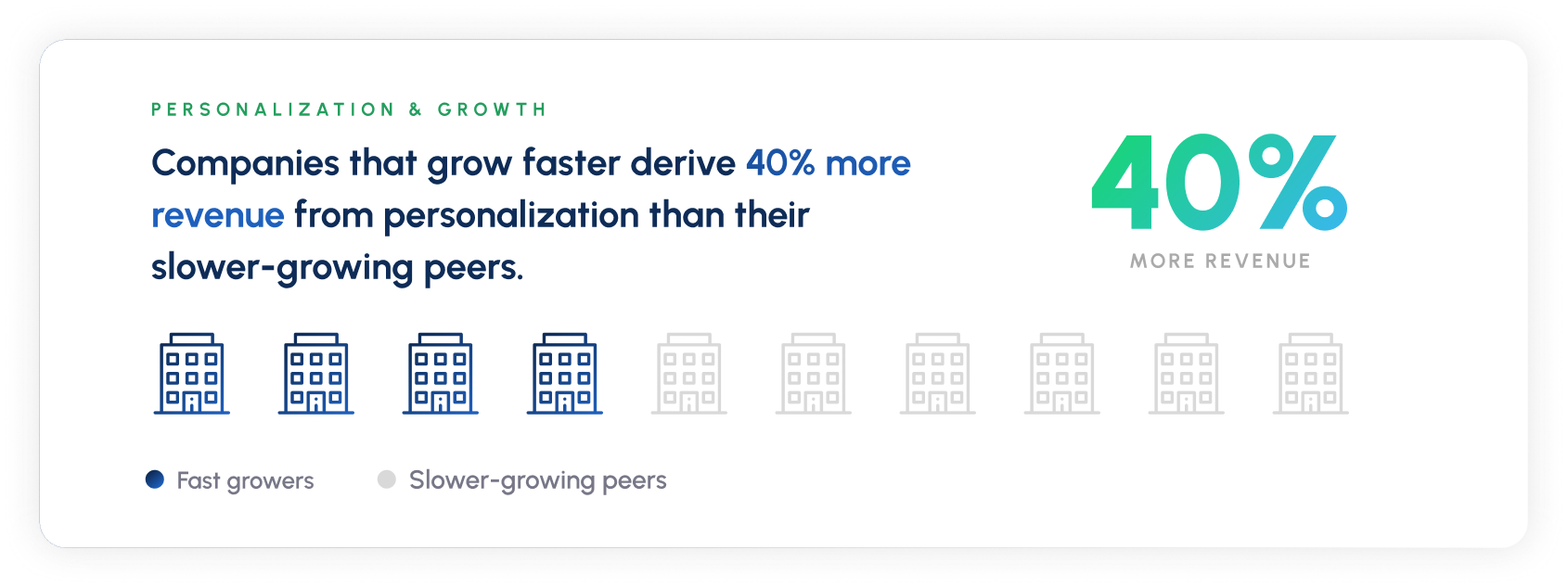
What Cross-Channel Frequency Control Actually Requires
Tightening individual channel caps does not fix this. A stricter email cap does not affect what paid social media delivers. A lower push limit does not change what display retargeting serves. Reducing frequency within each channel while the architecture remains unchanged simply means the customer receives fewer messages per channel and the same cumulative overload across all of them combined.
The fix is not a setting. It is a structural change. The frequency decision needs to move out of individual channel tools and into a layer that sits above all of them, one that can see the total contact load a specific customer is absorbing across every channel simultaneously, and enforce a limit at that level before any channel sends.
Three components make this possible. Each one depends on the previous.
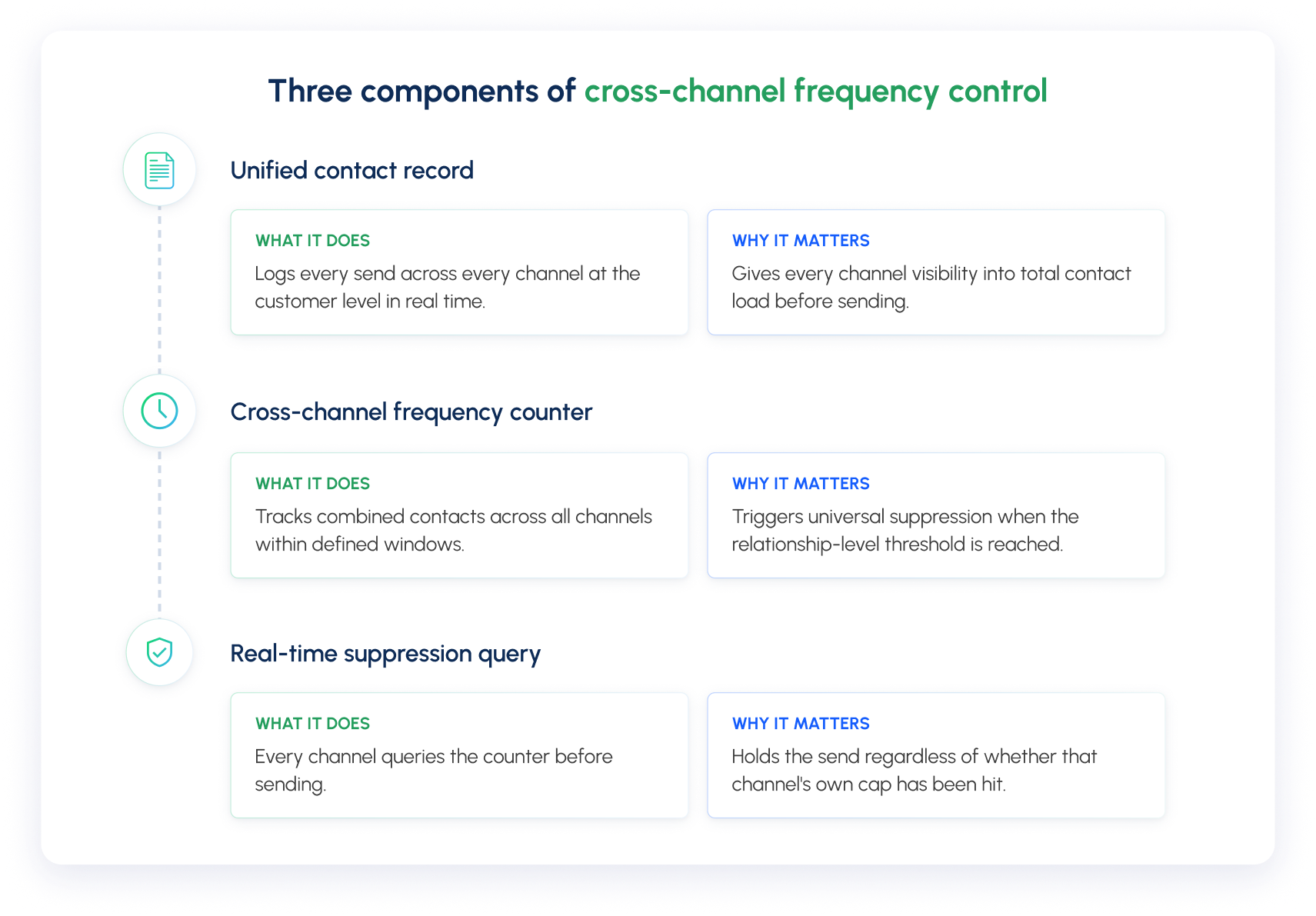
The unified contact record is the foundation. Without a live log of every send across every channel at the customer level, no channel can know the customer's actual combined contact load before it fires.
The counter sits on top of that record and calculates one number total brand contacts across all channels in a defined window. When that number hits the threshold, suppression triggers universally across every channel simultaneously. The suppression query is what enforces it every channel checks the counter before sending, and holds the send if the threshold is reached.
Most stacks have versions of all three inside individual platforms for that platform's own sends only.
The gap is between platforms. Closing it requires a layer that sits above every channel tool and returns suppression decisions in real time before any of them act.
Frequency damage shows up in churn data months after it starts. If you want to catch it earlier
Where to Start Before the Full Architecture Is in Place
Building cross-channel frequency infrastructure takes time. A practical interim approach:
- Identify the two or three channel combinations that overlap most for high-value segments typically email and push, or email and paid retargeting
- Manually enforce a combined contact rule for those combinations first
- Sync a suppression list across those channels on a daily cadence
This will not catch same-day conflicts; batch sync is not real-time suppression. But it immediately reduces the most persistent overlap patterns while the full architecture is being built.
On Tooling: What Platforms Like Braze Can and Cannot Do
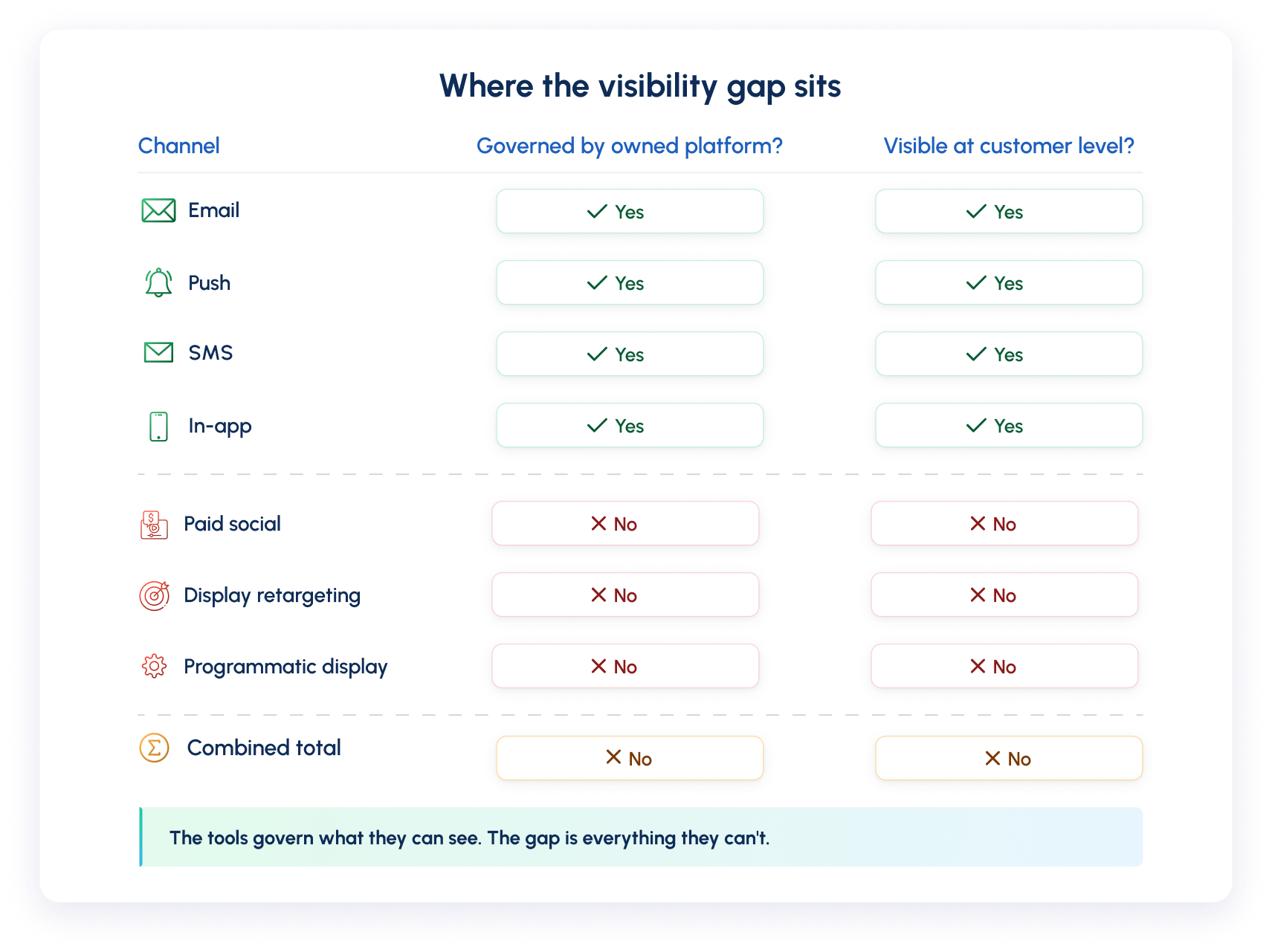
Tools like Braze offer meaningful frequency controls within their owned channel ecosystem. If email, push, and SMS all run through the same platform, cross-channel frequency governance within that ecosystem is achievable and for many organisations, implementing those controls properly is itself a significant improvement over the default configuration.
| What a unified owned platform can govern: | Where the governance stops: |
|---|---|
| Combined email and push frequency caps within the platform | Paid social - separate platform, separate audience management, separate frequency logic |
| Suppression logic that applies across email, SMS, and push simultaneously | Display retargeting- pixel-based, batch sync, no real-time owned channel visibility |
| State-based rules: a purchase suppresses abandoned cart flows across all owned channels | Programmatic display - third-party data refresh cycles, furthest from real-time suppression |
| Opt-out propagation within the platform ecosystem in real time | Combined owned and paid contact total - not visible inside any single owned platform |
The gap is paid and displayed. Closing it requires a suppression integration that sits outside the owned channel platform and feeds into paid audience management in near real time. That integration is not a feature inside existing platforms, it is a separate capability that has to be built or connected.
Tracking contact frequency across paid and owned channels simultaneously at the customer level, not the campaign level is where most stacks have a visibility gap.
Frequency Capping Best Practices That Work Across Channels
Most frequency capping guidance is written for single-channel contexts. These five practices operate at the relationship level, the only level where cross-channel frequency can actually be controlled.
1. Set the combined daily threshold before configuring any channel cap. The maximum number of brand contacts a customer should receive across all channels in 24 hours is the actual frequency policy. Per-channel caps are implementation details as they should be set to ensure the combined total never exceeds that number, not configured independently and assumed to produce a reasonable aggregate.
2. Count paid contacts the same as owned. Display impressions and retargeting ads are brand contacts. They count toward the customer's combined contact load the same way email and push do. Any frequency framework that excludes paid channels is enforcing limits on less than half of what the customer actually receives and making an incomplete picture the basis for frequency decisions.
3. Suppress on state change, not on schedule. A purchase, opt-out, or open support ticket should suppress every channel immediately, not at the next batch sync. A 12-hour suppression delay is enough to produce the post-conversion ad problem. Real-time state propagation is not optional if suppression is going to work at the relationship level.
4. Audit actual cross-channel contact before adjusting any cap. Reconstruct the full message sequence of a sample of customers received across all channels over 30 days before changing any setting.
Most cap adjustments are made based on single-channel performance signals, open rates, opt-outs, engagement drop. Those signals show what one channel produced. They do not show what the customer absorbed across all of them. Adjusting caps without the cross-channel picture is adjusting blind.
5. Track silent disengagement as the leading frequency signal. Unsubscribes confirm frequency damage has already occurred. Customers who stop engaging across all channels without formally opting out, no opens, no clicks, no conversions, show the earlier signal, often weeks before opt-out data moves. Track it at the relationship level, across channels combined, and correlate it with combined contact frequency to catch threshold breaches before they compound.
Is your suppression firing on clean data or available data? TrueMeasure ensures the data is right before the decision fires.
What Happens When Frequency Is Finally Managed at the Right Level
When frequency is enforced at the relationship level, every channel sends with full visibility into what the customer has already received across all channels combined. The threshold is set once. The architecture enforces it everywhere, automatically, before any channel acts.
The results are direct:
- Every contact is informed by the full cross-channel picture, not just what one channel can see
- Re-engagement sequences reach only customers who are genuinely inactive across all channels
- Suppression reaches paid channels at the moment of conversion the next ad is relevant, not redundant
- The combined message sequence becomes coordinated and deliberate
Audience engagement improves. Burnout drops. Unsubscribe rates reflect genuine preference, not frustration from a contact load no single channel was accountable for.
No new channels. No new budget. Just every existing channel makes smarter decisions because the right information is finally available at the right moment.
Outcome indicators what improves and why:
| What improves | Why it improves |
|---|---|
| Audience engagement | Messages arrive when appropriate not when each channel independently decided to send |
| Burnout rate | Over-delivery is visible before it becomes opt-outs intervention happens upstream |
| Unsubscribe quality | Opt-outs reflect genuine preference not accumulated frustration from invisible contact load |
| Re-engagement accuracy | Sequences trigger only on genuine cross-channel inactivity not single-channel signals |
| Paid media efficiency | Ad spend stops serving converted and oversaturated customers budget works against real gaps |
| Post-conversion experience | Conversion suppresses paid retargeting in real time the next ad is relevant, not redundant |
The Underlying Principle
No new channels. No new budget. No new campaigns.
Every existing channel makes smarter decisions because the right information is finally available at the right moment. The channels were not the problem. The campaigns were not the problem. The data was not the problem. The problem was that no system had visibility into what the others were doing at the moment it needed to act.
Relationship-level frequency management does not change what the stack is capable of sending. It changes what the stack chooses to send because every channel finally has the full picture before it decides.
That is the difference between a stack that executes and a stack that coordinates. Between channels that fire and a system that thinks. Between a customer who feels marketed at and one who feels understood.
The threshold is set once. The architecture enforces it everywhere. Every channel sends the full picture. No channel fires blind.
This is not about sending less. It is about every channel finally knowing enough to send right.
Stop managing frequency per channel. Join our 5 days Bootcamp that builds the layer that manages it across all of them
Kaviarasu S
Associate Content Writer
Xtelligence Inbox.
Your weekly dose of marketing smarts!