Interactions Correctly?


Why Chief Marketing Officers Are Becoming AI Architects, Not Just Users


Over the last 18 months, we've watched 50+ CMOs at Fortune 500 companies make the same expensive mistake. They keep buying smarter AI tools instead of building the intelligence layer that actually drives results.
Here's what the best ones figured out: competitive advantage doesn't come from having better features. It comes from owning the brain that connects them all.
What is AI Marketing today? Artificial intelligence in marketing now means an owned AI core: transparent decision logic, governed agents, cross-stack orchestration, and the ability to see why artificial intelligence acts, not just what it does, delivering closed-loop learning that lifts ROI.
As a CMO, this shift means you're no longer just selecting tools, you're architecting intelligence systems that your brand uniquely owns.
From Salesforce to Adobe, AI Arrived Ready-Made
For years, the story felt simple. Log in to the platform. Let its AI tune the knobs. Watch the graph go up.
What no one saw coming was how this comfort would become the trap that kills competitive advantage in an era where AI marketing trends demand strategic ownership, not passive consumption.
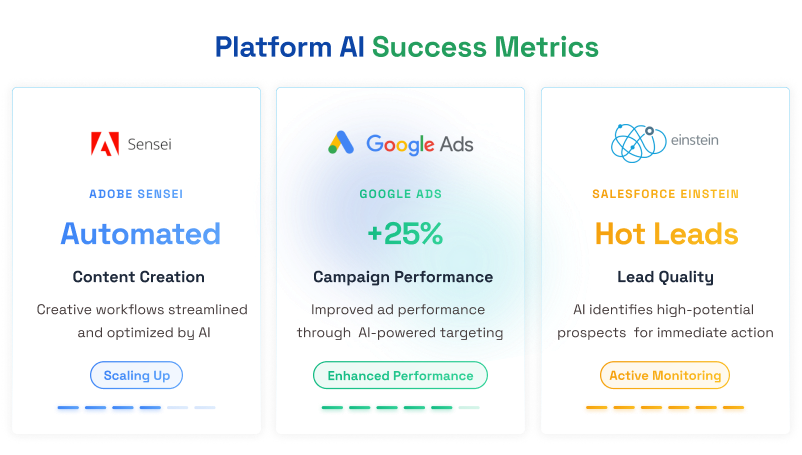
Elsewhere, Salesforce Einstein predicts which leads are most likely to close. Adobe's artificial intelligence engine, Sensei, generates dozens of creative versions with just a prompt. AI for marketing wasn't something brands had to build. Artificial intelligence came pre-installed, baked into marketing AI tools they already used.
The promise? Intelligence without effort and measurable AI ROI beyond feature wins through AI marketing automation.
Key Takeaways
vendor AI and
separately waste potential.
Foundation models changed everything . Old AI answered questions. New AI plans and executes across your entire stack.
Only you have your specific business rules and customer understanding. Everyone has data. **Only you have your specific business rules and customer understanding.**
Generic AI doesn’t know your customers. It writes fast but doesn’t know customer history or preferences.
Connected tools deliver exponential results. **Connected tools deliver exponential results.**
The brain controlling them becomes yours .
CMOs must own their AI, not rent it. Building your own intelligence layer is the only sustainable competitive advantage.
What CMOs Miss When AI Platforms Stay Isolated
CMOs did what seemed prudent. They followed the numbers. They placed trust not in coders or architects, but in AI marketing platforms.
There was relief in this delegation. Let the vendor worry about the algorithm. Let the tool decide what works best. Strategy could be left to humans; optimization to machines.
But this comfortable belief masked a quiet surrender of marketing intelligence.
When intelligence comes pre-packaged, we inherit its logic, but never shape it.
Each platform’s artificial intelligence worked only within its own domain. It could not see beyond its sandbox. It could not learn from what happened elsewhere. (ChiefMartec – The New Data Layer in Martech 2024)
A smart tool is not a smart system. And over time, the limits of platform-bound AI became visible to forward-thinking artificial intelligence marketing agencies.
We sat in on a planning session with a $2B retail CMO last month. They had fifteen different AI tools. Salesforce Einstein, Adobe Sensei, Google Smart Bidding—the works. Each one reporting great metrics.
But here's the kicker: none of them talked to each other.
And when they tried to understand why Smart Bidding chose certain audiences, or how Einstein prioritized specific leads, they hit a wall. The logic was locked inside vendor algorithms they couldn't access, audit, or adjust.
INSIDE OUR PROCESS: “When we audit these stacks (and trust me, we've seen some doozies), the pattern is always the same. Smart tools, dumb connections. We spent 3 weeks with that retailer just figuring out what data lived where before we could even think about orchestration.”
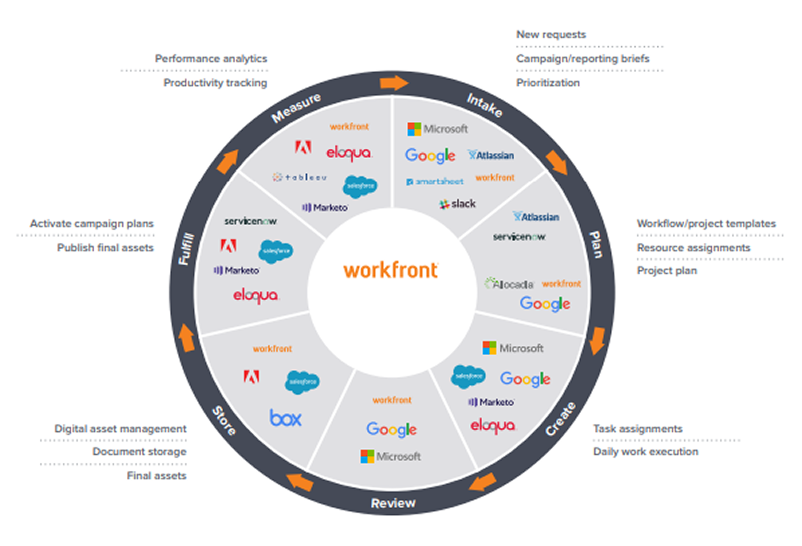
Every marketing team uses multiple tools, from Google and Microsoft AI to Salesforce and Adobe, that should work together seamlessly. But here's what most CMOs don't realize about how these platforms actually connect in their workflow...
When Marketing Intelligence Becomes Yours to Command
There is a quiet contradiction at the heart of modern AI marketing. We are surrounded by “intelligent” tools. Each one claims to optimise something: ad targeting, email timing, creative layout. And each one delivers measurable improvement.
In its own world.
But marketing with AI does not happen in silos. A customer who clicks an ad does not stop being a person when they open an email. Nor does a lead scored in Salesforce exist separately from how they were engaged on Instagram. Yet that is how most AI marketing campaigns works today.
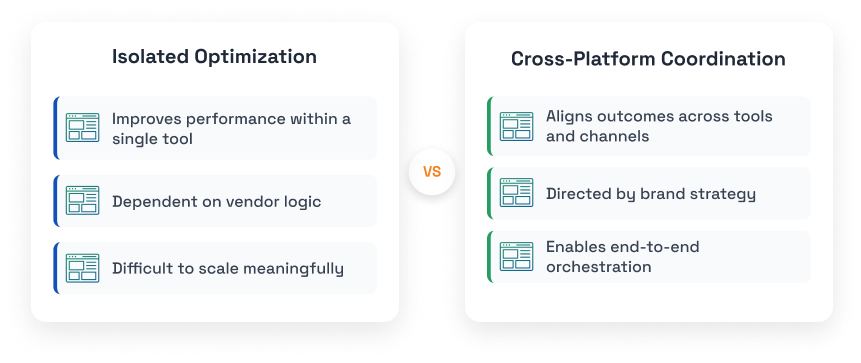
For too long, marketing leaders have mistaken these isolated wins for integrated intelligence. They have celebrated the parts while ignoring the system.
But marketing is a system. And any system that cannot coordinate its intelligence is, by design, inefficient. So what happens when brands finally hit this ceiling? The cracks start showing in unexpected ways…
When Platform Promises Meet Hard Reality
The promise of platform AI is not false. It is simply incomplete. Take the case of an AI in an e-commerce firm.
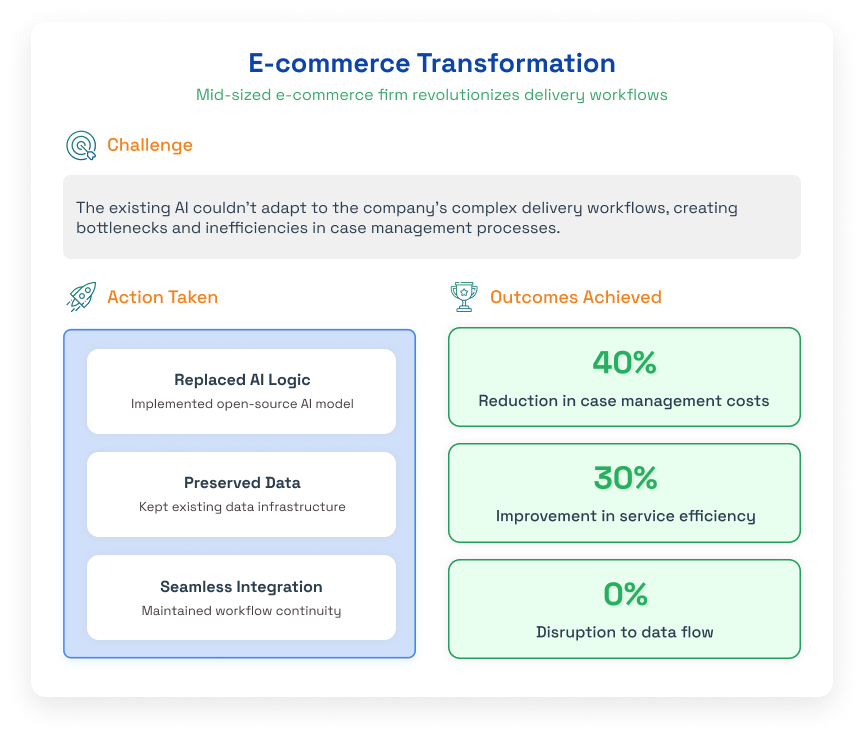
They relied on AI-powered case management. It worked. Until it didn’t. This kind of AI application, while powerful, is limited by the logic defined by the vendor.
Here's what nobody talks about: The moment you hit platform limits, you're stuck. You can't open the hood. You can't adjust the reasoning. You can't even see what signals the AI weighted most heavily.
We've seen CMOs spend huge amounts on "AI transformation" only to discover they've just built a prettier version of the same fragmented system.
This is the turning point. They realise that the limits they face are not about features, but foundations. And sometimes, progress begins by stepping out of the very tool that brought you this far.
How Foundation Models, Generative AI, and Frontier AI Changed the Game Rules
AI in marketing meant smart features inside bigger tools. Now, it means something else entirely for AI marketing companies and enterprises alike.
The rise of foundation models, like GPT, Claude, LLaMA, etc., has rewritten the rules of AI-powered marketing. (Accenture Technology Vision 2025)
These aren’t just better AI chatbots. They are general-purpose reasoning engines. They can write, translate, summarise, and now, they can act.
This is no small shift. Earlier, AI was optimised within tools. Now, AI can orchestrate between them. But this isn't just theory. CMOs are already making this leap and the results are telling for marketing and AI integration.
KEY INSIGHT!: “Foundation models enable systems that plan actions, use online tools, and collaborate. These agents can execute complex, multistep workflows across a digital ecosystem.”
Imagine an AI that reads your CRM, drafts a proposal, updates the CMS, and schedules the ad campaign, without switching interfaces. Now imagine being able to see why it chose that proposal tone, which CRM signals triggered the campaign timing, and how you can adjust those rules for next time.
That is the leap foundation models have enabled for AI marketing automation tools.
Marketing agents powered by foundation models are being built across industries. Some respond to real-time customer behaviour.
From Smart AI Tools in Marketing to a Cloud AI Core
To build with foundation models is to stop thinking in features and start thinking in systems. Until now, AI in marketing has been an accessory.
A smart assistant inside someone else’s product. It edited the ad, scored the lead, or timed the email. That’s how AI in email marketing worked.
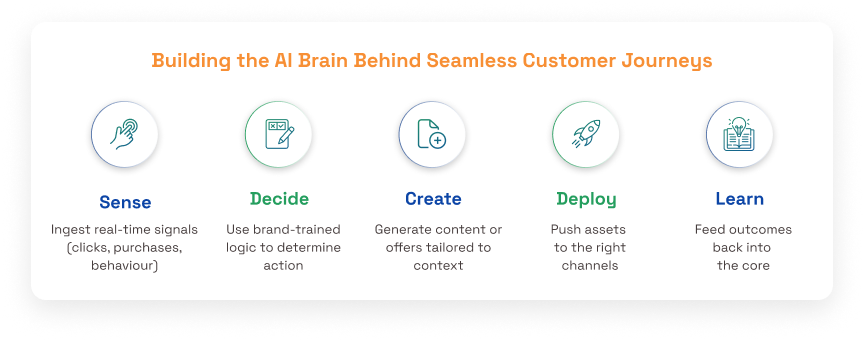
But what if the intelligence wasn’t scattered across platforms? What if it lived at the centre?
Three years ago, this was just a theory. Today, it's happening in boardrooms you'd recognize, and the results are rewriting the rules of marketing AI.
Instead of plugging into vendor logic, they are building their own AI marketing strategy. Instead of reacting to dashboards, they are designing the architecture. This is not just a technical upgrade. It is a shift in power. The brand, not the vendor, becomes the conductor.
But here's what most executives don't realize about this shift. It changes everything about how they compete.
What the Best AI Marketing Tools Reveal About the True Benefits of AI in Marketing
Historically, marketing executives leaned on tool-specific AI features to unlock efficiency. Each delivered meaningful improvements, but only within its silo:
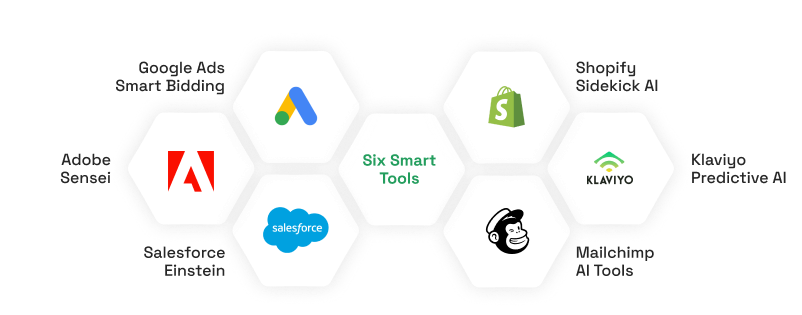
Here’s a comparison of top AI Marketing tools:
- Google Ads Smart Bidding → automatically adjusts keyword bids in real time to maximise conversions, leveraging signals like device, location, and audience intent.
- Salesforce Einstein → scores leads, predicts deal closures, recommends next actions, and surfaces opportunities for sales teams using AI for sales and marketing.
- Adobe Sensei → generates multiple creative variations, powers personalised product recommendations, and analyses customer journeys for targeting.
- Shopify Sidekick AI → suggests product descriptions, automates merchandising, and answers merchant questions about sales trends.
- Klaviyo Predictive AI → forecasts customer churn, predicts optimal email send times, and recommends segments for campaigns.
- Mailchimp AI Tools → generates subject lines, recommends content, and provides send-time optimisation for email campaigns.
Want the blueprint?
We convinced CMOs who've actually pulled this off to walk through their architectures step-by-step. (These are people running marketing at companies you'd recognize, they're just too busy executing to be posting about it on LinkedIn.)
Why Features Cannot Build Foundations
The truth is, these AI marketing software solutions are impressive. Google Ads Smart Bidding reshaped paid media. Salesforce Einstein changed how sales teams prioritise. Adobe Sensei revolutionised creative testing. Shopify, Klaviyo, and Mailchimp put predictive AI into the hands of every merchant and marketer. They each moved the industry forward.
But features alone don’t make a foundation. Each of these tools optimises within its own walls, blind to the signals beyond.
- Smart Bidding doesn’t know what content Adobe generated.
- Einstein doesn’t understand what loyalty trigger Klaviyo fired last week.
- Mailchimp can’t anticipate what Shopify’s Sidekick recommends in the store.
Efficiency isn’t the same as intelligence. Efficiency improves the part. Intelligence connects the whole. And in marketing, the competitive edge rarely comes from isolated wins; it comes from orchestrated systems that learn across every channel, every journey, and every interaction.
Systems where CMOs can see, direct, and refine the logic driving every decision.
So how exactly are forward-thinking brands building these systems? The answer lies in something most CMOs haven't considered..
How AI Marketing Companies Are Building Central Orchestration Around Real-World AI Marketing Use Cases
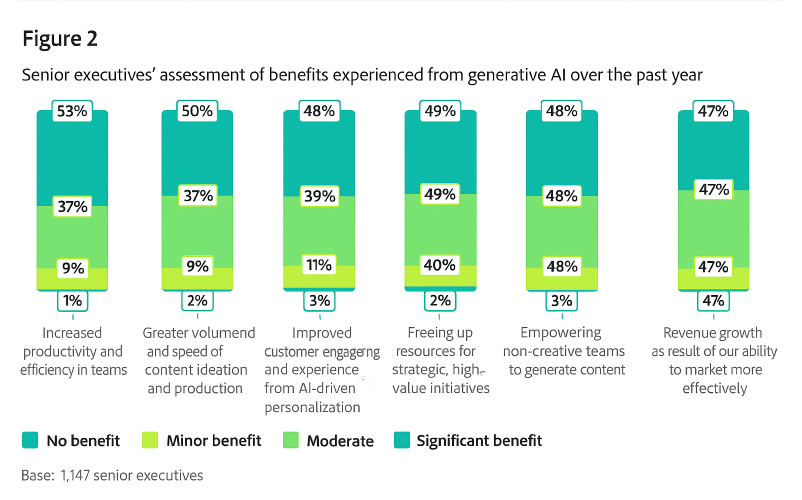
Senior executives report varying levels of benefits from generative AI implementation across different business functions. While significant benefits are evident in AI-powered content creation and customer service, productivity gains in core marketing operations remain inconsistent without proper orchestration.
Some are beginning to operate with a central orchestration engine, an AI marketing platform “core” that sits above tools. (IBM – Top AI Agent Frameworks)
This core is not another dashboard. It is a decision layer that:
- Pulls customer data from CRM platforms.
- Generates content or offers using foundation models trained on brand context through generative AI in marketing.
- Decides placement based on real-time journey analytics.
- Pushes assets automatically into programmatic ad tools, email systems, or social channels.
- Learns continuously from each response, feeding the insights back into the brand brain.
- Logs every decision with clear reasoning which signals triggered the action, why certain content was chosen, and how the system weighted competing priorities.
- Gives CMOs governance controls to adjust rules, audit outcomes, and refine logic based on brand strategy, not vendor defaults.
Think of it as the difference between a conductor and a musician. The tools (ads, CRM, email) are the musicians. The central AI brain is the conductor, ensuring they play in harmony.
In a market where every brand uses similar tools, this shift matters. Because the tools may be the same. But the intelligence guiding them can be yours alone.
But there's a catch, not all brand intelligence is created equal. The difference comes down to one crucial factor...
How Memory Becomes Your Market Advantage
Data has always been called the new oil. But oil has little value until refined. And data has little power until interpreted through proper marketing AI analytics.

For years, marketive executives collected vast amounts of it, website clicks, CRM histories, and call centre logs. But the interpretation, the intelligence, was outsourced to AI marketing software providers.
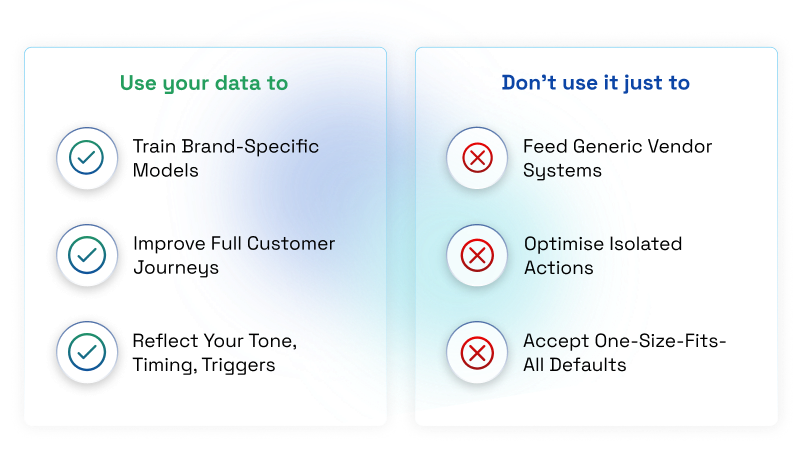
Recent analysis shows that while most marketing stacks now include a unified data layer, fewer than 30% (CDP Institute) use that data to drive brand-specific learning.
Intelligence exists; it just hasn’t been claimed. When CMOs own the intelligence, they compete on knowledge.
It is memory, the ability to learn from your own history, that becomes the moat.
The same principle applies across verticals, from AI in ecommerce to artificial intelligence in health care. The competitive edge lies in how well data informs brand-specific learning.
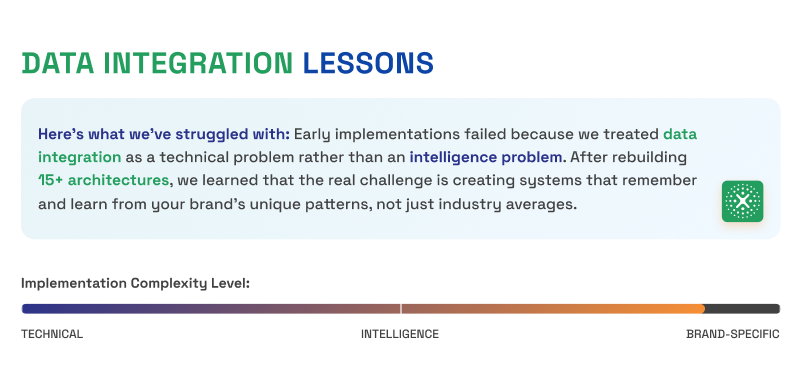
Here's what we've struggled with: Early implementations failed because we treated data integration as a technical problem rather than an intelligence problem. After rebuilding 15+ architectures, we learned that the real AI Marketing challenge is creating systems that remember and learn from your brand's unique patterns, not just industry averages.
When Brand-Trained Agents Outperform Generic AI
Brands are investing in brand-trained agents. AI that operates not on averages, but on accumulated brand memory through AI marketing automation tools.
The AI agents market reached $5.40 billion in 2024 and is projected to grow to $50.31 billion by 2030 (McKinsey)
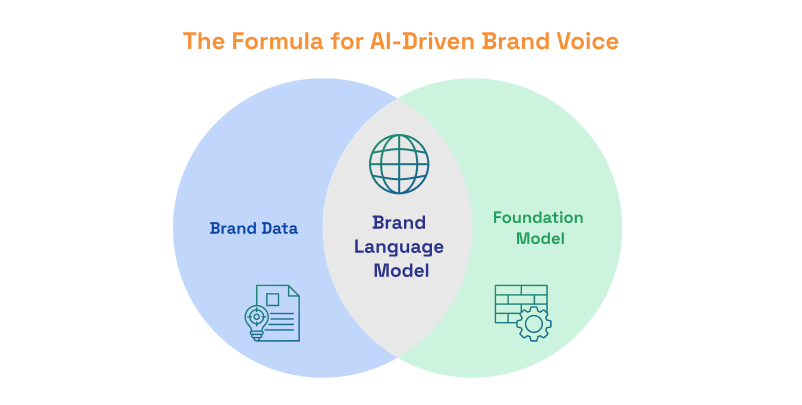
The past two years have seen a flood of generic AI agents entering the marketing stack. Tools such as ChatGPT, Claude, Microsoft Copilot, and Google’s Gemini have shown just how quickly text can be generated, documents summarised, and campaigns drafted.
A leading telecom company faced fragmented campaign logs and struggled to execute multiple campaigns in sync. While generic AI tools could automate parts of the process, they couldn’t adapt to the brand’s governance rules or handle cross-platform continuity.
Xerago built brand-trained orchestration agents that embedded the telecom company’s logic, governance rules, and historical memory.
These agents connected CRM, campaign platforms, and analytics into one loop. The result: execution time across four simultaneous campaigns dropped dramatically, errors were eliminated, and every campaign reflected the brand’s tone and compliance standards.
Generic agents will get you speed. Brand-trained agents get you outcomes. The next question is obvious: how do you engineer the latter, repeatably?
The Six Drivers That Separate Real AI Intelligence From Expensive Tool Collections
After building AI orchestration systems for 50+ companies, one thing is clear: results don’t come from piling on tools. They come from six habits we see in every winning setup.
1.They start with customers.
Dashboards don’t buy. People do. The best teams anchor AI to customer behavior, not vendor features.
2.Know which data actually matters
Leaders don’t chase every metric. They focus on the few signals that drive action and revenue. And they can explain to their teams exactly why those signals matter because their AI doesn't hide its reasoning in vendor black boxes. (McKinsey - AI in the Workplace Report)
3.Connect tools instead of collecting them
We’ve audited stacks with 20+ disconnected AI tools. Until those systems talk to each other, you’re buying speed and delivering drag.
4.Design journeys that convert
Traffic is cheap. Systems that anticipate friction and move customers to act are rare.
5.Stop waiting for customers to find you
“If we build it, they will come” died with the Yellow Pages. Smart companies use AI to nudge, trigger, and orchestrate journeys that move people from browse to buy.
6.Attach revenue to every AI investment
The difference between a showcase project and a growth engine is simple: a revenue number tied to every initiative.
The first wave of AI in marketing was about speed. Faster dashboards, faster content, faster reports. But the second wave is about depth and intelligence that doesn’t just move quicker, but moves smarter for your brand. That shift is defined by 10 Core Values.
10 Core Values That Make AI Intelligence Yours to Own
Generic AI agents can spin answers and automate tasks at speed. But the second you push them into a real marketing program (campaign depth, brand governance, compliance guardrails), they snap. Fast and versatile, yes. Strategic and durable, no.
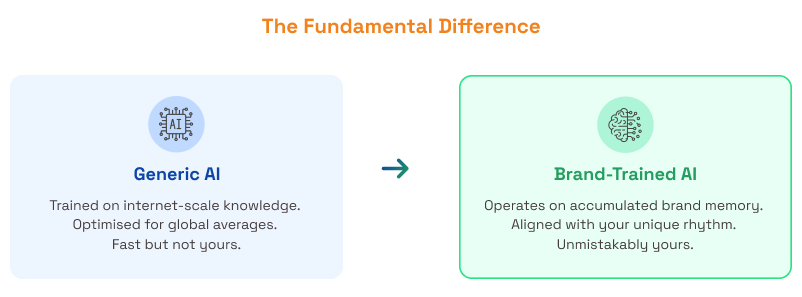
This is where the second wave of AI reform is emerging. Companies are moving beyond generic agents toward brand-trained intelligence in AI marketing automation.
These aren’t “AI add-ons” slapped onto a platform. They’re systems pulling directly from your CRM history, campaign archives, loyalty data, and compliance logic. They don’t just complete tasks faster; they make decisions the way your brand would.
Chief marketing officers are building agents that don’t just complete tasks, they think in the brand’s logic. (McKinsey – Seizing the Agentic AI Advantage 2025)
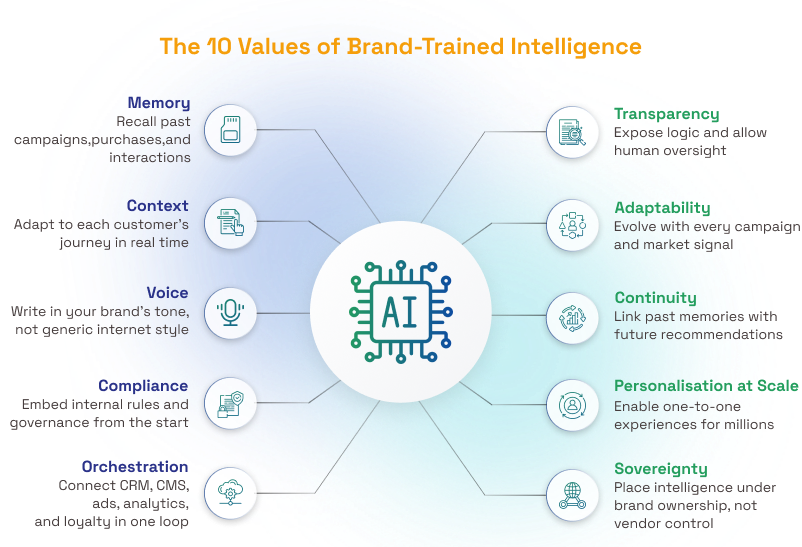
Together, these values transform AI from a utility into a strategic core. They ensure that agents don’t just act faster, but act truer, reflecting the brand’s history, its tone, its governance, and its future ambitions.
When intelligence is shaped by these principles, it ceases to be a vendor feature and becomes a competitive architecture. That is the shift from automation to ownership in AI marketing solutions.
Orchestration Delivers Exponential Returns
Great marketing does not happen at one touchpoint. It unfolds across a journey.
From the first click to the final conversion, from a product query to post-purchase service, what matters is not each step, but how the steps connect.
Traditional AI treats each moment in isolation. Ad platforms optimise for clicks. CRM score leads. Email engines test subject lines.
But customers do not move in silos. They expect memory. They expect rhythm.
This is where orchestration begins. An enterprise software company recently took this idea seriously. We helped them integrate their data lake, analytics, and campaign tools. Their AI didn’t just react. It coordinated.
The impact? A 30% rise in program adoption. A 45% surge in community participation. Not because each tool worked harder, but because they worked together.
In systems thinking, the whole is more than the sum of its parts. In marketing AI, this is not philosophy. It is performance.
The brands that coordinate their stack, using their own logic, don’t just improve. They accelerate.
While Adobe and Salesforce do excellent work in their domains, our approach focuses on what happens between platforms.
Even Adobe's most sophisticated users hit walls when trying to turn analytics insights into coordinated action across platforms. The gap isn't in Adobe's capabilities, it's in the intelligence layer that should connect everything else.
How to Build the Architecture of AI Marketing Independence
By now, the argument is clear. To move beyond platform-bound AI, CMOs must do more than deploy tools. They must build systems. But what does that actually look like?
Here's the framework we've developed:
After 18 months refining this across 40+ implementations, we call it the Xerago Digital Impact ArchitectureTM; four layers that transform fragmented AI tools into coordinated intelligence.
Most companies skip straight to the technology layer (the yellow section) without building the foundation. They buy Salesforce Einstein and Adobe Sensei but never create the data and analytics infrastructure that lets these tools learn from each other.
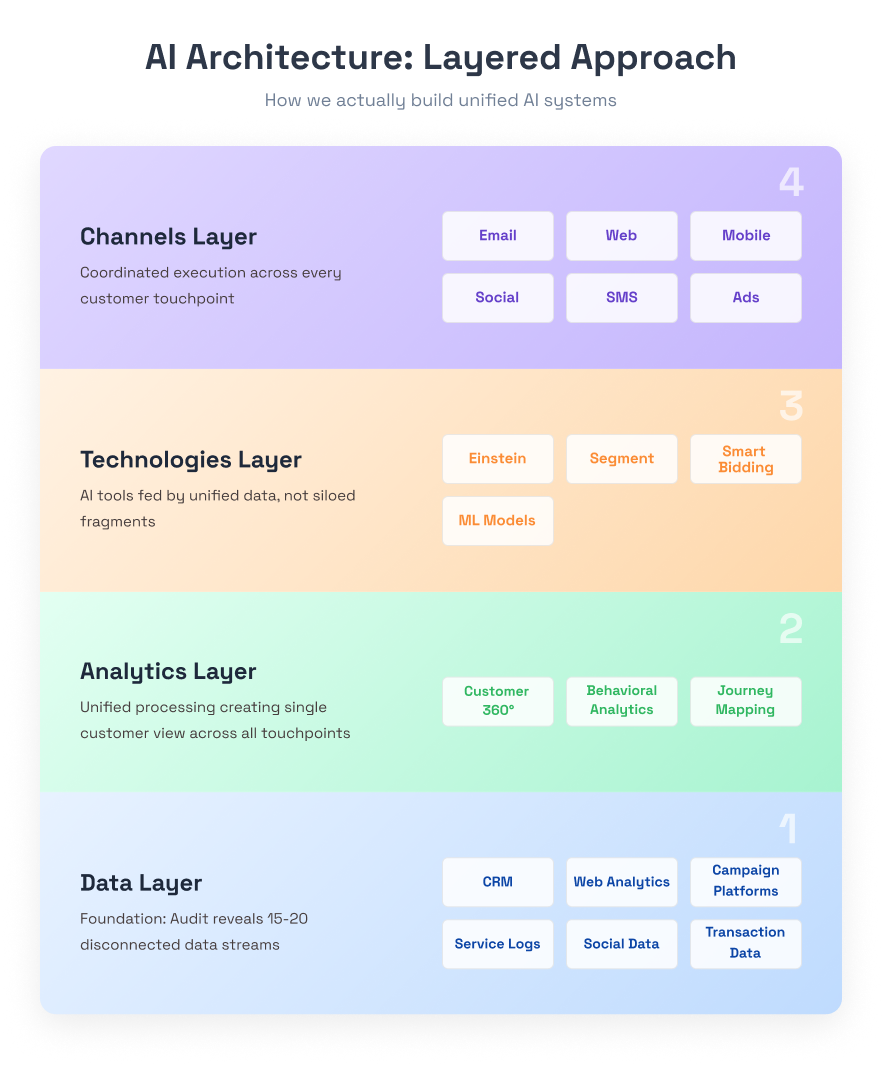
Version 1 of this framework was a disaster. We tried to map everything at once and clients got overwhelmed. This streamlined approach focuses on the four layers that actually matter for AI orchestration.
This is a rewire. Your CMS stays. Your CRM stays. But the intelligence no longer lives inside them. It lives above them. Across them.
Cloud AI infrastructure enables integration across CRM, CMS, and even artificial intelligence websites.
The result? Greater agility. Lower cost of change. And a system that improves with every action, not just every upgrade.
For decades, marketing infrastructure was vendor-shaped. Now, it can be brand-shaped through AI-driven marketing principles.
Own the Logic, Own the Advantage
Strategy is not just what you do. It is how you decide. In the age of AI, that decision-making logic, what to say, when to say it, and to whom, is increasingly automated. The only question is: whose logic will guide it?
For years, brands borrowed intelligence from vendors. They rented optimisation. They accepted default workflows. But most CMOs are making a different choice.
They are building AI that reflects their context, their customer journeys, their creative tone, and their strategic bets through comprehensive AI marketing solutions.
Owning the logic changes the balance of power. It means you're no longer guessing why certain campaigns worked while others failed. Instead, you compete on knowledge, memory, and orchestration that belongs to you alone. The brand becomes not just a user of AI, but an architect of it.
At its deepest level, owning the logic is also a moral choice. (Deloitte)
Because if you let external platforms dictate the patterns of engagement, you risk outsourcing not just optimisation, but the very story of your brand. You risk becoming a passenger in your own marketing strategy, watching AI make choices you can't explain to your board, your customers, or even your own team.
The future belongs to the ones who embed AI into their DNA, not as a feature but as a foundation. They will be remembered not for the tools they used, but for the systems they built.
Ashvini SK
Senior Content Writer
Xtelligence Inbox.
Your weekly dose of marketing smarts!