Interactions Correctly?


Agentic Marketing: How to Decide Which Marketing Decisions to Delegate to AI


In 5 days, define one high-value use case, the right agent authority and the guardrails to match.
Marketing teams have spent the last few years asking what AI can help them do. Write a copy. Summarize reports. Build audiences. Analyze performance. Generate campaign ideas. Personalize content.
Agentic AI changes the question. An agent does not just produce something for a marketer to review. It can increasingly recommend what should happen next, interact with systems, and in some cases take action.
- If an agent recommends moving the budget from one campaign to another, should it also be allowed to make that change?
- If it can change bids, how far should it be allowed to move them?
- If it identifies an underperforming campaign, should it pause it automatically?
- If it sees an opportunity to spend more, should it be allowed to increase the budget?
The important question is no longer simply whether the agent is capable of doing these things. Marketers also need to decide whether those decisions should be delegated to the agent in the first place.
Why Marketers Need to Answer This Question Now
This is becoming a practical issue because agentic systems are moving closer to the places where marketing and commerce decisions are actually made.
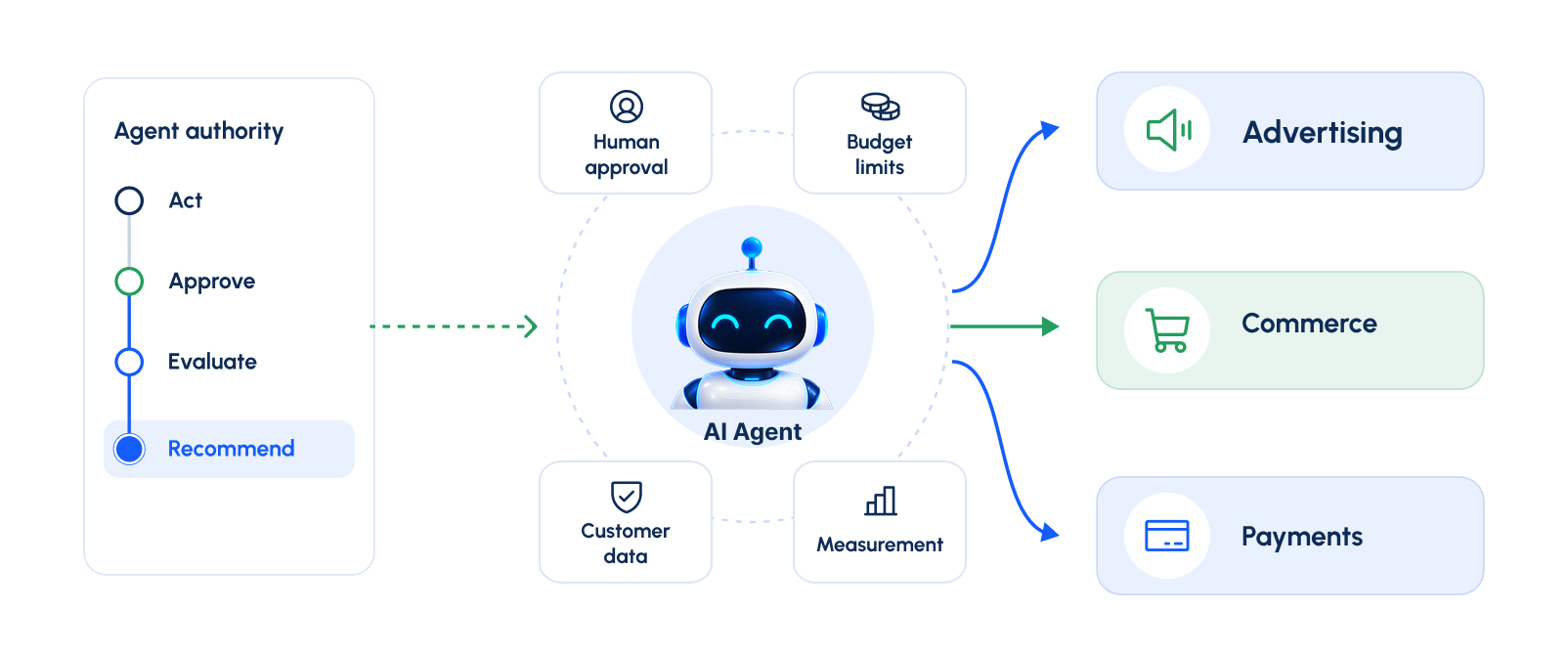
In advertising, IAB Tech Lab released AAMP 3.0 in September 2026, extending its Agentic Advertising Management Protocols into the RFP-to-buy process. OpenProposal gives buyer and seller agents a standardized way to exchange and evaluate proposals before a media transaction moves toward execution. IAB Tech Lab says this is intended to support agents taking on more responsibility in media discovery, evaluation, and planning.
That matters because the conversation is starting to move beyond AI producing recommendations. The underlying advertising infrastructure is beginning to support agents participating in workflows that have traditionally depended on manual coordination between people.
Commerce is moving in the same direction.
Google's Universal Commerce Protocol, launched in 2026 with Shopify and other major commerce companies, creates a common language through which AI surfaces can interact with merchant systems for activities such as product discovery and checkout. It is designed to work with existing retail infrastructure and other agent protocols rather than operate as a standalone shopping experiment.
Payment infrastructure is also being designed around delegated authority. OpenAI's Agentic Commerce Protocol, for example, allows a delegated payment request to carry limits such as a maximum chargeable amount and expiry, while the merchant continues to process the actual transaction.
What it does show is that the infrastructure is being developed for agents to move beyond understanding and recommending and participate more directly in business actions.
That makes the question of authority much more practical. Once an agent is connected to real budgets, customer data, media systems, products, and transactions, marketers need to decide what it should be allowed to do within those environments.
That is what I am going to explore in the following sections: how marketers can evaluate a decision before delegating it to an AI agent, what level of authority is appropriate, where human approval should remain, and how those decisions should be controlled and measured.
Is your martech stack ready for agents that act, not just recommend?
Xerago helps enterprises in banking, insurance, telecom, retail and healthcare find where AI agents can safely plug into their marketing systems, and where they shouldn't yet.
Step 1: Start by Defining the Exact Marketing Decision You Want the AI Agent to Make
The first step is to make the decision specific. Broad objectives often contain several smaller decisions, and those smaller decisions may require very different levels of authority.
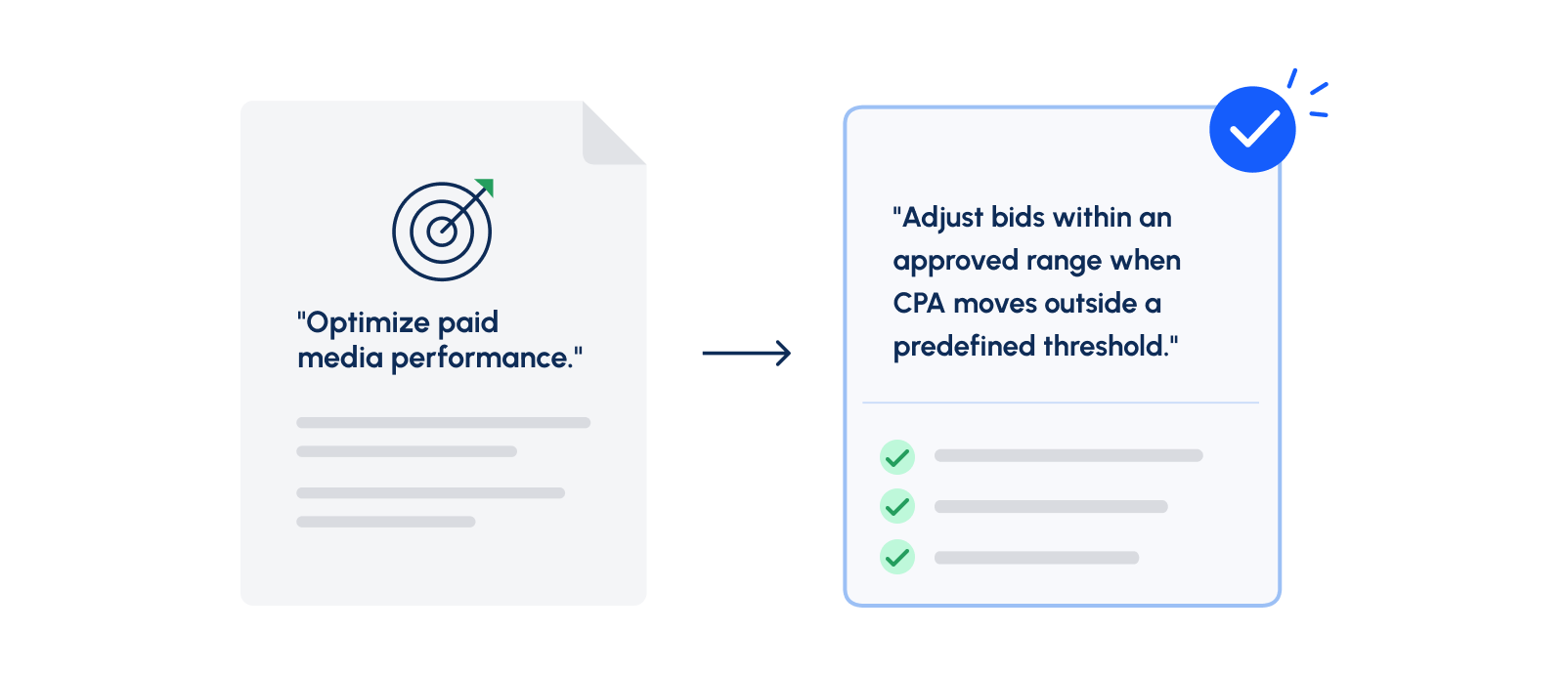
For example, a marketer might want an agent to “optimize paid media performance.” In practice, that could involve analyzing campaign performance, identifying wasted spend, recommending budget changes, adjusting bids, pausing campaigns, moving budget between campaigns, increasing overall spend, or even launching a new campaign.
These activities may all support the same objective, but they should not automatically be treated as the same type of decision.
Allowing an agent to identify wasted spend is relatively different from allowing it to move a significant amount of budget between campaigns. The first is primarily an analytical task. The second creates a direct financial consequence.
So before deciding how much autonomy an agent should receive, marketers need to make the individual decision clear.
Instead of giving an agent a broad instruction such as “optimize paid media,” the scope could be defined more precisely:
“The agent may adjust bids within an approved range when CPA moves outside a predefined threshold.”
That makes it possible to define limits, measure the outcome, and determine when human approval should be required.
The principle here is: before delegating a broader workflow, identify the individual decisions inside it.
Once the decision itself is clear, the next question is how much authority the agent actually needs to carry it out. Need help turning these decision rules into campaign execution? Explore Xerago’s Campaign Management Services.
Step 2: Decide Whether the Agent Should Recommend, Act, or Commit
Not every decision needs the same level of autonomy.
A useful way to separate them is into three levels.
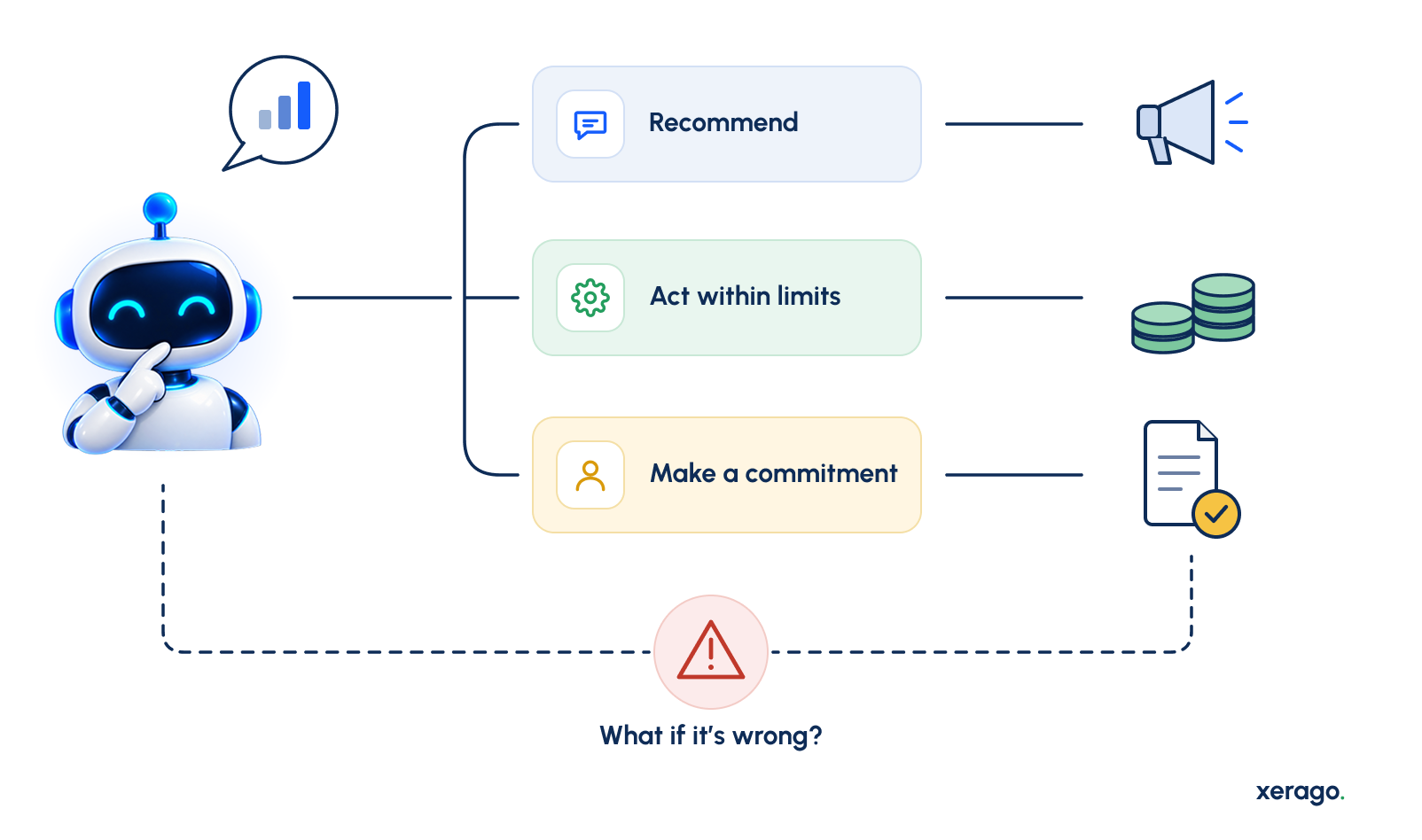
Recommend
At the first level, the agent evaluates the situation and proposes what should happen.
For example, it might recommend moving 8% of paid search spend from Campaign A to Campaign B.
The marketer can review the recommendation and decide whether to proceed. The agent contributes analysis and speed, while the human retains the authority to make the change.
Act
At the next level, the agent is allowed to take action within boundaries that have already been defined.
For example, it might be permitted to adjust bids by up to 10% whenever CPA moves outside an approved target range.
The marketer no longer needs to approve every individual adjustment. Instead, the marketer defines the rules within which the agent is allowed to operate.
This is a form of bounded autonomy.
Commit
The level of control needs to change again when an agent starts making decisions that create a more material business consequence.
That could include:
- committing additional media spend
- buying inventory
- issuing an offer
- changing a customer price
- approving a promotion
- completing a commercial transaction
At this point, the agent is not simply optimizing an activity. It may be committing money, changing a customer outcome, or representing the business in a way that is more difficult to reverse.
Once the decision has been identified, marketers therefore need to determine whether the agent should only recommend an action, be allowed to act within approved boundaries, or have the authority to make a commitment on behalf of the business.
That level of authority provides the starting point for governance. The next step is to understand what happens if the decision turns out to be wrong.
Step 3: Evaluate the Consequence if the Agent Makes the Wrong Decision
Every delegated decision should be considered in terms of its potential downside.
If an agent produces a weak email subject line, the impact is likely to be limited. A small bid adjustment that performs poorly may also be relatively manageable.
The situation changes when the decision involves a large media commitment, pricing changes affecting thousands of customers, or a customer-facing claim that has not been properly approved.
The amount of autonomy an agent receives should therefore reflect the potential consequence of getting the decision wrong.
Marketers can evaluate that consequence across four areas.
Financial impact
How much money can this decision affect?
A small optimization and a significant media commitment should not necessarily follow the same approval process.
Customer impact
Could the decision affect what a customer sees, pays, receives, or experiences?
As the decision gets closer to the customer, the consequences of an error can become more significant.
Brand impact
Could the agent communicate something inaccurate, off-brand, misleading, or inconsistent with the company's position?
A mistake in an internal report is different from an incorrect claim communicated publicly.
Data impact
Does making the decision require access to sensitive customer, commercial, or behavioral information?
The more sensitive the information required, the more carefully access and authority need to be managed.
Looking at these factors gives marketers a practical way to connect autonomy with consequence. Decisions with relatively limited impact may be appropriate for greater automation, while decisions with significant financial, customer, brand, or data implications generally need tighter boundaries.
Consequence, however, is only part of the assessment. Marketers should also consider whether a bad decision can be corrected easily after it happens.
Step 4: Ask How Easy It Is to Reverse the Agent's Decision
Reversibility provides another useful way to assess how much autonomy an agent should receive.
If an agent generates an inaccurate report, the report can be corrected. If it changes a bid, that bid can usually be adjusted again. If it pauses a campaign incorrectly, the campaign can generally be restarted.
Other decisions are much harder to undo.
A large media commitment may already have contractual or financial consequences. An incorrect discount could reach thousands of customers before it is corrected. Customer information exposed to the wrong system may create a problem that cannot simply be reversed.
So rather than looking only at whether an agent is capable of making a decision accurately, marketers should also ask how difficult recovery would be if the decision were wrong.
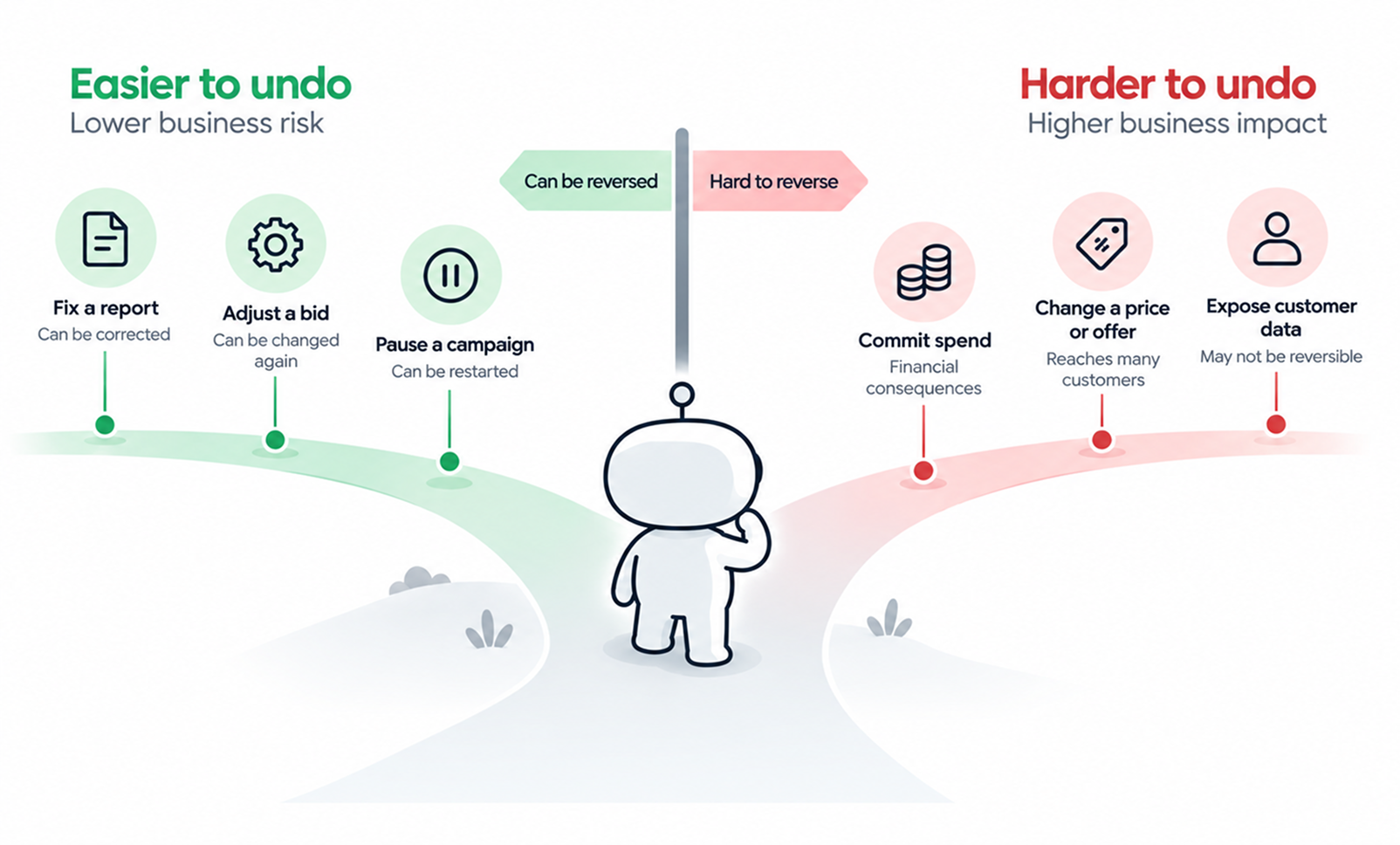
As a general approach, decisions that are inexpensive and easy to reverse may support more autonomy. Decisions that are costly to reverse should have tighter limits, while decisions that are difficult or impossible to reverse are stronger candidates for human authorization.
Once marketers understand both the consequence and the reversibility of a decision, they can make a more informed decision about the information the agent should be allowed to use.
Step 5: Give the Agent Only the Data Needed for That Decision
Agents become more capable when they have access to more context, but that does not mean every agent should have access to every available source of data.
Depending on the task, an agent might use campaign performance, CRM records, customer behavior, transaction history, product information, pricing, inventory, loyalty data, or customer-service interactions.
The right level of access should depend on the decision being made.
An agent producing a weekly campaign-performance summary may need access to analytics and media data, but it is unlikely to need unrestricted access to personally identifiable customer information.
A retention agent may legitimately require customer history, while a media-buying agent may not.
The practical principle is to give the agent the minimum amount of data required to make the decision it has been authorized to make. In other words, the decision boundary should help determine the data boundary.
Once the decision, risk, reversibility, and data requirements are clear, marketers can then decide where human approval should enter the process.
Step 6: Define Exactly Where Human Approval Is Required
“Keep a human in the loop” is common advice in discussions about agentic AI, but it leaves an important operational question unanswered: where exactly should that human intervene?
There are several ways this can work.
Before the action
The agent can make a recommendation, but a marketer approves it before anything changes.
This can make sense when the decision has meaningful financial, customer, or brand consequences.
Above a threshold
The agent can act independently within a defined range, but anything beyond that range requires approval.
For example, an agent may be allowed to adjust bids by up to 10%, while a larger change is escalated to a marketer.
When an exception occurs
The agent can continue operating normally until a predefined exception appears. That might include a sudden decline in performance, unusual spend, missing data, or an action that falls outside an approved rule.
The exception then triggers human review.
After the action
For decisions that are lower risk and highly reversible, the agent may be allowed to act independently while its decisions are logged and reviewed afterwards.
The appropriate model will vary by decision. The important point is to define human intervention as part of the operating process rather than relying on the general idea that a person will somehow remain involved.
Once an agent has permission to act, marketers also need to be able to assess whether those actions are producing the intended result.
Step 7: Define How the Agent's Decision Will Be Measured and Audited
Delegating a decision becomes difficult to govern if the organization cannot see what the agent did or assess the result.
Marketers should be able to understand what the agent decided, what information informed that decision, which rules were applied, whether human approval was required, and what happened afterwards.
Every delegated decision therefore needs a success measure and an audit trail.
For a paid media decision, the outcome might be evaluated through CPA, conversion volume, incremental revenue, or spend efficiency.
For a customer experience decision, the relevant measures might include conversion, retention, complaint rate, or engagement.
The exact metric will vary with the decision, but the underlying principle is consistent: the organization needs enough visibility to understand both the action and its outcome.
That becomes even more important as AI agents begin to participate not only in internal marketing workflows, but also in decisions being made on behalf of customers.
The Same Decision Framework Matters When AI Agents Start Acting for Customers
So far, the discussion has focused on decisions that marketers may delegate to agents.
Agentic commerce introduces another side to the same issue: customers can also increasingly use AI agents to support their own decisions.
Inside a company, the delegation may look like:
Marketer → AI agent
The marketer allows the agent to support or make certain decisions on behalf of the business.
On the customer side, it can look like:
Customer → AI agent
The customer asks an agent to help discover, compare, evaluate, or eventually transact.
As AI shopping agents become more involved in those activities, marketers may not control every step between customer intent and product selection in the same way they do today.
A traditional digital journey might involve search, a website visit, a product page, a cart, and checkout. In an agent-mediated journey, some of the discovery and evaluation may happen inside the agent before the customer ever reaches the brand.
The same governance questions still matter, but this also introduces another issue for marketers: whether the agent can understand the brand and product accurately enough to include it in the customer's consideration in the first place.
Product and Brand Data Need to Be Understandable to AI Agents
If agents increasingly participate in product discovery and comparison, product information needs to work for more than just human visitors.
Agents also need enough structured and current information to understand what the product is, what it costs, whether it is available, which features it includes, where it can be delivered, and what policies apply.
That makes areas such as accurate product attributes, current pricing, inventory, availability, shipping information, merchant policies, structured feeds, APIs, loyalty eligibility, and clear product differentiation increasingly important.
A website explains the offer to a customer. Agent-ready information also needs to give machines enough structured context to understand the offer correctly.
.png)
However, improving machine readability creates another strategic consideration for marketers. The easier products are for agents to compare, the more important meaningful differentiation may become.
Marketers Need to Make Brands Machine-Readable Without Making Them Interchangeable
An AI agent comparing products may evaluate factors such as price, features, ratings, delivery, and availability.
Those attributes are useful, but marketing has never depended on product attributes alone.
Brands also compete through trust, reputation, customer experience, loyalty, perceived quality, and preference.
The goal, therefore, is not simply to make a product easy for an AI agent to parse. Marketers also need to ensure that the value that differentiates the brand is represented clearly enough to survive an increasingly comparison-driven environment.
That raises an important strategic question: how can brands become easier for machines to understand without becoming easier to substitute?
Structured product information helps an agent understand the offer. Brand preference and differentiated value may still influence whether that offer is chosen.
As agents become more involved in that choice, marketers will also need better visibility into how those decisions are being made.
Marketers Will Need to Measure What Happens Inside Agent-Mediated Decisions
Traditional digital marketing measurement often follows a fairly visible path from impression to click, session, and conversion.
An agent-mediated journey may introduce additional stages such as retrieval, comparison, and recommendation before the customer takes an action.
That can create gaps in visibility.
A marketer may know that a transaction happened but not whether the product was one of several options considered by an agent, why it was recommended, or why competing products were excluded.
Over time, marketers may therefore need to understand questions such as whether an agent could retrieve the product accurately, whether it entered the consideration set, whether it was recommended, and what factors influenced the final outcome.
These are not yet standardized marketing metrics. They are better understood as an emerging measurement challenge.
The underlying issue, however, is consistent with the rest of the article: when agents participate in decisions, marketers need enough visibility to understand both what was decided and what happened as a result.
Before Delegating Any Marketing Decision to an AI Agent, Run This Evaluation
Before giving an agent authority to make or execute a marketing decision, marketers should be able to answer eight questions:
- What exact decision are we delegating?
- Is the agent recommending, acting, or committing?
- What happens if the decision is wrong?
- How easy is the decision to reverse?
- What data does the agent actually need?
- Where does human approval become mandatory?
- How will the decision and outcome be measured?
- How will the action be logged and audited?
Taken together, these questions provide a more practical way to think about agentic maturity than simply counting how many agents or workflows an organization has automated.
The goal is not to automate every decision that can technically be automated. It is to delegate decisions where the value of doing so justifies the level of authority and risk involved.
Agentic Marketing Maturity Is About Knowing Where Machine Authority Should Stop
Marketing teams are likely to work with more agents as these capabilities become integrated into advertising, commerce, customer experience, and marketing operations.
The harder question will be deciding how much responsibility those agents should receive.
Some decisions are repetitive, measurable, low risk, and relatively easy to reverse. Those may be suitable for greater delegation.
Other decisions have more significant financial, customer, data, or brand consequences and will need clearer limits or approval.
There will also be decisions where organizations choose to retain human judgment because accountability, context, or commercial responsibility matters more than the efficiency gained through automation.
So rather than measuring progress by how much marketing has been automated, marketers should focus on whether they have made deliberate choices about what AI can decide, under what conditions it can act, and where human responsibility needs to remain.
The future of agentic marketing will not belong to the teams that automate the most decisions. It will belong to the teams that know which decisions are worth delegating, which need guardrails, and which should stay human.
Start with a 5-Day Agentic Marketing Bootcamp
In five days, Xerago works with your team to identify a high-value use case, define the right level of agent authority, establish the required guardrails, and turn the concept into a working model your team can evaluate in a real business context.
The objective is not to automate every marketing decision.
It is to build an operating model where AI agents can act with the right authority, within the right boundaries, and with clear accountability.
Kaviarasu S
Associate Content Writer
Xtelligence Inbox.
Your weekly dose of marketing smarts!
Related Posts
