

GenAI is Just One Piece: Navigating the Diverse World of AI
Authored by Ram Prabhakar
Published: November 20, 2024 | Updated: December 13, 2024
Generative AI has created enough buzz at least in tech eco-sphere.
GenAI is that one living digital creature that can create, think and adapt - basically a tech that really makes concepts comes to life.
Though it has captured the spotlight, it is often being equated with whole AI ecosystem itself. Since its emergence, it has revolutionized creative fields, driving headlines and sparking excitement.
However, it’s crucial to recognize that Generative AI is just one facet of a vast and diverse AI landscape. Adopting Generative AI involves a fundamentally different approach and mindset compared to traditional AI.
GenAI has unveiled a wide range of astounding applications that improve human creativity, simplicity of use, and problem-solving. Yet, as we delve deeper into this realm, we must navigate the shadows that accompany its promise. Thus, it’s critical to recognize and evaluate when to use Gen-AI or augment it with alternative AI techniques to amplify its impact.
The AI Spectrum: Beyond the Basics
The realm of AI extends far beyond generative models, encompassing a variety of approaches that offer significant potential for businesses.
- Predictive AI: This involves using historical data to forecast future outcomes. By analyzing trends, businesses can make informed decisions that enhance efficiency and profitability. For instance, predictive maintenance in manufacturing helps reduce downtime by anticipating equipment failures before they occur.
- Machine Learning & Statistical Models: These foundational AI techniques leverage algorithms to learn from data, enabling systems to identify patterns and make predictions. This can be applied across various domains, such as finance, where risk assessment models evaluate creditworthiness based on historical data.
- Natural Language Processing (NLP): Beyond generative capabilities, NLP enables machines to understand and interpret human language. Applications like sentiment analysis can gauge customer opinions from social media, helping brands refine their marketing strategies.
- Sentiment Analysis: Companies use sentiment analysis to gauge public opinion about their products or services by analyzing social media and reviews. Understanding consumer sentiment helps businesses tailor their strategies and improve their offerings based on customer feedback.
- Anomaly Detection: Essential for fraud prevention, this model analyzes patterns to identify outliers in data that could indicate fraudulent activity, safeguarding organizations against financial loss.
Determining the Applicability of Generative AI
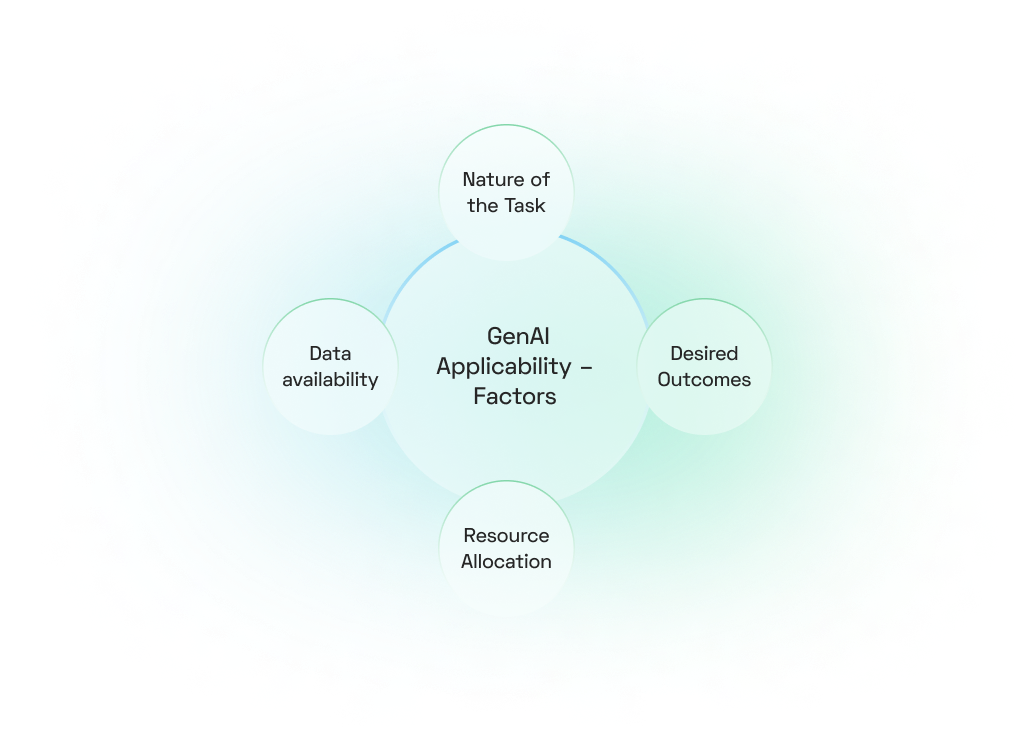
When considering whether to implement Generative AI for a specific use case, several factors come into play:
Areas Where Generative AI Can Work
- Content Creation at Scale: Generative AI is highly effective when there is a need for large-scale content generation, such as writing product descriptions, marketing copy, or generating social media posts.
- Personalization and Customer Engagement: Generative AI can be used to deliver personalized experiences to customers at scale. For example, it can generate personalized product recommendations, dynamic emails, or chatbot interactions that respond intelligently based on user behavior and preferences.
- Customer Support: GenAI can power chatbots that handle common customer inquiries, providing immediate responses and freeing human agents for complex issues.
- Creative Ideation and Prototyping: For teams in creative fields, generative AI can be an excellent tool for idea generation, brainstorming, or prototyping. It can assist with generating new concepts in design, marketing campaigns, or even product innovations, offering fresh perspectives or unique variations that may not have been previously considered.
- Data Augmentation for Machine Learning Models: In situations where there is a limited amount of training data for machine learning models, generative AI can create synthetic data to augment existing datasets. This helps improve the performance of models by expanding their ability to learn from a more diverse range of examples, especially in fields like healthcare or fraud detection where data may be sparse or sensitive.
- Automating Repetitive Tasks: For repetitive tasks that require significant manual effort but low levels of decision-making complexity—such as transcribing audio to text, summarizing reports, or automating image creation with an image generator—generative AI can automate these processes, freeing up human resources for higher-value activities.
Areas Where Generative AI May Not Be Suitable
- High-Stakes Decision Making: Generative AI, while powerful, lacks the ability to understand the nuanced implications of decisions. When it comes to high-stakes decisions—such as financial investments, healthcare diagnostics, or strategic business planning—human judgment is irreplaceable. Generative AI can offer suggestions, but humans should ultimately drive the decision-making process to avoid errors or unintended biases.
- Predictive and Forecasting Applications: Generative AI is not suited for tasks that require accurate predictions or forecasts. Predictive modelling and forecasting involve analyzing historical data trends to project future outcomes, which require precise statistical techniques and data-driven models.
- Situations Requiring Deep Contextual Understanding: Generative AI often struggles to fully grasp complex contexts or ambiguous situations. If a task requires deep understanding, empathy, or a nuanced interpretation of context—such as counselling, sensitive customer communications, or cultural content creation—AI may fall short.
- Planning: Generative AI is not ideal for planning tasks that require structured and strategic decision-making. Traditional AI and optimization models provide more accuracy and control than generative approaches.
- Autonomous Systems: Generative AI is not designed for high-stakes autonomous system applications that require precise real-time decision-making and control. These systems rely on advanced machine learning, sensor fusion, and real-time analytics to operate safely and efficiently, areas where generative AI falls short.
Embracing Synergy: GenAI X AI = 2x Impact
Combining generative AI with other AI models can create powerful synergies that enhance capabilities across various applications.
Here are some key advantages and areas where this combination shines:
- Enhanced Creativity and Personalization
Limitations of GenAI: Although GenAI can produce impressive content, it often lacks a nuanced understanding of user preferences and behavioural dynamics. This is where complementary AI technologies step in.
Personalized Newsletters
By combining GenAI with reinforcement learning models, a media company can generate tailored articles that evolve based on reader engagement metrics.
While GenAI crafts the initial content, reinforcement learning fine-tunes it to ensure that the newsletters resonate more profoundly with individual subscribers. This synergy leads to a personalized experience that captures the interests of users far better than GenAI could achieve alone.
Tailored Marketing
In retail, generative models can create personalized marketing campaigns, but predictive analytics are necessary to analyze customer behaviour effectively.
For example, an AI-driven retail brand employs predictive analytics to assess purchasing patterns, which then inform GenAI to generate targeted promotions. The result is a marketing strategy that not only appeals to consumers but also increases conversion rates and enhances customer engagement.
- Improved Decision-Making
Limitations of GenAI: GenAI's creative outputs may not always align with real-world data trends, making it essential to integrate additional AI technologies for better decision-making.
Data Augmentation: Customer Insights
An e-commerce platform utilizes GenAI to synthesize realistic customer feedback data, which serves as input for predictive models. This augmented data allows for a deeper understanding of customer preferences, leading to more accurate product recommendations.
While GenAI generates varied feedback scenarios, predictive analytics provide the context needed to drive actionable insights.
Simulation for Scenario Planning
A grocery chain combines GenAI with simulation algorithms to forecast various scenarios, such as seasonal demand spikes. GenAI can suggest promotional strategies, but without simulation models, those strategies may not be effectively aligned with actual market conditions.
The synergy ensures that the grocery chain is well-prepared for fluctuating consumer demands, enhancing inventory management and strategic planning.
- Enhanced Natural Language Understanding
Limitations of GenAI: While GenAI can generate human-like text, it may struggle with understanding the subtleties of language in real-time applications.
Intelligent Customer Support
A telecom company integrates GenAI with intent recognition systems to develop an advanced chatbot. GenAI generates contextually relevant responses, but intent recognition ensures that the chatbot accurately interprets customer queries.
This combination results in more effective and context-aware conversations, improving customer satisfaction and reducing resolution times.
Content Moderation
In social media platforms, GenAI can generate diverse examples of harmful content, but additional AI models are necessary to train moderation systems. By combining generative AI with machine learning models focused on content filtering, platforms can create safer user environments by effectively moderating inappropriate content.
- Cross-Domain Applications
Limitations of GenAI: GenAI's outputs can be generic without the context provided by specialized AI systems.
Patient Support Tools
In telehealth services, generative models simulate patient scenarios to aid in diagnostic training. However, integrating these models with data analytics allows for the development of more precise and contextual diagnostic tools.
This synergy ultimately leads to improved patient care and better decision-making by healthcare professionals.
Finance Application: Fraud Detection Systems
Banks utilize GenAI to create synthetic financial transaction scenarios, but to enhance fraud detection; these scenarios must be paired with machine learning algorithms that adapt to new fraudulent tactics.
The combined approach not only strengthens security for customers but also ensures that financial institutions remain one step ahead of emerging threats.
- Streamlined Development Processes
Limitations of GenAI: While generative AI can accelerate content creation, it may not always provide the robustness and user-centric focus needed in product development.
Rapid Prototyping: UX Design Experience
A tech company utilizes generative design algorithms to create innovative user interface prototypes. While GenAI can quickly generate design concepts, integrating these algorithms with user experience (UX) testing and feedback mechanisms is essential for refining the designs.
Analytics: Customer Journey Mapping
A retail company employs generative design algorithms to visualize and prototype customer journey maps. While GenAI can generate initial maps based on customer data, integrating these designs with real-time analytics and customer feedback is essential for refining them.
This synergy allows businesses to identify critical touch-points, pain points, and opportunities for enhancement, leading to a deeper understanding of the customer experience.
- Multimodal Applications
Limitations of GenAI: GenAI typically generates content in a single modality, which can restrict user experience.
Interactive Shopping Experiences
An online furniture retailer combines GenAI with visual recognition systems to enhance the shopping experience.
While GenAI can generate descriptive text for product images, visual recognition enables customers to search for items using images. This multimodal approach enriches the shopping experience, making it more intuitive and engaging.
Art and Media Application: Immersive Gaming
A gaming company merges generative models for audio and visual content, but the integration of player behaviour data allows for truly interactive environments. While GenAI can create dynamic content, it’s the synergy with behavioural analytics that creates immersive experiences that adapt to player actions.
Navigating the Duality of Generative AI
Generative AI is undoubtedly a powerful tool, capable of remarkable feats. Yet, as we harness its potential, we must remain vigilant about the inherent challenges and risks.
By prioritizing transparency, consistency, and fairness, we can unlock the full promise of Generative AI while safeguarding against its pitfalls. As we continue to innovate, let’s commit to fostering a responsible AI ecosystem that benefits all of society.
But the question remains: How can we leverage Generative AI effectively while mitigating its risks?
The answer lies in a collective commitment to thoughtful development, ethical considerations, and continuous dialogue.
Global Office Locations


#901, 9th Floor , Ellora Fiesta.
Plot No - 8 , Sector - 11 , Sanpada.
Opp. Juinagar Rly Station.
Navi Mumbai – 400 705

Xerago Towers, Plot 80 & 93,
Industrial Estate, Perungudi,
Chennai, Tamil Nadu - 600096
Office No. 26, 10/F, Beverley Commercial Centre,
87-105 Chatham Road South, Tsim Sha Tsui, Kowloon,
Hong Kong